ANXTECH AD19 Mini Thermal Imaging Camera Review: Affordable Heat Detection for Homeowners


ANXTECH AD19 Mini Thermal Imaging Camera Review: Affordable Heat Detection for Homeowners
ANXTECH AD19 Mini Thermal Imaging Camera
Buy if you want a simple, pocket-sized thermal camera for finding drafts and insulation gaps at home. Skip if you need professional accuracy, Mac support, or detailed imaging beyond 3 feet.
Buy on AmazonWhat We Liked
- Size, Weight, and Grip
- One-Button Operation
- Thermal Image Enhancement
- Practical Home Energy Checks
What Could Be Better
- Resolution
- Temperature Range
- Windows-Only Image Transfer
How we test: Every product is used in real conditions and evaluated using our standardized scoring criteria. Read our full review methodology.
Ever wondered if your home is silently wasting energy through drafty windows and poorly insulated walls? A thermal imaging camera can reveal those invisible heat leaks in seconds, but most options cost hundreds of dollars and come loaded with features you may never use.
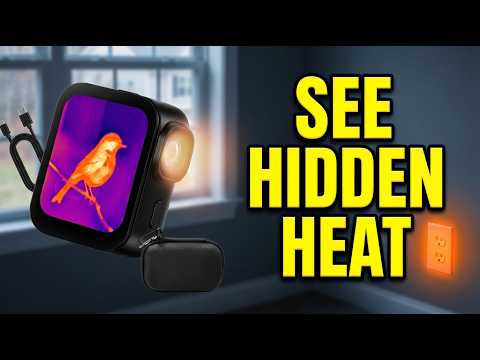
The ANXTECH AD19 is a compact thermal imaging camera designed for beginners who want a simple way to spot temperature differences around the house. At just 1.4 ounces and $129.99, it promises to put thermal imaging cameras within reach of everyday homeowners.
I tested this mini thermal camera around my home, scanning windows, doors, HVAC vents, and electronics to see if it delivers on that promise. The results were a mix of genuine usefulness and notable limitations.
The short version? For basic home energy checks, it does the job. But there are trade-offs worth understanding before you buy.
What I Liked
Size, Weight, and Grip
The AD19 is remarkably small. At 1.77 x 1.48 x 0.63 inches and just 1.4 ounces, it genuinely fits in a pocket without any bulk. Most thermal cameras feel like dedicated tools you need to plan to bring along, but this one travels with you effortlessly.
The package includes a lanyard, a carrying case, a USB-C charging cable, and a microfiber cleaning cloth. The build is all plastic but feels sturdy enough for occasional home use. For a similarly compact gadget focused on content creation rather than thermal detection, the FLATIC 5K Digital Camera packs 5K video capability into an equally portable form factor. Travelers who appreciate this kind of portability for quick scans might also consider the Abyliee Hidden Camera Detector, another compact device that checks hotel rooms and Airbnbs for surveillance equipment.
One-Button Operation
Simplicity is the AD19’s strongest selling point. There is no phone to pair, no app to download, and no account to create. Press the power button and a live thermal view appears on the 1.83-inch IPS touchscreen within seconds.
This grab-and-go approach sets it apart from many thermal cameras that require a smartphone. If you just want to point and see heat differences, the AD19 removes every barrier to doing that. The COONYES 4K 56MP Vlogging Camera takes a similar approach to simplicity, letting beginners start recording 4K video with minimal setup and a straightforward mode dial.
Thermal Image Enhancement
The camera offers multiple color palettes including iron, rainbow, white hot, and black hot. Each palette highlights temperature differences in various ways, giving you flexibility depending on what you are scanning.
In my testing, the iron palette provided the best detail for typical home inspection tasks. The rainbow palette made it easier to spot specific hot and cold spots at a glance. Switching between palettes takes a single tap on the touchscreen.
Practical Home Energy Checks
Where this camera proved its value was in real-world home scanning. Pointed at my windows and doors, it clearly showed cold air infiltration around the frames where seals had worn out. I could see exactly where drafts were entering the house.
Scanning HVAC vents revealed which ones were pushing warm air effectively and which were underperforming. I found one vent that was barely producing any heat, which explained why that room was always the coldest in the house.
For a homeowner looking to reduce energy waste, these are findings that translate directly into savings. Identifying a single drafty window seal or failing vent can help you prioritize repairs that make a real difference.
What Needs Improvement
Resolution
The 80x60 IR resolution is the AD19’s most significant limitation. Within three to five feet, you can distinguish temperature differences between surfaces clearly enough. Beyond that range, the image becomes too coarse to provide useful detail.
If you are trying to scan an entire wall from across the room, the thermal cameras in this resolution tier will struggle. For close-up work like checking outlets, pipes, and window seals, it is adequate.
Temperature Range
The measurement range spans 14°F to 284°F with an accuracy of plus or minus 9°F. That covers most home inspection scenarios, but the accuracy margin means this is not a tool for precision temperature readings.
For identifying relative hot and cold spots, the accuracy is sufficient. If you need exact temperature data for professional reports or diagnostics, the range and precision fall short of what you would get from a FLIR or HIKMICRO unit.
Windows-Only Image Transfer
Image transfer requires connecting via USB-C to a Windows computer. Mac and mobile devices are not supported for pulling photos off the camera, which is a notable inconvenience for anyone outside the Windows ecosystem.
The camera stores a maximum of 30 images at a time, so you will need to offload regularly during longer inspection sessions. These software limitations feel like an area where the AD19 cut corners to hit its price point.
How It Compares
The budget thermal camera market has grown considerably, and the AD19 sits at the entry level. Understanding where it fits among the best thermal cameras helps clarify who it serves.
The TOPDON TC001 offers 256x192 resolution at around $200-300, a massive step up in image quality. However, it requires a smartphone to operate and does not function as a standalone device. If you prefer an all-in-one tool with no phone dependency, the AD19 has an advantage there.
The FLIR C5 represents the professional compact tier at $599-649. It delivers 160x120 resolution, MSX image enhancement tech, WiFi connectivity, and cloud storage. For anyone doing professional inspections or needing detailed documentation, the FLIR is in a different league. But at five times the price, it targets a different buyer.
For the most budget-conscious option, phone-attached thermal cameras like the GoYoJo 192x192 dongle offer higher resolution at around $80. The trade-off is that they require your phone and lack the standalone simplicity of the AD19.
The AD19 occupies a specific niche: the cheapest standalone thermal camera you can grab and use instantly. It does not compete on resolution or accuracy with any of these alternatives, but none of them match its combination of pocket size, independence from a phone, and sub-$130 pricing.
Final Verdict
The ANXTECH AD19 earns a 3.8 out of 5. It delivers on its core promise of making thermal imaging accessible to beginners at a price that does not require a serious investment.
The strengths are clear: pocket-sized portability, standalone operation with no app required, and genuinely useful results for home energy checks. I tested it across windows, vents, and doors, and it consistently revealed temperature differences that helped me identify real problems.
The weaknesses are equally clear: low resolution limits range, the accuracy margin rules out precision work, and Windows-only image transfer is a frustrating limitation. These trade-offs are expected at this price point, but they are worth understanding.
For homeowners who want a simple tool to find heat leaks and check insulation without spending $500 or more, the AD19 is a practical choice. It is not the best thermal camera on the market, but it may be the best entry point into thermal imaging for everyday use.
Specifications
| Brand | ANXTECH |
| Model | AD19 |
| IR Resolution | 80 x 60 |
| Refresh Rate | 9 Hz |
| Temperature Range | -10°C to 140°C (14°F to 284°F) |
| Accuracy | ±9°F (±5°C) |
| Display | 1.83 inch IPS Touchscreen |
| Visible Camera | 1600x1200 (~2MP) |
| Weight | 1.4 oz (40g) |
| Dimensions | 1.77 x 1.48 x 0.63 inches |
| Battery | 1 Lithium Ion battery (included) |
| Connectivity | USB-C (Windows only for image transfer) |
| Image Storage | Up to 30 images |
| ASIN | B0FH4VML7D |
| Spectral Range | 8-14 µm |
| Warranty | 6-month limited warranty |
Frequently Asked Questions
Is it worth buying a thermal imaging camera like the ANXTECH AD19?
For homeowners, a budget thermal imaging camera can pay for itself by helping you identify heat leaks that drive up energy bills. The AD19 at $129.99 is an accessible entry point. If you find even one drafty window or underperforming vent, the fix could save you more than the cost of the camera over a single heating season.
How accurate are thermal imaging cameras at this price point?
The ANXTECH AD19 has an accuracy of plus or minus 9°F, which is typical for budget thermal cameras. This is sufficient for identifying relative temperature differences between surfaces, but not precise enough for exact temperature readings. Professional-grade thermal cameras from FLIR offer accuracy within 3-5°F.
What are the disadvantages of thermal cameras like the AD19?
The main disadvantages are low 80x60 IR resolution that limits detail beyond three to five feet, Windows-only image transfer with no Mac support, a maximum of 30 stored images, and a limited temperature range of 14°F to 284°F. These are common trade-offs in entry-level thermal cameras for home use.
What is the difference between a thermal camera and a regular camera?
A regular camera captures visible light, while a thermal imaging camera detects infrared radiation emitted by objects based on their temperature. The AD19 displays this as a color-mapped image where different colors represent different temperatures, allowing you to see heat patterns invisible to the naked eye. It also includes a 2MP visible light camera for reference images.
What is the best thermal imaging camera for home inspection?
It depends on your budget and needs. The ANXTECH AD19 works for basic home energy checks under $130. The TOPDON TC001 at $200-300 offers much better resolution but requires a smartphone. For professional home inspections, the FLIR C5 at $599-649 provides superior resolution, accuracy, and reporting features. Each thermal camera fills a different niche.
How do thermal cameras work for finding heat leaks?
Thermal cameras detect temperature differences on surfaces. When you point the AD19 at a wall or window, cooler areas appear in different colors from warmer areas. Drafts around window frames show as cold spots, poorly insulated walls show as temperature gradients, and failing HVAC vents show as cooler than expected. This makes invisible energy waste visible so you can take action.
Ready to Buy?
ANXTECH AD19 Mini Thermal Imaging Camera delivers on its promises. If it fits your needs, it's a solid choice you won't regret.
Check Price on Amazon Founder & Product Reviewer at TheReviewRewind
Daniel has tested 400+ products across 20+ categories through hands-on, real-world testing. Every review includes video documentation and standardized scoring criteria. His reviews appear as Amazon shoppable videos and here on TheReviewRewind.
We earn a commission if you make a purchase, at no extra cost to you. This does not influence our ratings or recommendations. Full disclosure
Looking for more options? See all our Electronics reviews.
Related Reviews