BestQool Red Light Therapy Panel Review: 14 Days On My Lower Back


BestQool Red Light Therapy Panel Review: 14 Days On My Lower Back
BestQool Red Light Therapy Panel
Buy if you want six wavelengths, verified 96.1 mW/cm² output, and zero EMF in a flexible 3-in-1 panel for under $300. Skip if you need full-body coverage in one piece or refuse to use it consistently for several weeks.
Buy on AmazonWhat We Liked
- Six Wavelengths Cover Skin And Deep Tissue
- 140W Output And Verified Irradiance
- 3-In-1 Stand Adjusts To Any Position
- Zero EMF At Six Inches
- Real Pain Relief By Week Two
What Could Be Better
- Power Cable Sticks Straight Out
- Marketing Power Numbers Are Optimistic
- Lighting Products Are Non-Returnable
- Results Require Daily Sessions For Weeks
How we test: Every product is used in real conditions and evaluated using our standardized scoring criteria. Read our full review methodology.
My lower back has been a quiet wreck since my last move. Heating pads helped for an hour, ibuprofen worked but I did not love taking it daily, and the chiropractor visits added up. So I bought the BestQool Red Light Therapy Panel and made it sit on my desk for two weeks.
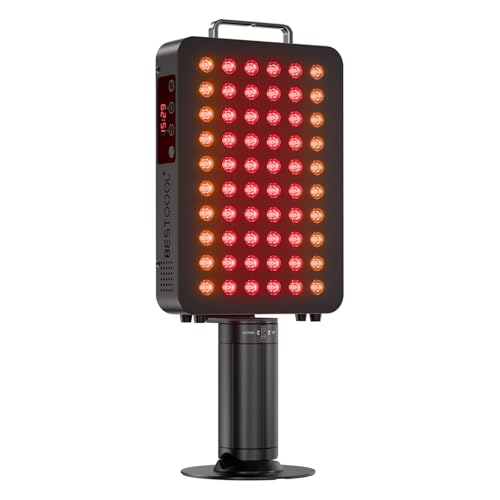
The BestQool Red Light Therapy Panel is an FDA-cleared, FSA/HSA-eligible at-home photobiomodulation device. It packs six wavelengths in a single 60-LED dual-chip array — 630, 660, and 680 nm of visible red plus 810, 850, and 940 nm of near-infrared — covering everything from the surface of the skin down through tissue, muscle, and joint depths.
I tested it daily for two weeks at 20 minutes per session, aimed straight at my lumbar spine, with both red and near-infrared running. By the second week the pain had clearly eased and my range of motion was better. It is not a miracle, but it works when you stay consistent.
Here is what I liked, what could be better, and who actually needs to spend $289 on a red light therapy panel.
Six Wavelengths Cover Skin And Deep Tissue
Most entry-level red light therapy devices only run two wavelengths — usually 660 and 850 nm — which is enough for general use but limiting if you want skin work and joint work in the same session. The BestQool BQ60 Pro stacks six wavelengths in one panel: 630, 660, and 680 nm reach the epidermis and dermis for collagen and tone, while 810, 850, and 940 nm push down into muscle and joint tissue.
In practice that meant I did not need to fiddle with separate devices. One 20-minute session on my lumbar spine delivered the deep-tissue near-infrared, and a second session pointed at my face the next morning gave me the surface red. The therapeutic spread is genuinely useful. If you want that same wavelength coverage somewhere humid, the BestQool Waterproof Red Light Therapy Panel brings 660nm and 850nm into a sauna or steam shower inside an IPX6 housing. If six wavelengths are more than you need, the LEDINO Red Light Therapy Panel sticks to just 660nm and 850nm on a flexible stand for around a quarter of the price.
140W Output And Verified Irradiance
The published spec is 96.1 mW/cm² of irradiance at 3 inches with a true 140W draw. Light Therapy Insiders measured the smaller BestQool Pro 100 at 51.7 mW/cm² average using a calibrated spectrometer — solid for a budget panel, even after the typical gap between marketing claims and reality.
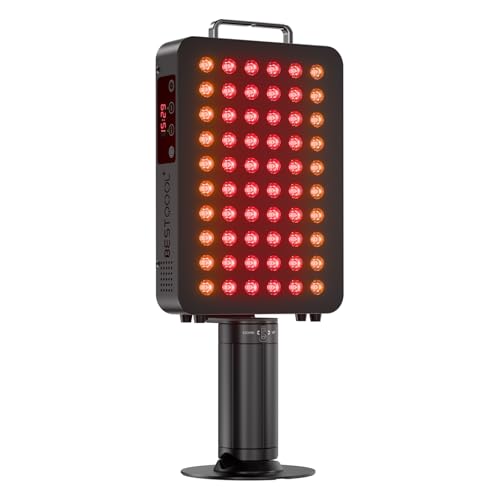
That output translates to short, effective sessions. Twenty minutes a day was enough to deliver the dose I wanted without sitting in front of the panel for an hour.
3-In-1 Stand Adjusts To Any Position
The included mount works as a desk stand, a bed clamp, and a door pulley. The 360° rotating panel adjusts vertically and horizontally, so I could lie flat on the floor with the head pointed at my back, sit at my desk with the panel angled at my face, or clamp it to the headboard before bed.
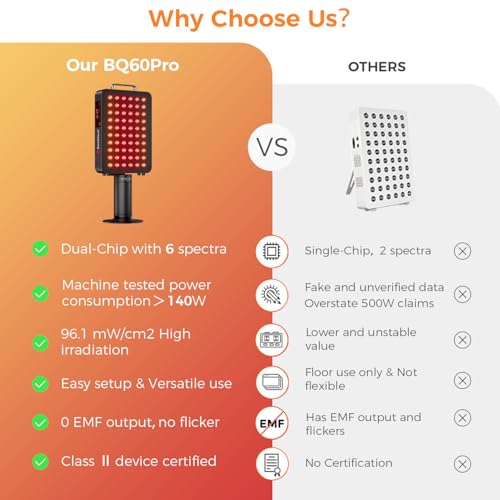
One-person setup took me under five minutes the first time. Most cheaper light therapy devices ship with stiff stands that lock you into one angle. Wearable alternatives like the ADIUPUL Cordless Back Massager Belt trade panel positioning for a wrap that delivers red light, heat, and vibration directly to the lumbar. Seated solutions like the CARSHION Back Massager with Heat take a different route entirely, building vibration and warmth into a chair cushion across upper back, lower back, and thigh zones.
Zero EMF At Six Inches
EMF anxiety is a fair concern with anything that draws 140W and uses an LED driver. BestQool publishes a zero-EMF reading at six inches, and the doctor who tested the larger Pro 300 over seven days reported the same. I treat that as adequate — at recommended treatment distance, the field is below the noise floor of consumer meters.
It also runs flicker-free on the dual-chip LEDs. Some of BestQool’s older budget panels had detectable flicker; this one does not.
Real Pain Relief By Week Two
By Day 5 I noticed my morning stiffness was milder. By Day 10 the dull ache I get from sitting for four hours was clearly down. By the end of the two weeks my range of motion in the lumbar spine was better, and lifting felt safer than it had in months.
Dr. Holden Stanfill ran a separate 7-day trial on the Pro 300 panel and reported deeper sleep by Day 2 and reduced stiffness by Day 4. His verdict matches mine: as a tool for recovery, inflammation, skin health, or sleep, it absolutely works when you use it consistently.
Power Cable Sticks Straight Out
The power cord exits dead center on the back of the panel, which is fine on a desk but awkward if you ever want to hang it flush against a wall. Most competing red light therapy panels use angled exits so the cord runs sideways. It is a small fix but BestQool has not made it yet.
I worked around it by leaving an inch of clearance between the panel and the wall when I clamped it to my headboard. Easy fix, but worth knowing.
Marketing Power Numbers Are Optimistic
BestQool publishes 96.1 mW/cm² at 3 inches for the BQ60 Pro and reports up to 90 mW/cm² at 6 inches on the older Pro 100. When Light Therapy Insiders ran the Pro 100 with a calibrated spectrometer at 6 inches, the average came out at 51.7 mW/cm². That is a real gap.
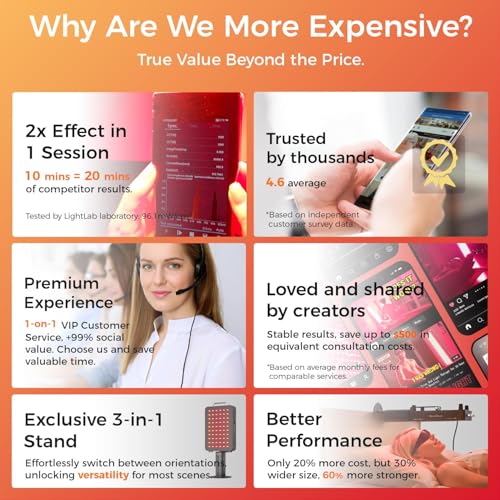
The number you actually use sessions at — 3 inches on the BQ60 Pro — is still in line with the published spec, and 51.7 mW/cm² is more than enough therapeutic dose at home. But if you cross-shop on raw irradiance numbers, derate BestQool’s specs by 30 to 40 percent before comparing.
Lighting Products Are Non-Returnable
Per BestQool’s stated return policy, lighting products cannot be returned for a refund. The company will only replace defective units within the two-year warranty (extendable to three years with registration). The 30-day return window in their FAQ comes with a 20% restocking fee.
That is a tougher policy than Hooga’s no-restocking 30-day return or Block Blue Light’s 30-day no-fee window. If you want a true trial period, look elsewhere.
Results Require Daily Sessions For Weeks
Red light therapy follows a biphasic dose response — too little is ineffective, too much actually reduces the benefit. Twenty minutes a day for two weeks is the floor for noticing real change on chronic pain or skin concerns. If you skip days or expect overnight results, you will be disappointed.
This is true of every red light panel on the market, but the BestQool’s price tag makes the consistency requirement feel more pointed. Treat it like a workout habit.
BestQool vs Joovv Solo 3.0
The Joovv Solo 3.0 is the premium reference point in red light therapy panels. It runs $1,500 to $2,500 depending on the modular stack, ships with medical-grade build quality, and has a long track record of independent third-party irradiance testing.
The BestQool BQ60 Pro delivers comparable in-session irradiance (96.1 mW/cm² at 3 inches) and more wavelengths (six versus two) at roughly one-fifth the price. You give up Joovv’s modular full-body upgrade path and the polished iOS app, but for a single-target home setup the value gap is hard to argue with.
BestQool vs Mito Red Light MitoPRO
Mito’s MitoPRO 750 sits in the mid-tier at around $499 and runs five wavelengths — but stops at 850 nm. The BestQool adds 940 nm for slightly deeper near-infrared penetration and matches Mito on irradiance.
Mito’s edge: US-based brand support and published third-party testing transparency. BestQool’s edge: more wavelengths and a lower entry price. If you only care about 660 and 850 nm, Mito has a longer track record. If you want the full spread including 940 nm, BestQool is the cheaper path.
BestQool vs Hooga PRO300
The Hooga PRO300 is the value-tier benchmark at $199. It uses two wavelengths (660 and 850 nm), a stiff stand, and basic dual-chip LEDs. It is excellent for someone who wants the minimum viable red light therapy panel and does not want to spend more.
The BestQool BQ60 Pro costs about $90 more but gives you four extra wavelengths, the 3-in-1 stand-clamp-pulley mount, and a built-in timer with proper presets. If $90 is the deciding factor, get the Hooga. If you want flexibility and depth coverage, the BestQool wins. For readers who only need shoulder coverage rather than a full panel, the Comfytemp Cordless Red Light Therapy Shoulder Wrap delivers 660 and 850 nm therapy in a wearable, cordless form. And if even the Hooga’s price is more than you want to spend, the Puroth Red Light Therapy Lamp drops to around $59 with a bigger panel and a full floor stand, though without BestQool’s verified output.
My final rating for the BestQool Red Light Therapy Panel is 4.7 out of 5. The combination of six wavelengths, verified 96.1 mW/cm² output at 3 inches, zero EMF at six inches, and a flexible 3-in-1 mount at $289 is hard to find elsewhere — Joovv runs five times more, Hooga gives you fewer wavelengths, and Mito stops short at 850 nm.
The two real caveats are the optimistic published irradiance numbers (treat them as ceilings, not averages) and the tight non-returnable lighting policy. Neither is a dealbreaker, but both deserve to be priced into the decision.
If you want a credible at-home photobiomodulation device that handles both skin and deep-tissue work, this is the one to buy at the mid-tier. The improvement on my lower back over 14 days was concrete, repeatable, and worth the panel.
This review is informational and is not intended to diagnose, treat, prevent any disease, or replace consulting a clinician when you are treating a health problem.
Specifications
| Wavelengths | 630nm, 660nm, 680nm, 810nm, 850nm, 940nm |
| LEDs | 60 (dual-chip) |
| Irradiance | 96.1 mW/cm² at 3 inches |
| Power | 140W |
| EMF | 0 at 6 inches |
| Timer | Built-in 5/15/20/40 minutes |
| Mounting | 3-in-1 stand, clamp, or pulley |
| Beam angle | 60° |
| Certification | FDA-cleared, FSA/HSA eligible |
Frequently Asked Questions
Is BestQool a good red light therapy brand?
Yes, particularly the multi-wavelength BQ60 Pro at this price point. BestQool sits in the value-to-mid tier — better wavelength coverage than Hooga, lower entry price than Mito, and a fraction of Joovv's cost. Light Therapy Insiders flagged the older Pro 100 as exceptional value, and the BQ60 Pro builds on that with six wavelengths and dual-chip flicker-free LEDs.
Is the BestQool Red Light Therapy Panel FDA approved?
The BestQool Red Light Therapy Panel is FDA-cleared, not FDA-approved. Clearance means the device is recognized as low-risk and meets safety standards; approval would mean the FDA has tested it for specific medical conditions. This is the same regulatory status as nearly every at-home red light therapy device on the market.
Do red light therapy panels actually work?
Yes, with consistent daily sessions over weeks. My 14-day test on lower back pain showed clear improvement in pain and range of motion by week 2. Dr. Holden Stanfill's 7-day trial on the Pro 300 reported deeper sleep by Day 2 and reduced morning stiffness by Day 4. Photobiomodulation has solid clinical evidence — but only at the right dose and frequency.
How long should each BestQool Red Light Therapy Panel session last?
Start at 10 to 15 minutes per area for the first week, then move up to 20 minutes daily. The built-in timer offers 5, 15, 20, and 40-minute presets, but more is not better — red light therapy follows a biphasic dose curve, so longer sessions can reduce the benefit.
What is the most reputable red light therapy company?
Joovv and PlatinumLED lead the premium tier with the most published third-party data and clinical research backing. BestQool, Mito Red Light, and Hooga lead the value tier. For most home users targeting pain relief, recovery, or skin health, the value tier panels deliver the same therapeutic dose at a fraction of the price.
Does the BestQool Red Light Therapy Panel emit EMF?
EMF readings drop to zero at six inches per BestQool's published spec, confirmed by independent reviewers on the BQ60 Pro. The 60-degree beam angle and recommended treatment distance keep you well outside any meaningful field. EMF is one of the most-asked questions about home red light panels, and BestQool's design has it handled.
Ready to Buy?
BestQool Red Light Therapy Panel delivers on its promises. If it fits your needs, it's a solid choice you won't regret.
Check Price on Amazon Founder & Product Reviewer at TheReviewRewind
Daniel has tested 400+ products across 20+ categories through hands-on, real-world testing. Every review includes video documentation and standardized scoring criteria. His reviews appear as Amazon shoppable videos and here on TheReviewRewind.
We earn a commission if you make a purchase, at no extra cost to you. This does not influence our ratings or recommendations. Full disclosure
Looking for more options? See all our Health & Household reviews.
Related Reviews