Carpenter Bee Blocker Pro Plugs Review: A Permanent Seal for Bee Holes


Carpenter Bee Blocker Pro Plugs Review: A Permanent Seal for Bee Holes
Carpenter Bee Blocker Pro Plugs
The Carpenter Bee Blocker Pro plugs solve the part of the carpenter bee problem that sprays and wood putty never do: re-entry. The 304 stainless steel mesh friction-fits into existing half-inch holes, and bees can't chew through it the way they chew through filler. Treat the nest first, though, and expect to putty over the screens if you want an invisible repair.
Buy on AmazonWhat We Liked
- 304 Stainless Steel Bees Cannot Chew Through
- Friction Fit With No Glue or Caulk
- The Extension Pole Adapter Earns Its Place
- Rust-Resistant on Cedar and Log Timber
- It Layers With Chemical Treatment Instead of Replacing It
- A Genuinely Fast One-Person Job
What Could Be Better
- You Have to Treat the Nest Before You Seal It
- Not Every Hole Is a Clean Half-Inch
- The Mesh Stays Visible Unless You Cover It
- It Does Nothing to Prevent New Holes
- Thirty Plugs Disappears Quickly
How we test: Every product is used in real conditions and evaluated using our standardized scoring criteria. Read our full review methodology.
If your deck rail or fascia board looks like Swiss cheese, you already know what carpenter bees can do to wood. You have probably also cycled through the sprays, the wood putty, and the can of expanding foam, only to watch the bees chew right back into the same holes the following spring.
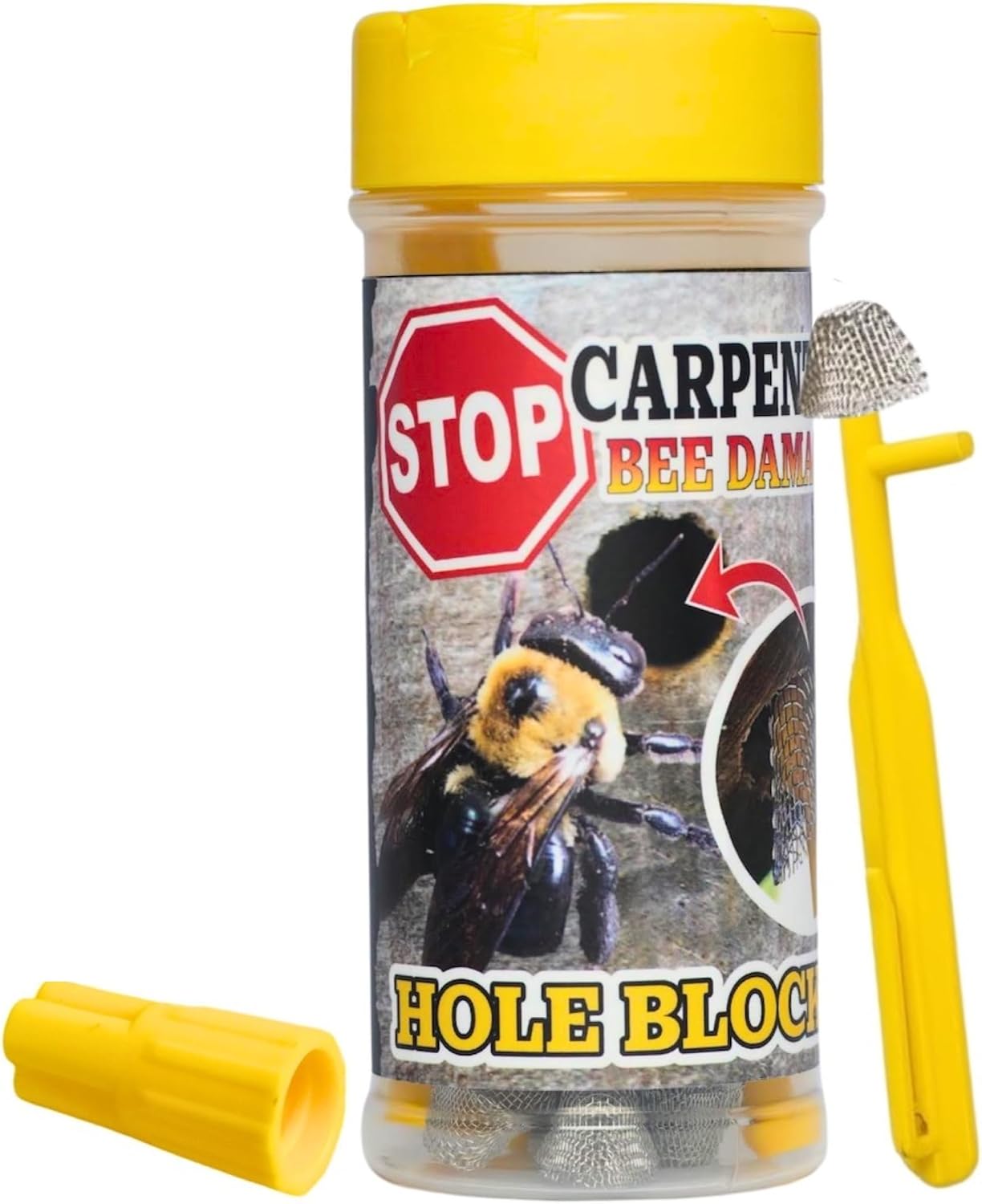
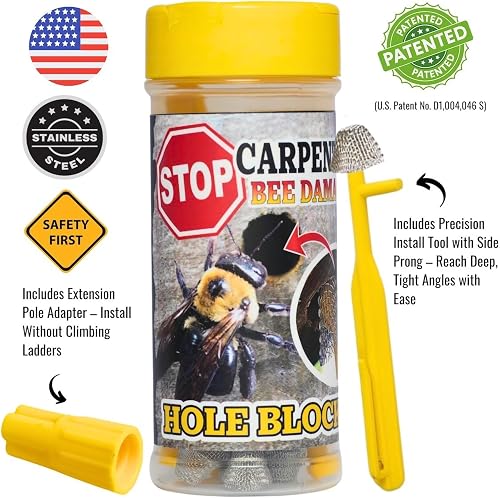
The Carpenter Bee Blocker Pro from BB PRO takes a different approach. Instead of poisoning the bees or filling the hole with something soft, it plugs each gallery with a 304 stainless steel mesh screen that friction-fits into the opening. The 30-count kit runs $19.95 and ships with a precision install tool and an extension pole adapter.
I went through the kit hole by hole on wood that already had visible carpenter bee damage. What follows covers how the screens actually seat, where the design earns its patent, and the two steps you have to get right before you seal anything.
Amazon shoppers have it at 4.4 stars across 238 ratings, and the pest control pros who use it professionally reach for it before the wood filler comes out.
What I Liked About the Carpenter Bee Blocker Pro Plugs
The value here is narrow but real. This product solves re-entry, and it solves it with a material that carpenter bees have no answer for.
304 Stainless Steel Bees Cannot Chew Through
Each screen is built from 304 stainless steel mesh, the same grade used for outdoor hardware that has to sit in weather for years. Wood putty, caulk, and expanding foam all fail the same way over time: they shrink, crack, or get pushed out, and the bees chew straight back through.
Steel does not give them that option. Exterminators make the same point when they walk homeowners through a repair, noting that wood putty alone is like putting a bandage on a leak because the bees will chew right through it.
The mesh is also malleable enough to deform into an out-of-round hole. It takes real effort to tear one by hand, which is a good sign for something meant to sit in a fascia board for a decade.
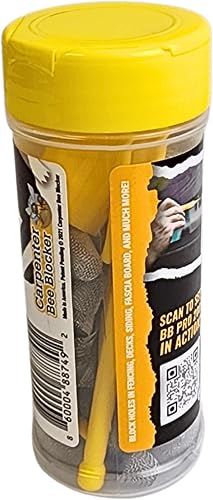
Friction Fit With No Glue or Caulk
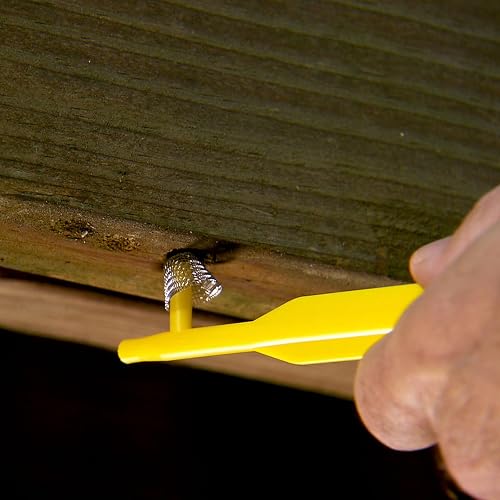
Installation is mechanical. You push the screen into the hole with the install tool, the mesh expands against the wood fibers, and it locks in place. There is no cure time, no mixing, and nothing to sand.
That matters more than it sounds. A putty repair commits you to a dry time and a sanding pass before you can paint, while a screen is finished the moment it seats flush.
The Extension Pole Adapter Earns Its Place
Carpenter bees favor eaves, soffits, and second-story fascia, which is exactly where you do not want to be balancing on a ladder with a putty knife. The included adapter threads onto a standard extension pole, and the precision tool clips onto either the top or the side.
I could reach overhead holes standing flat on the ground. For a one-person job on a two-story elevation, that changes the afternoon from a ladder project into a walk-around.
Rust-Resistant on Cedar and Log Timber
Because the screens are stainless rather than plain steel, they do not bleed rust streaks down the wood. Anyone who has stuffed a hole with ordinary steel wool and come back a year later to an orange stain will appreciate the difference.
On premium cedar siding or log cabin timber, a rust streak is its own repair job. This sidesteps it.
It Layers With Chemical Treatment Instead of Replacing It
The screens are a mechanical barrier, not a pesticide, so nothing stops you from dusting or spraying the gallery first and then sealing it. One contractor on r/Construction put it plainly, calling stainless screens a more permanent fix than caulk or glue while noting you can still hit the hole with spray, foam, or dust.
That flexibility is why pest control operators use it as step one of a treatment rather than an alternative to one.
A Genuinely Fast One-Person Job
The whole kit is a bottle of screens, a small tool, and a pole adapter. There is no assembly and no bait to refresh.
One Trustpilot reviewer reported sealing every hole on a wooden fence in under ten minutes and immediately ordering the 200-count version. That tracks with how quickly the screens seat once you find the holes.
What Needs Improvement
None of these are dealbreakers, but they are the difference between a repair that holds and one that creates a new problem.
You Have to Treat the Nest Before You Seal It
This is the big one, and the packaging undersells it. Carpenter bee galleries run several inches deep and often turn at an angle, so a hole that looks empty can still hold larvae.
Seal a live gallery and the bees inside do not simply die quietly. Installers demonstrating this exact kit warn that if you wait too long and seal holes with active bees inside, they will drill a fresh hole to get out, which means new damage in wood that was previously intact.
Plan on treating with an insecticide dust or foam first and waiting 24 to 48 hours before the screens go in.
Not Every Hole Is a Clean Half-Inch
BB PRO markets the screens as a universal fit, and the mesh does deform to cover a range of openings. But carpenter bees are not precision machinists, and woodpeckers make it worse by tearing holes open to reach the larvae.
Buyers of rigid plug-style products run into this constantly. One reviewer of a competing plastic plug complained that the bees were not given enough training to consistently create perfect half-inch holes, and that the plugs simply would not seat in many of them.
The mesh handles variation better than a hard plug does. It still will not bridge a hole that a woodpecker has opened into a crater.
The Mesh Stays Visible Unless You Cover It
A seated screen looks like a small silver disc in the wood. On a rough barn or an unfinished fence, nobody will notice.
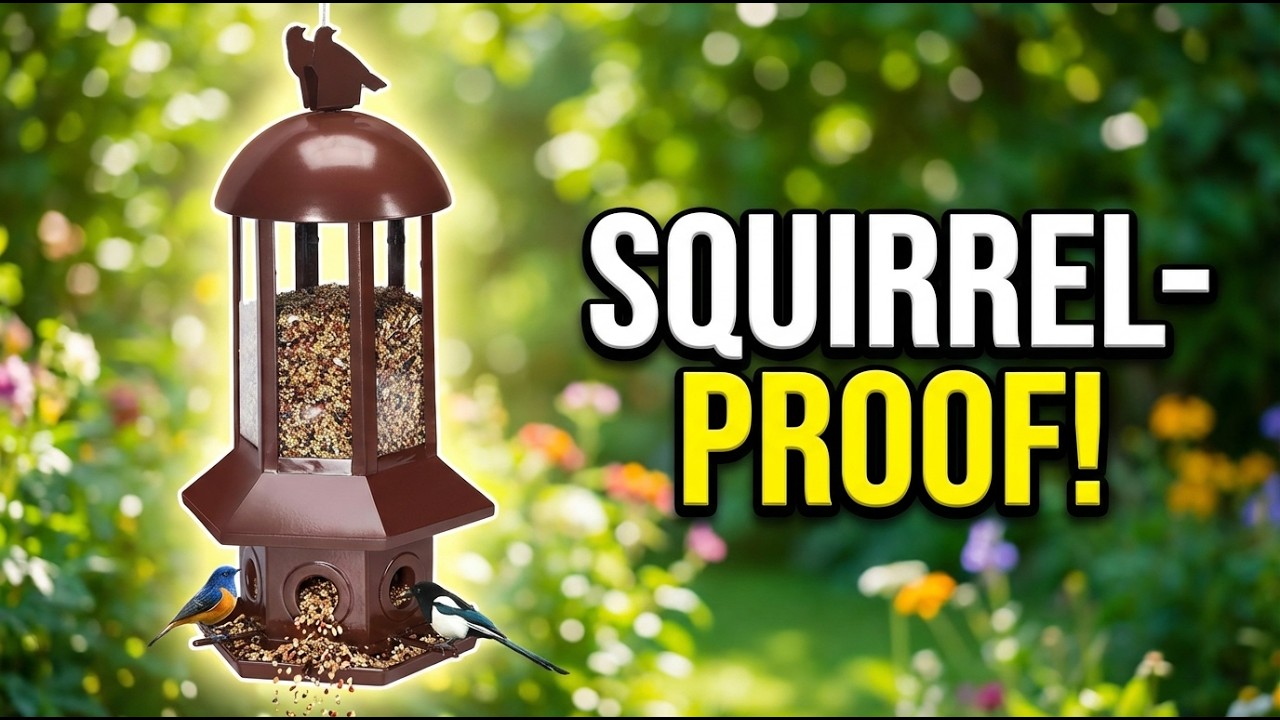
On painted trim or a finished deck rail, you will. Getting an invisible repair means puttying over the screen, sanding, and painting anyway, so the kit shortens that job without eliminating it. If the deck is where you put that effort, a weather-rated fixture like the Sorflife squirrel proof bird feeder is the kind of addition that looks intentional next to a repaired rail.
It Does Nothing to Prevent New Holes
The screens are strictly a re-entry blocker. Bare, unfinished wood next to a sealed hole is just as attractive to next spring’s females as it was before.
Every credible source on carpenter bee control lands in the same place: paint or seal the exposed wood, because finished surfaces are what actually discourages new drilling. Budget for that as a separate task.
Thirty Plugs Disappears Quickly
An established infestation on a deck or porch ceiling routinely runs past 30 holes, and homeowners consistently report finding more than they expected once they start looking. At $19.95 for the 30-count, a bad porch can take two or three bottles.
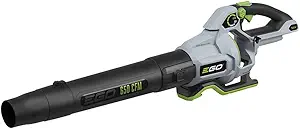
If you already know the damage is widespread, the 200-count version is the more sensible buy. Clearing leaf litter and cobwebs off the deck and eaves first with a blower like the EGO Power+ LB6500 makes that hole count much easier to get right before you order.
How the Carpenter Bee Blocker Compares
Carpenter bee products split into two camps: things that kill or capture bees, and things that close the wood. The Blocker Pro is firmly in the second camp, which makes some comparisons more useful than others.
Against Wooden Corks
Best Bee Brothers sells hand-dipped wooden corks in two sizes, and they are the closest mainstream competitor for sealing holes. Corks give you a wood-on-wood repair that takes stain naturally, which is the aesthetic advantage.
The limitation is fit. The company itself notes that if your holes are too large for the corks, you have additional damage typically caused by woodpeckers. A compressible mesh screen tolerates that variation better than a rigid cork does.
Against Plastic Plugs
Trebor’s plastic plugs are cheaper per unit and come in half-inch and three-eighths-inch sizes. In practice, buyers report the hard plastic does not give a snug fit, that plugs pop out, and that holes falling between the two sizes cannot be sealed at all.
Hard plastic also has the wrong failure mode outdoors. It gets brittle in UV, while 304 stainless does not.
Against Steel Wool and Putty
The classic DIY method is stuffing the hole with steel wool and capping it with exterior caulk or wood filler. It works, it costs almost nothing, and the bees cannot chew steel wool any more than they can chew mesh.
The catch is rust. Ordinary steel wool oxidizes and streaks the wood, which is precisely the problem 304 stainless avoids. You are paying roughly $0.67 a hole for a pre-sized, rust-proof version of a repair you could improvise for pennies.
Against Carpenter Bee Traps
Hanging traps like the Best Bee Brothers Ultimate Pro do something different: they catch adult bees in flight rather than closing the wood. Reviewers rate them well for population control across a yard.
Traps and screens are complements, not substitutes. A trap reduces the number of bees looking for a nest site, while the screens make sure the galleries already in your fascia never get used again.
Final Verdict
The Carpenter Bee Blocker Pro earns its place by solving one specific problem completely. Carpenter bees reuse the same galleries year after year, and every soft filler eventually loses to their mandibles. A 304 stainless steel mesh screen does not.
At $19.95 for 30 screens, an install tool, and a pole adapter, the kit is priced fairly against wooden corks and plastic plugs that fit worse and weather badly. The extension pole adapter is the underrated piece, because it turns second-story soffit work into a ground-level task.
Just be clear about what you are buying. This is a re-entry blocker, not an exterminator and not a preventative. Treat the gallery first and give it a day or two, or you risk sealing live bees in and getting a brand new exit hole for your trouble. Then paint or seal the surrounding bare wood, because nothing about a plugged hole discourages next spring’s females from starting a fresh one.
Get it if you have visible holes and you are tired of repeating the same putty repair every spring. Skip it if you have no damage yet and are shopping for prevention, or if your infestation is large enough that the 200-count version makes more sense.
I rate it 4.1 out of 5.
Specifications
| Brand | BB PRO |
| Color | Silver |
| Product Dimensions | 1.38"L x 1.38"W x 1.02"H |
| manufacturer_part_number | BBPRO30 |
| Material | Stainless Steel |
| model_number | BBPRO30 |
| Number of Pieces | 1 |
| power_source | manual |
| Style | Modern |
| Target Species | Bee |
| Unit Count | 30.0 Count |
| UPC | 860004887409 |
Frequently Asked Questions
Do the Carpenter Bee Blocker Pro plugs really work?
For their intended job, yes. The 304 stainless steel mesh physically blocks carpenter bees from re-entering a gallery, and unlike wood putty or caulk they cannot chew through it. Amazon buyers rate the kit 4.4 out of 5 across 238 ratings, and pest control professionals use the screens as the first step of a repair before applying wood filler. What they will not do is kill bees or stop new holes from being drilled elsewhere.
Do I need to spray or dust the hole before plugging it?
You should. Carpenter bee galleries run several inches deep and can hold larvae even when they look empty. If you seal a hole with live bees inside, they can drill a new exit hole and cause fresh damage. Treat the gallery with an insecticidal dust or foam, wait 24 to 48 hours, then insert the screen.
Can you permanently get rid of carpenter bees with these?
The screens permanently close the holes you plug, which breaks the reuse cycle those galleries would otherwise support for years. Full control takes more than that. You also need to treat active nests and paint or seal exposed bare wood, since unfinished lumber is what attracts new females each spring.
Will the plugs fit holes that are not exactly half an inch?
The mesh compresses and deforms, so it handles a reasonable range of hole sizes better than rigid cork or plastic plugs do. Very large openings are the exception. If a woodpecker has torn a gallery open to reach larvae, the hole may be too wide for a screen to grip and will need a dowel or patch instead.
Do the stainless steel screens rust or stain the wood?
No. They are made from 304 stainless steel, the same grade used in outdoor hardware, so they are rust-resistant and will not bleed orange streaks down cedar siding or log timber. That is the main advantage over stuffing holes with ordinary steel wool, which does oxidize over time.
How many plugs will I actually need?
More than you expect. Homeowners routinely find more holes than they counted once they start inspecting fascia boards, deck rails, and eaves closely. The 30-count kit covers a moderate problem, but an established infestation on a porch or barn can easily exceed it, in which case the 200-count version is the better value.
Do I still need to putty and paint over the screens?
Only if appearance matters. A seated screen sits flush and looks like a small silver disc, which is fine on a fence or barn. On painted trim or a finished deck, you will want to cover it with exterior wood filler, sand it smooth, and paint to match.
Ready to Buy?
Carpenter Bee Blocker Pro Plugs delivers on its promises. If it fits your needs, it's a solid choice you won't regret.
Check Price on Amazon Founder & Product Reviewer at TheReviewRewind
Daniel has tested 400+ products across 20+ categories through hands-on, real-world testing. Every review includes video documentation and standardized scoring criteria. His reviews appear as Amazon shoppable videos and here on TheReviewRewind.
We earn a commission if you make a purchase, at no extra cost to you. This does not influence our ratings or recommendations. Full disclosure
Looking for more options? See all our Patio, Lawn & Garden reviews.
Related Reviews