GoveeLife WiFi Refrigerator Thermometer Review: 3-Way Alerts, Tested


GoveeLife WiFi Refrigerator Thermometer Review: 3-Way Alerts, Tested
GoveeLife WiFi Refrigerator Thermometer
Buy if you want remote alerts and temperature history for a fridge, freezer, or garage unit you cannot afford to lose, especially across several appliances on one gateway. Skip if your fridge exterior is plastic and you dislike lanyards, or you only want a simple at-a-glance dial thermometer with no app.
Buy on AmazonWhat We Liked
- Three-Way Alerts That Reach You Even When You're Away
- A Fast, Accurate NTC Probe You Can Calibrate
- One Gateway Covers Up to Ten Sensors at Once
- Temperature History, Graphs, and Data Export
- A Thin Flat Cable That Seals the Door Without Leaks
What Could Be Better
- The Magnet Won't Grip a Plastic Fridge Exterior
- The Adhesive Holder and Fixed Cable Can Fuss
- Remote Cloud Readings Lag the Local Display
- It Needs 2.4GHz Wi-Fi and the Govee Home App
How we test: Every product is used in real conditions and evaluated using our standardized scoring criteria. Read our full review methodology.
A chest freezer full of meat or a garage fridge you rarely open can quietly stop working, and most people find out only when the smell hits. By then the food is gone, and you never got a single warning.
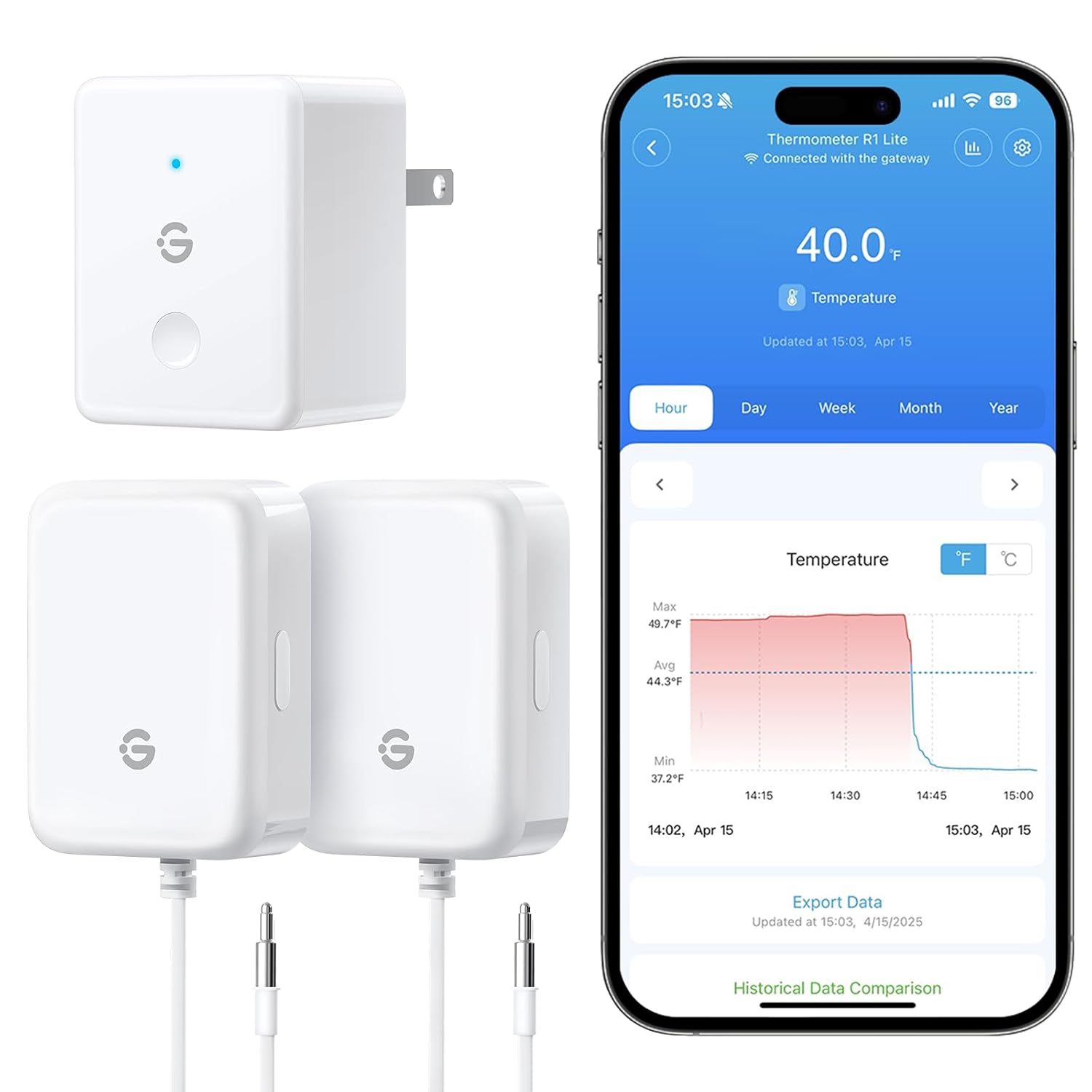
The GoveeLife WiFi Refrigerator Thermometer sets out to end that guessing game. Sold at retail as the Govee Smart Thermometer R1 Lite, this kit pairs two wireless sensors and a dongle-style Wi-Fi gateway with the Govee Home app, so you can watch any refrigerator or freezer from your phone. Each sensor has a small LCD display on the outside, an NTC probe on a thin cable, and a built-in 80dB alarm, and the pack runs on four AAA batteries. At around $34 on Amazon, where it holds a 4.4-star rating across more than 600 reviews, it is one of the cheaper ways into connected temperature monitoring.
I went through the setup, the mounting options, the three alert methods, and the app’s history graphs to see whether this is genuinely useful or just another gadget. The short version: for anyone protecting food they cannot afford to lose, it is cheap insurance, with a few mounting and connectivity quirks worth knowing first.
What I Liked
Three-Way Alerts That Reach You Even When You’re Away
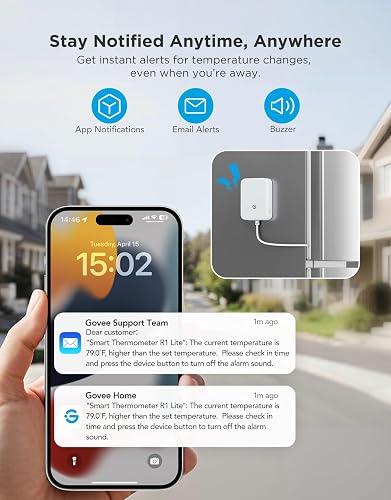
The whole point of this thermometer is redundancy. If the temperature drifts outside the range you set, you get a push notification, an email, and an 80dB buzzer on the sensor itself. Even if your phone is on silent or you are across town, one of those three will reach you.
That buzzer sits on the sensor unit, not the gateway, and it is loud enough to hear from inside the house when the freezer is out in the garage. It works like a security alarm for your food, yelling for help when nobody is watching a screen. You can also set a Smart Anti-False Alarm delay so a quick door opening does not trip it every time.
A Fast, Accurate NTC Probe You Can Calibrate
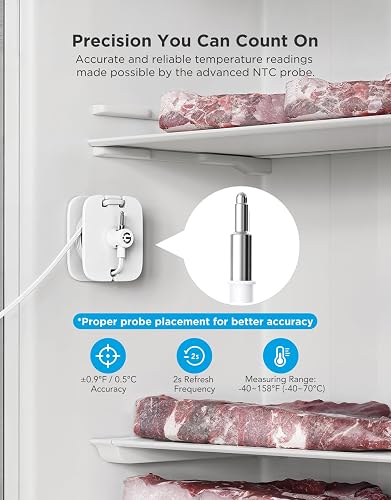
Each sensor uses an ultra-sensitive 2.7mm NTC probe rated to plus or minus 0.9°F (0.5°C) with a two-second response time. The reading you see is essentially the real temperature, not a guess from 30 seconds ago, and if you are picky you can calibrate it in the app for real-time accuracy you trust.
The range runs from -40°F to 158°F, so the same sensor works in a deep freezer, a regular fridge, a garage, or even a hot tub. One practical note from the video: after you first drop the probe in, it can take 15 to 20 minutes to settle to the true temperature, so do not panic at the first reading.
One Gateway Covers Up to Ten Sensors at Once
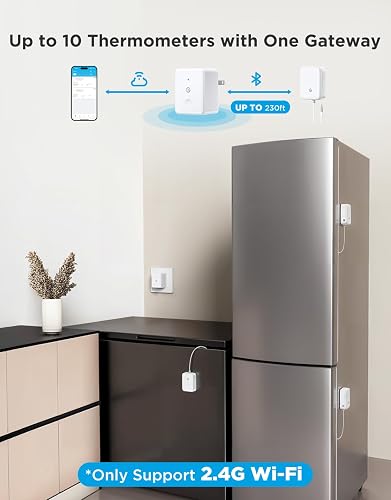
A single dongle-style gateway supports up to 10 sensors over a range of about 230 feet, so you are not buying a new hub for every appliance. A kitchen fridge, a garage fridge, and a chest freezer can all show up on one home screen in the app. The sensors talk to the gateway over Bluetooth, and the gateway bridges everything to WiFi.
That matters for food safety at home or in a small food business, where one glance shows every temperature at once. Most people will not need all 10 sensors, but it is room to grow into without buying another bundle. If one of those spaces is a chilly garage or home office, the Dish Space Heater adds fast, quiet warmth to a single room you actually spend time in.
Temperature History, Graphs, and Data Export
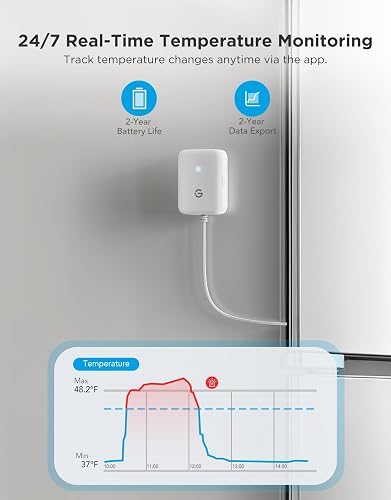
Beyond live readings, the Govee Home app logs temperature over time and lets you zoom from hourly to yearly views. You can export the historical data, and GoveeLife includes two years of free data storage, which is handy if you ever need records.
GoveeLife also rates the sensor for up to two years of battery life, which keeps maintenance low. The trend graphs are genuinely useful for spotting a fridge that is slowly creeping up in temp before it becomes a problem.
A Thin Flat Cable That Seals the Door Without Leaks
The probe rides on a thin, flat cable designed to pass through the door gasket without holding the seal open. In the video it closed cleanly on a freezer with no obvious cold-air leak, which is the clever part of the design.
You stick the display on the outside with the magnet, drop the probe inside, and route the cable through the seal. Setup takes about five minutes, and the wireless sensors come with the batteries already installed.
What Needs Improvement
The Magnet Won’t Grip a Plastic Fridge Exterior
The display unit has a strong magnet, but many modern fridges are plastic or coated on the outside, so it may not grab. GoveeLife includes lanyards to hang the sensor instead, which works, but it is an extra step the product photos do not prepare you for.
If your fridge is smooth plastic and you do not want to deal with a lanyard, factor that in before you buy. The reviewer in the video flagged this as the one real mounting catch.
The Adhesive Holder and Fixed Cable Can Fuss
The included adhesive probe holder can loosen after a few days in the cold, damp interior. The easy fix is a small piece of tape to keep the flat cable tidy where it crosses the seal, but you should not have to.
A couple of owners also noted the probe cable is permanently attached and cannot be unplugged, which makes routing it a little awkward. Neither issue is a dealbreaker, but both are the kind of thing you notice during setup.
Remote Cloud Readings Lag the Local Display
The sensor display and the local app update fast, but once a sensor is bound to the gateway, the readings you see remotely refresh about every 10 minutes. For catching a slow failure that is fine, but it is not second-by-second when you are away from home.
The gateway can also drop offline and need re-pairing, and like most Govee gear it only talks to 2.4GHz networks, which brings me to the next point.
It Needs 2.4GHz Wi-Fi and the Govee Home App
Remote monitoring depends on the gateway reaching a 2.4GHz network; it will not connect to a 5GHz-only mesh, so some garage setups need a band split or an extender. This is a thermometer, not a thermostat, so it only reports temperature and cannot adjust the appliance itself.
The Govee Home app also draws recurring complaints for clutter and post-update bugs, though setup for the thermometer itself is quick. Privacy-minded buyers should skim Govee’s data and account policy before enabling cloud history, since readings sync to a Govee account.
How It Compares
At around $34 for two sensors and a gateway, the GoveeLife kit is one of the cheapest ways to get remote fridge and freezer alerts. Here is how it stacks up against the thermometers people cross-shop. One note first: this probe model tracks temperature only, not humidity, so if you need humidity too, Govee’s ambient H5179 sensor is the sibling to look at.
GoveeLife vs SensorPush HT1
SensorPush is the accuracy favorite, with tighter tolerances and minute-by-minute logging stored on the sensor itself. The catch is cost: remote alerts require its separate G1 gateway, pushing a single-sensor setup to roughly $150 to $165.
The GoveeLife bundle includes its gateway and two sensors for a fraction of that. SensorPush makes sense only if you need lab-grade precision or a tamper-proof compliance log for an inspection. That same appetite for fine, repeatable precision shows up in the kitchen with the MHW-3BOMBER R3 Manual Coffee Grinder, which adjusts grind size in 16-micron steps for espresso and pour-over.
GoveeLife vs Inkbird and ThermoPro
Inkbird’s IBS-TH2 stores tens of thousands of readings on-device and runs several sensors in one app, but remote access leans on a Bluetooth gateway rather than an included Wi-Fi one. ThermoPro’s budget RF and Bluetooth thermometers are cheaper and need no app, yet they are display-only with no way to warn you when you are away.
The GoveeLife’s included Wi-Fi gateway and 80dB freezer alarm are the difference if remote alerts are the whole reason you are buying.
GoveeLife vs Temp Stick and a Basic Dial
Temp Stick connects straight to WiFi with no separate gateway and reaches colder temperatures for blast freezers, but it costs several times more than this two-sensor kit. Against a plain dial fridge thermometer that only shows the current number, the GoveeLife is a clear upgrade for anyone who wants alerts and history.
If you only glance at the temperature once in a while and never want an app, a simple dial still does the job for a few dollars. If you would rather automate a daily kitchen task than babysit a dial, the Avigator Coffee Maker With Grinder grinds and brews fresh drip coffee from one compact machine.
Final Verdict
The GoveeLife WiFi Refrigerator Thermometer earns a 4.2 out of 5. It does one job well: watching your fridge or freezer so you do not have to, with alerts that actually reach you three different ways.
The fast NTC probe, the one-gateway-for-the-whole-house design, and the genuinely useful history graphs make it cheap insurance against a silent freezer failure and the food safety scare that follows. The plastic-fridge magnet limitation, the roughly 10-minute remote refresh, and the 2.4GHz-only gateway are real trade-offs, but none is a dealbreaker at this price.
Bottom line: if you have a garage fridge or a chest freezer stocked with food you cannot afford to lose, this GoveeLife monitor is well worth checking out. If your refrigerator exterior is plastic and you only want an at-a-glance reading with no app, a basic thermometer will serve you better.
Specifications
| additional_features | 2 Years Free Data Storage, App Alarm, Smart Anti-False Alarm, WiFi & Bluetooth, ±0.9°F High Accuracy |
| age_range_description | All |
| Brand | GoveeLife |
| Color | White |
| Connectivity Technology | 2.4G Wi Fi, Bluetooth |
| Display Type | APP |
| Included Components | WiFi Gateway*1, Thermometer sensor*2, Battery*4, Holder*2, Lanyard*2, FDA Tape*4 |
| indoor_outdoor_usage | Indoor |
| item_length | 3.5 inches |
| manufacturer | GoveeLife |
| model | H5111 |
| model_name | Refrigerator Thermometer Lite |
| number_of_batteries | 4 AAA batteries required. (included) |
| Outer Material | Acrylonitrile Butadiene Styrene |
| part_number | B5111102 |
| power_source | Battery Powered |
| Product Care Instructions | Freezer Safe, Wipe Clean |
| response_time | 2 seconds |
| reusability | Reusable |
| Specification Met | FCC |
| style_name | BT Gateway+2 Sensor |
| unit_count | 1 Count |
| upc | 810127738782 |
| upper_temperature_range | 158 °F |
| Special Feature | 2 Years Free Data Storage, App Alarm, Smart Anti-False Alarm, WiFi & Bluetooth, ±0.9°F High Accuracy |
| Age Range (Description) | All |
Frequently Asked Questions
Can I monitor my refrigerator temperature remotely over WiFi?
Yes, as long as you use the included gateway. The sensors connect to the gateway over Bluetooth, and the gateway bridges to your 2.4GHz Wi-Fi so you can check temperatures and get alerts from anywhere in the Govee Home app. Without the gateway the sensors still work locally over Bluetooth, but only within range of your phone.
How accurate is the GoveeLife WiFi Refrigerator Thermometer?
The 2.7mm NTC probe is rated to plus or minus 0.9°F (0.5°C) with a two-second response time, which is accurate enough for food safety monitoring. If you want to be sure, compare it against another thermometer and use the app's calibration setting to line it up. Give the probe 15 to 20 minutes to settle after you first place it.
Does it need a subscription or special Wi-Fi?
There is no subscription, and GoveeLife includes two years of free data storage and export. The only requirement is a 2.4GHz Wi-Fi network for the gateway, since it will not connect to a 5GHz-only network. Some mesh setups need you to split the bands or add a 2.4GHz extender in the garage.
Will the sensor stick to a plastic fridge?
The magnetic back only grips metal, so it may not hold on a plastic or coated fridge exterior. GoveeLife includes lanyards to hang the sensor and adhesive for the probe holder, so you still have mounting options. Keep a small piece of tape handy, as the adhesive holder can loosen in the cold.
How long does the battery last?
GoveeLife rates each sensor for up to two years of battery life on its AAA batteries, which come installed in the box. The app shows a low-battery alert so you can swap them before you lose coverage. Very cold environments can shorten battery life, so check the level if a sensor lives in a deep freezer.
GoveeLife vs SensorPush, which should I buy?
Choose the GoveeLife bundle for value and convenience, since it includes the gateway and two sensors for around $34 and sends app, email, and buzzer alerts. Choose SensorPush if you need lab-grade accuracy or a tamper-proof, minute-by-minute log, and do not mind paying roughly $150 or more once you add its gateway.
Ready to Buy?
GoveeLife WiFi Refrigerator Thermometer delivers on its promises. If it fits your needs, it's a solid choice you won't regret.
Check Price on Amazon Founder & Product Reviewer at TheReviewRewind
Daniel has tested 400+ products across 20+ categories through hands-on, real-world testing. Every review includes video documentation and standardized scoring criteria. His reviews appear as Amazon shoppable videos and here on TheReviewRewind.
We earn a commission if you make a purchase, at no extra cost to you. This does not influence our ratings or recommendations. Full disclosure
Looking for more options? See all our Home & Kitchen reviews.
Related Reviews