HEIAT Titanium Cutting Board Set of 3 Review: Is the Knife Trade-Off Worth It?


HEIAT Titanium Cutting Board Set of 3 Review: Is the Knife Trade-Off Worth It?
HEIAT Titanium Cutting Board Set of 3
Buy if you want a low-maintenance, non-porous cutting board set that rinses clean and helps you cut plastic and microplastics out of your kitchen. Skip if you own high-carbon Japanese knives or prize edge retention, because titanium dulls blades faster than wood or plastic.
Buy on AmazonWhat We Liked
- Odors and Stains Rinse Off With Just Water
- Truly Low-Maintenance, Dishwasher-Safe Care
- Three Practical Sizes and a Double-Sided Design
- A Thin, Space-Saving Profile That Stays Put
- A Real Escape From Plastic and Microplastics
What Could Be Better
- It Dulls Knives Faster Than Wood or Plastic
- The Metallic Chopping Noise Takes Adjusting
- The Largest Board Is Heavy and Hard to Lift
- 'Titanium' Labeling Varies Across the Market
How we test: Every product is used in real conditions and evaluated using our standardized scoring criteria. Read our full review methodology.
Every time you drag a knife across a plastic cutting board, you shave a few invisible flecks off the surface, the microplastics that end up in your food. Switch to a wooden board and you trade that for juices soaking in, garlic and onion smells that linger, and a surface you can’t put in the dishwasher. The HEIAT Titanium Cutting Board Set of 3 promises a third path: a non-porous metal surface that rinses clean and is built to last a lifetime.
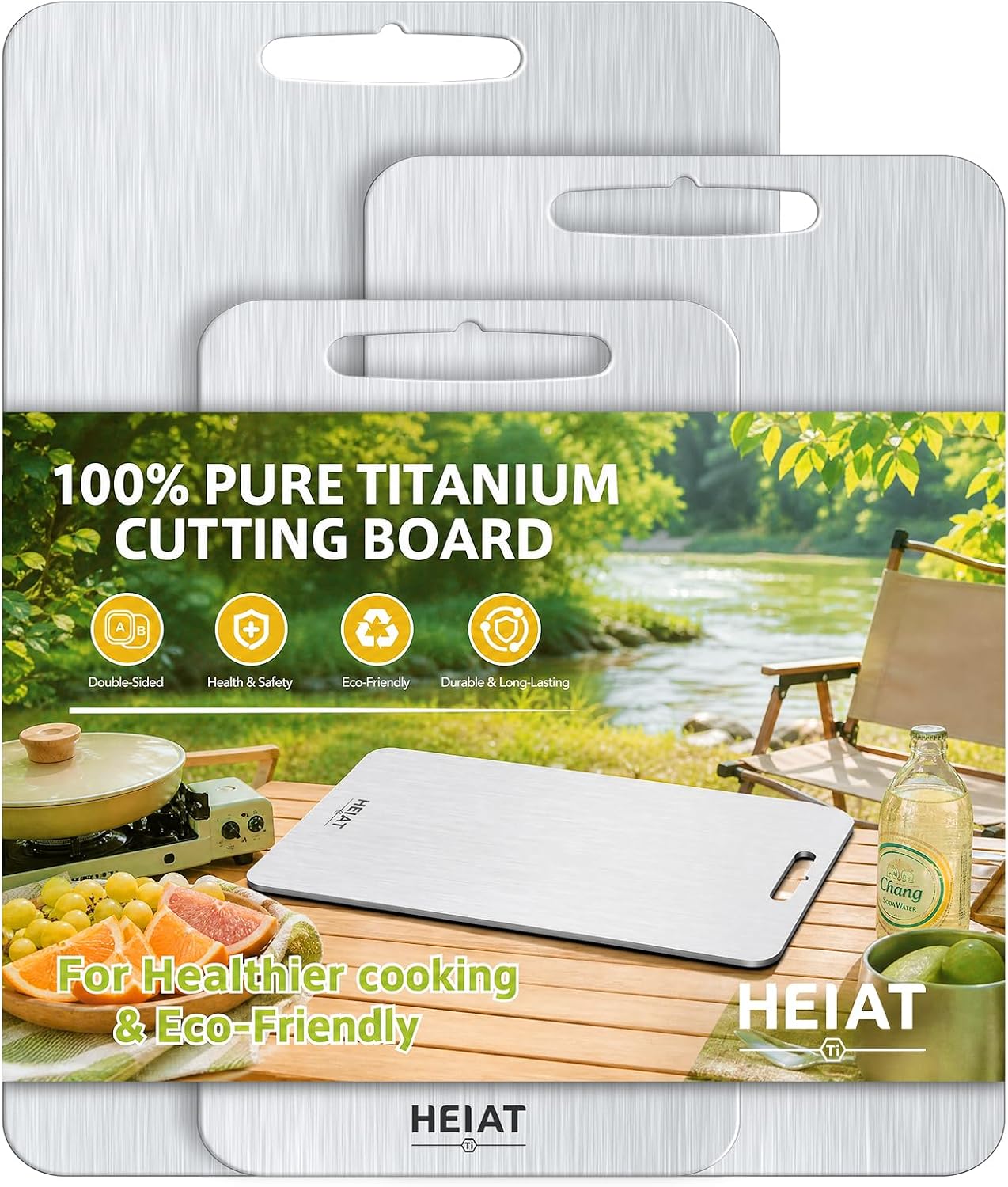
This is a set of three double-sided boards cut from a single piece of pure titanium in roughly 16-, 13-, and 10-inch sizes, selling on Amazon for around $59.99. There are no coatings, no glue, and no bonded seams for bacteria to hide in.
I put the set through a hands-on cooking test, chopping onions, garlic, and raw chicken to see whether the hygiene payoff justifies leaving wood and plastic behind. The short answer? It genuinely delivers on cleanup and durability, but there is one real trade-off with your knives you need to understand before you buy.
What I Liked
After a week of daily use on this titanium cutting board set, a handful of strengths stood out clearly. This is a titanium board that is genuinely easy to clean, and that is where it earns its place on my counter.
Odors and Stains Rinse Off With Just Water
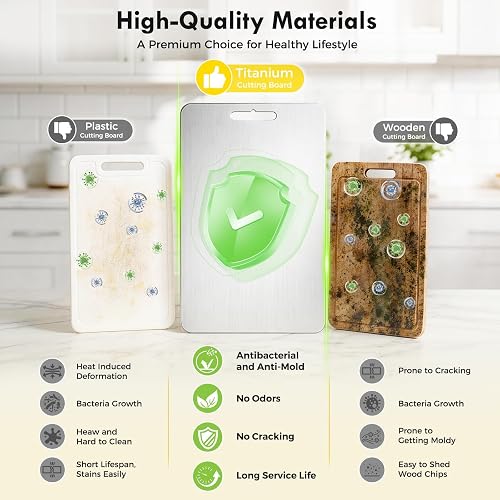
The hygiene story is the reason to buy these, and it holds up. Garlic, onion, and raw fish, the smells that haunt a wooden board for days, rinsed off the titanium with plain water and no soap. Because the titanium surface is non-porous, there is nothing for odor to soak into and nothing that lets a stain set.
That lines up with the Amazon customer reviews, which repeatedly note the titanium doesn’t retain odors or absorb a smell after washing. It is also why the surface resists bacteria: there are no grooves for it to hide in the way a scratched plastic board has. HEIAT markets the boards as antibacterial with a claimed 99.99% blockage of common food-source bacteria, though I’d treat that specific figure as a manufacturer claim rather than a lab result you can verify at home.
Truly Low-Maintenance, Dishwasher-Safe Care
If you are tired of babying a wooden board, this is the payoff. There is no oiling, no hand-washing rule, and no drying ritual; you rinse it or drop it in the dishwasher and walk away. Unlike wooden cutting boards that can crack or warp with that treatment, solid titanium is practically indestructible and shrugs it off.
The boards are also thin enough to slide between plates in the rack, so a full set doesn’t clog your dishwasher the way a bulky block would.
Three Practical Sizes and a Double-Sided Design
The set includes three boards, roughly 16 by 10, 13 by 8, and 10 by 6 inches, which covers most jobs from a quick lemon or piece of fruit up to a full meal prep. Each board is double-sided, so you can keep raw meat like chicken on one face and vegetables on the other, then flip to a clean side when you are cutting meat you have already cooked.
That built-in separation is the kind of cross-contamination protection you normally need two boards for, and here it is in every board in the set. For anyone cooking for a family, having the right size on hand keeps the workflow organized. If you are outfitting a first kitchen or apartment around these boards, the Amorston 22 Piece Knife Set rounds out the prep station with every knife in one purchase. For raw meat separation with no washing at all, the Mind Reader E-Z Board disposable cutting board hands you a fresh sheet for every task instead.

A Thin, Space-Saving Profile That Stays Put
Each board is about a sixteenth of an inch thick, so all three together take up less cabinet space than a single wooden board. Despite that thinness, the roughly two-pound weight and lightly brushed texture kept the board planted on the counter during my test.
Food didn’t skate around the surface the way I expected metal to behave, and the board itself didn’t budge while I was chopping.
A Real Escape From Plastic and Microplastics
If microplastics are the reason you are here, this is one of the most direct swaps you can make, because the cutting board is where a blade meets food every single day. Titanium won’t shed particles like plastic does, and there is no coating to wear off into your cooking.
Combined with the fact that it won’t crack like wood or hold a smell, it is about as low-worry as a prep surface gets.
What Needs Improvement
No board is perfect, and with titanium the biggest issue is baked into the material itself.
It Dulls Knives Faster Than Wood or Plastic
This is the trade-off, and it is a real one. Titanium is far more rigid than wood or plastic, so instead of the surface cushioning your blade, your knife edge absorbs the impact and rolls or dulls faster. Counterintuitively, titanium is softer than hardened knife steel on paper; the real problem is that it gives no cushion, so a kitchen knife edge deforms against it.
Independent testing backs this up. Serious Eats measured a new knife dropping from a sharp 108 to a dull 261 on a sharpness tester after just a handful of cuts, and Prudent Reviews found titanium was the single worst board material for edge retention across everything they tested.
America’s Test Kitchen reached the same conclusion and does not recommend metal boards for this reason. You can manage it by honing more often or rotating in a wood board for delicate work, but if you own high-carbon Japanese knives and prize a razor edge, this surface will frustrate you.
The Metallic Chopping Noise Takes Adjusting
Cutting on solid metal simply sounds different. Every chop lands with a distinct tap or clink instead of the soft thud of wood, and in lab measurements titanium ranked among the loudest surfaces tested. It is not unbearable, and most people adjust within a week, but if you do a lot of rapid mincing or cook in a quiet, open kitchen, the sound is worth knowing about.
The Largest Board Is Heavy and Hard to Lift
The set weighs around two pounds, and while the small and medium boards feel fine, the largest one has real heft. Because it is so thin, it can also be awkward to pick up off a flat counter, and the handle cutout only helps so much. One critical Amazon reviewer flagged the weight directly.
‘Titanium’ Labeling Varies Across the Market
This is a caution about the whole category rather than a defect. Testers at America’s Test Kitchen found several boards sold as titanium were actually stainless steel, and some marketed as medical-grade were nothing of the sort. This listing’s own spec sheet oddly lists a “Stainless Steel” set name alongside its pure-titanium claims.
Any metal cutting board should pass a simple check: titanium is non-magnetic, so a fridge-magnet test on arrival confirms what you actually received.
How It Compares
Titanium is only one option in a crowded field, and where it lands depends on what you value most.
vs End-Grain Wood (Maple and Walnut)
A quality hardwood cutting board, like an end-grain maple or walnut chopping board from Teakhaus or Boos, is the opposite trade-off. Wood fibers compress to cushion the blade, so in the same testing that punished titanium, an end-grain walnut board dulled an identical knife by a tiny fraction as much. The catch is upkeep: wood needs periodic oiling, careful hand-washing, and can still harbor bacteria in deep cuts if you neglect it.
vs Hasegawa Natural Rubber
Natural rubber boards, such as the Hasegawa favored by many chefs, were the quietest and gentlest surface in independent tests while still being easy to sanitize. They give you much of titanium’s low-maintenance hygiene without wrecking your knife edge. They cost more than plastic and lack titanium’s indestructible, dishwasher-proof durability.
vs Plastic and Other Titanium Sets
A good HDPE plastic board is cheap, dishwasher safe, and easy on knives, but it develops grooves and is the exact microplastics source titanium buyers want to escape. Against rival titanium products from brands like Everti or HonTitan, the HEIAT set competes on breadth rather than extras, bundling three double-sided sizes instead of a single board with a juice groove or built-in sharpener.
For hygiene and durability with almost no upkeep, this set is a strong pick. If protecting a fine knife edge is your priority, end-grain wood boards, rubber, or knife-friendly plastic make more sense, and titanium is best kept as a dedicated raw-meat cutting surface. Since a titanium surface is harder on blades, it pairs well with a set you can touch up easily, like the imarku 14-Piece Kitchen Knife Set and its built-in sharpener. A larger budget option in the same vein is the Amorston 21 Piece Knife Set, which packs 21 sharp pieces and a sharpener of its own for everyday chopping.
Final Verdict
The HEIAT Titanium Cutting Board Set of 3 does exactly what titanium is supposed to do in the kitchen: it stays non-porous, rinses clean of odors and stains, survives the dishwasher, and will almost certainly outlast every other board you own.
At 4.4 out of 5, it earns a recommendation with one clear caveat. It loses ground because titanium is genuinely harder on knife edges than wood or plastic, and because the metallic chopping noise and heavy largest board take some getting used to. Those are real trade-offs, not dealbreakers, if hygiene and low maintenance top your list.
Bottom line: If you want to get plastic and microplastics out of your food prep and you are done oiling a wooden board, buy this set and keep a separate wood board around for delicate knife work. If a razor-sharp edge matters more than easy cleanup, look at end-grain wood or rubber instead.
Specifications
| additional_features | Antimicrobial |
| Brand | HEIAT |
| Color | Silver |
| Included Components | no |
| item_dimensions_l_x_w_x_thickness | 16.5"L x 10.5"W x 0.06"Th |
| item_highlight | 3-Piece Multi-Size Set One-Piece Pure Titanium Reversible Double-Sided Design Dishwasher Safe Gift-Ready Packaging |
| Item Weight | 2 pounds |
| manufacture_year | 2026 |
| manufacturer | HEIAT |
| manufacturer_part_number | Heiat-cb-3pk |
| Material | Titanium |
| model_number | Heiat-cb-3pk |
| number_of_items | 1 |
| number_of_packs | 3 |
| pattern | Brushed |
| Product Care Instructions | Dishwasher Safe |
| Recommended Uses For Product | Meat |
| set_name | Heiat Stainless Steel Cutting Board Set |
| Shape | Rectangular |
| size | set of 3 (S+M+L) |
| unit_count | 1 Count |
| warranty_type | Manufacturer Warranty |
| Product Dimensions | 16.5"L x 10.5"W x 0.06"Th |
| Special Feature | Antimicrobial |
Frequently Asked Questions
Is the HEIAT titanium cutting board set worth buying?
It is worth it if hygiene and low maintenance are your priorities. The boards rinse clean of odors and stains, are dishwasher safe, and should last a lifetime. The main reason to pass is that titanium dulls knives faster than wood or plastic.
Do titanium cutting boards dull knives, and is the HEIAT set safe for knives?
Yes, titanium dulls knives faster than wood or plastic because the rigid surface offers no give and rolls the blade edge. It will not chip a knife the way glass or ceramic can, but you will need to hone more often. Reserve delicate high-carbon knives for a wood board.
Are titanium cutting boards more hygienic than wood?
Titanium is non-porous, so liquids, odors, and bacteria have nowhere to soak in, and it cleans up with a quick rinse. Properly maintained wood is also considered safe and is naturally antibacterial. Titanium's edge is that it is far lower maintenance and dishwasher safe.
Do professional chefs use titanium cutting boards?
Most professional chefs do not use titanium as their main board because it dulls knives and slows down prep. Some keep one for allergy or raw-meat work where a fully non-porous surface matters. For everyday chopping, most pros stick with end-grain wood or color-coded plastic.
Is the HEIAT cutting board set really 100% pure titanium?
HEIAT markets the set as one-piece pure titanium with no coatings or bonded layers. Because some boards sold as titanium are actually stainless steel, it is smart to verify on arrival. Titanium is non-magnetic, so a fridge magnet that does not stick is a quick confirmation.
What is the healthiest cutting board to use in the kitchen?
There is no single answer, but non-porous surfaces like titanium and well-maintained hardwood such as maple both rank highly for food safety. Titanium avoids microplastics entirely and needs no oiling. Wood is gentler on knives but requires more upkeep to stay hygienic.
Ready to Buy?
HEIAT Titanium Cutting Board Set of 3 delivers on its promises. If it fits your needs, it's a solid choice you won't regret.
Check Price on Amazon Founder & Product Reviewer at TheReviewRewind
Daniel has tested 400+ products across 20+ categories through hands-on, real-world testing. Every review includes video documentation and standardized scoring criteria. His reviews appear as Amazon shoppable videos and here on TheReviewRewind.
We earn a commission if you make a purchase, at no extra cost to you. This does not influence our ratings or recommendations. Full disclosure
Looking for more options? See all our Home & Kitchen reviews.
Related Reviews