LEGLO 24 Oz Rubber Mallet Hammer Review: Firm Taps Without the Dents


LEGLO 24 Oz Rubber Mallet Hammer Review: Firm Taps Without the Dents
LEGLO 24 Oz Rubber Mallet Hammer
Buy if you tap tile, flooring, pavers, or tent stakes and want 24 oz of force without denting the surface. Skip if you need a non-marring white face for delicate finished work, or a dead blow that will not rebound.
Buy on AmazonWhat We Liked
- The Solid Rubber Head Taps Without Denting Anything
- 24 Ounces Is the Sweet Spot for Seating Heavy Material
- The Steel-Core Handle Will Not Crack Like a Wood Handle
- The Non-Slip Grip Stays Put Through Repetitive Tapping
- Thirteen Inches Fits Tight Spaces and a Pegboard Hook
What Could Be Better
- Black Rubber Can Leave Scuffs That White Rubber Will Not
- It Rebounds Instead of Dampening Like a Dead Blow
- One Rubber Compound Means No Second Face to Switch To
- Rubber Heads Harden and Crack, and Durability Is Unproven
How we test: Every product is used in real conditions and evaluated using our standardized scoring criteria. Read our full review methodology.
Reach for a claw hammer to tap a tile into place and you learn the lesson fast. You dent the wood, crack the tile, or mushroom the top of the tent stake you were trying to drive.
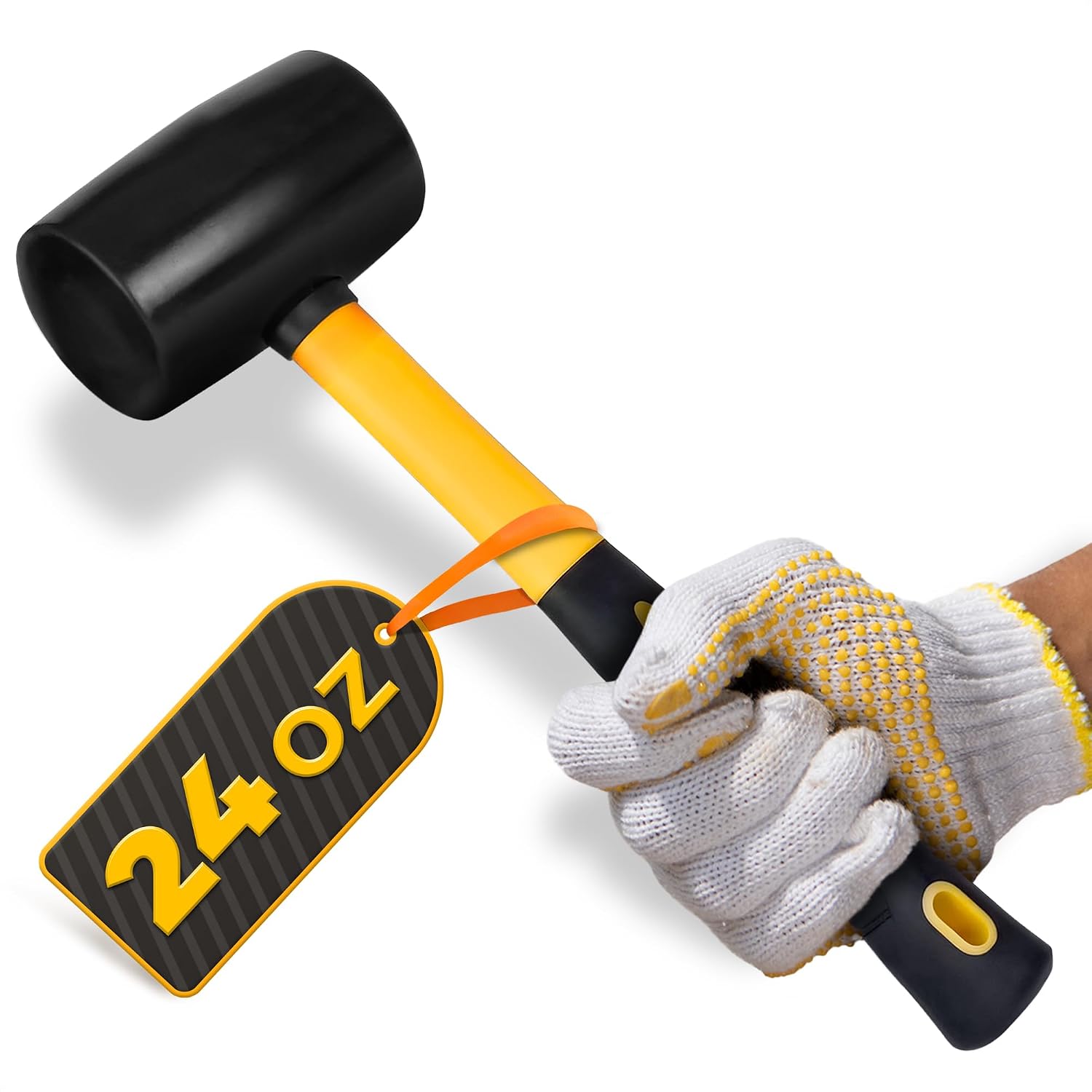
The LEGLO 24 Oz Rubber Mallet Hammer exists to solve that one problem. It is a soft-face hammer built on a solid block of hard rubber with a steel-core handle and a textured non-slip grip, and it lists at $23.99 on Amazon with a 4.5-star average across 229 ratings.
I put this rubber hammer through the jobs it is sold for: woodworking and furniture assembly, flooring panels, tile work, and stakes driven into packed soil. I also read what woodworkers and flooring installers say about black rubber heads before recommending one to anybody.
The short version is that this is a well-balanced mallet at a fair price, with one design choice that will matter more to some buyers than others.
What I Liked
The Solid Rubber Head Taps Without Denting Anything
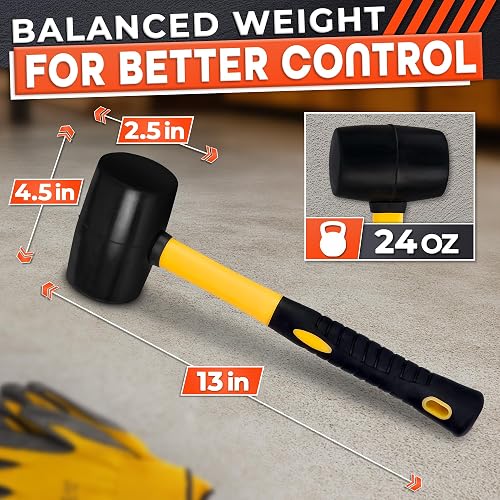
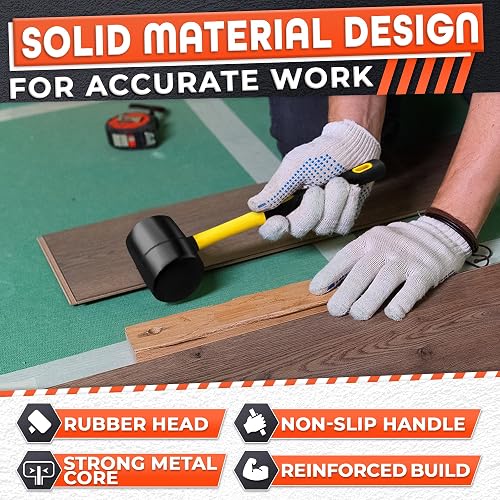
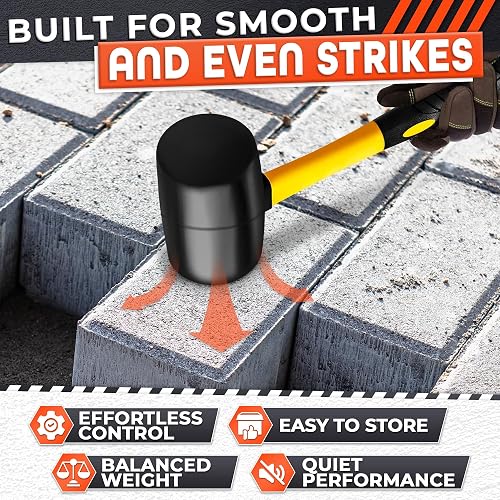
The head is one block of hard rubber, flat on both faces, measuring 4.5 inches long by 2.5 inches across. That broad face spreads the blow instead of concentrating it, so you can seat a tile, close a wood joint, or square up a flooring panel without leaving a mark.
A metal hammer does none of that gently. One Amazon buyer put it plainly: this mallet “protects objects that could mar if hit with a metal headed hammer.”
24 Ounces Is the Sweet Spot for Seating Heavy Material
At 24 oz, or 1.5 pounds on the scale, this sits a step above the 16 oz mallets most toolboxes already hold. The extra mass moves material in fewer swings, which pays off on pavers, large-format porcelain, and solid hardwood flooring.
D and G Flooring’s mallet guide draws the same line: 16 oz is the all-day laminate standard, while “heavier 24-ounce or 32-ounce heads belong with solid 3/4-inch hardwood like white oak or Brazilian cherry.” It still does not feel like a chore to swing, because the weight sits up in the head where it does the work.
The Steel-Core Handle Will Not Crack Like a Wood Handle
This is not a wood handle mallet. LEGLO builds it on a metal core wrapped in rubber and plastic, and that core is what separates it from the cheapest imports on the same search page.
Composite poly handles are the budget norm, and per D and G Flooring they “tend to loosen at the head connection within a year of regular use.” Worth noting: the Amazon spec sheet lists handle material as “Rubber,” which describes the grip rather than the shaft, while the listing’s own highlight and the tool in hand both say steel core. LEGLO makes the same all-metal argument in the kitchen with its stainless steel lemon squeezer, where a pinned steel hinge replaces the plastic joint that usually fails first.
The Non-Slip Grip Stays Put Through Repetitive Tapping
The ergonomic grip is textured rubber over the shaft with a slight swell toward the base. Tapping down a row of tiles or working along a deck, the handle does not twist in your palm.
It also absorbs a fair share of the strike shock instead of sending all of it back into your wrist. On repetitive soft blow tasks, that is the difference between finishing a room and stopping to shake out your hand.
Thirteen Inches Fits Tight Spaces and a Pegboard Hook
Overall length is 13 inches, which is short for a mallet carrying this much head weight. That gets it inside cabinets, under counters, and into a crowded toolbox without a fight.
There is a hanging hole at the base of the handle for a pegboard. One buyer called out the same detail: “This is well made and has a hook at the end of handle so you could hang it as well.”
What Needs Improvement
Black Rubber Can Leave Scuffs That White Rubber Will Not
The head is black rubber, and that is the one specification I would change. Trade forums are consistent about it: “I always use white rubber mallets because they don’t leave black marks on my work,” one LumberJocks poster wrote.
A hardwood flooring installer described the same failure in sharper terms, saying a black mallet “made a couple of ugly scuff marks on the walls that had to be painted over.” On unfinished stock, pavers, and stakes this is a non-issue, but for prefinished flooring or light-colored tile you will want a scrap block between the mallet head and the work.
It Rebounds Instead of Dampening Like a Dead Blow
A solid rubber head bounces. A dead blow hammer, loaded with steel shot or sand, does not, and it drives more of your swing into the workpiece instead of back up the handle.
Home Grail’s comparison states it directly: a rubber mallet “will rebound with a similar force” when you strike hard. In tight quarters that rebound is something you have to control rather than something the tool handles for you.
One Rubber Compound Means No Second Face to Switch To
Both ends of the head are the same hard rubber. Double-faced mallets from Estwing and Faithfull pair a softer face with a firmer one on a single tool, which is genuinely useful when a job moves between delicate trim and a stubborn joint.
Here you get one compound and one answer. It is a reasonable answer for the price, but it is a fixed one.
Rubber Heads Harden and Crack, and Durability Is Unproven
Rubber and urethane heads degrade with age no matter whose name is on them. One Sawmill Creek member’s Bessey mallet lasted close to 20 years before “a large chunk broke off of the head,” and Garage Journal threads are full of premium dead blows that crumbled in storage.
A 4-star Amazon buyer of this LEGLO reported theirs “didn’t last long,” which is one complaint set against a 4.5-star average from 229 ratings. Treat it as a data point rather than a pattern, but understand that a model this new has no long-term durability record yet.
How It Compares
LEGLO vs Estwing DFH-24 Double-Faced Mallet
Estwing’s 24 oz DFH-24 is the name-brand answer at this weight. It runs a genuine hickory handle with triple wedge construction and two striking compounds, one soft and one hard, and Estwing has built its tools in Rockford, Illinois since 1923.
The LEGLO counters with a steel core that will not split or dry out and a shorter 13-inch profile for tight work. Fiberglass handle rivals sit between the two: Tolsen’s 25037 and Faithfull’s combination mallet both pair a fiberglass shaft with a non-marring head, and the Faithfull adds a semi-hard white face for finishing work.
LEGLO vs 16 oz Mallets Like the TEKTON Double-Faced
Most people shopping for a rubber mallet hammer end up at 16 oz. TEKTON’s 16-ounce double-faced model runs about $14 and, per D and G Flooring, “covers 95% of LVP and laminate work without complaint,” with budget Edward Tools rubber mallets sitting in the same bracket on Amazon.
Step up to this LEGLO when you are seating pavers, large-format porcelain, or 3/4-inch hardwood, where a lighter head means more swings for the same result. For everyday laminate and light carpentry, the 16 oz mallet is both the better daily driver and the cheaper buy. Go lighter still and LEGLO’s own small rubber mallet hammer drops to 180 grams with two replaceable faces for jewelry, fret work, and flat-pack assembly.
LEGLO vs a Shot-Filled Dead Blow Hammer
A dead-blow hammer solves the marring problem a different way. It transfers more energy per strike without rebounding, which makes it the stronger pick for stubborn joints, automotive work, and sheet metal or general metalworking.
The trade-off is a harder face and a head that can degrade badly with age. For soft-blow tasks around finished wood and tile, the solid rubber head is the more forgiving tool, and most shops end up owning one of each.
Final Verdict
The LEGLO 24 Oz Rubber Mallet Hammer earns a 4.2 out of 5 from me. It does the one job a rubber mallet exists to do, and it does it with a steel core, a grip that stays put, and a 13-inch length that fits where longer mallets will not.
The black rubber head is the caveat. It will scuff prefinished surfaces that a white face would leave clean, and the head is a single compound with no long-term durability record behind it yet.
At $23.99 against a 4.5-star average from 229 Amazon ratings, it is a sensible amount of money for a tool most toolboxes are missing. If you already own a hammer and keep running into jobs where it is too harsh, this is the softer companion that fills the gap.
Specifications
| brand_name | LEGLO |
| color | Yellow |
| grip_type | Non-slip, Textured |
| handle_material | Rubber |
| head_material | Rubber |
| head_style | Flat |
| included_components | No |
| item_dimensions_l_x_w_x_thickness | 13"L x 4.5"W x 2.5"Th |
| item_highlight | Solid Rubber Head on a Steel-Core Handle for Flooring, Pavers, Landscaping and Furniture Assembly, with Non-Slip Grip |
| item_type_name | Rubber Mallet |
| item_weight | 1.5 pounds |
| manufacturer | LEGLO |
| model_number | RB-24OZ |
| number_of_items | 1 |
| number_of_packs | 1 |
| style_name | 24Oz Mallet |
| unit_count | 1 Count |
Frequently Asked Questions
What is a rubber mallet hammer used for?
A rubber mallet delivers a firm strike without marring the surface it lands on. The common jobs are seating tile, closing wood joints, squaring flooring panels, assembling furniture, setting pavers, and driving tent stakes. LEGLO also markets this one for light automotive work where a steel hammer would damage threads or a finished part.
How is a hammer different from a mallet?
A hammer has a hard steel head built to drive nails, pull fasteners, and strike metal. A mallet has a soft head — rubber, urethane, wood, or rawhide — built to move something without denting it. The two are not interchangeable, and this type of hammer is not for driving nails or demolition.
Is there a difference between white and black rubber mallets?
Yes, and it matters. Most mallet heads are natural rubber or a synthetic blend, and the black compound can leave dark scuff marks on light or prefinished surfaces, which is why many flooring installers and woodworkers insist on white. The soft rubber of a white non-marring face marks less but tends to wear faster in exchange. The LEGLO uses a black rubber head.
What is the best weight for a rubber mallet?
For most people, the best rubber mallet weight is 16 oz. That is the all-day standard for LVP, laminate, and engineered flooring because you can tap quickly without forearm fatigue. A 24 oz mallet head like this one earns its keep on solid 3/4-inch hardwood, dense porcelain tile, and pavers, where a lighter mallet just means more swings.
Can you use a rubber mallet for chiseling?
You can, and many woodworkers do for light paring cuts. A rubber head delivers less impact force than a steel hammer, which helps when you are trying not to cut too deep with a chisel. The drawback is rebound: a solid rubber mallet bounces off the chisel handle, so a wooden joiner's mallet or a dead blow gives you more control on heavy chopping.
Does the LEGLO 24 oz mallet have a wood handle?
No. The handle is a metal core wrapped in a textured rubber grip, so it will not crack, split, or dry out the way a hickory handle can. The Amazon spec sheet lists handle material as "Rubber," which describes the grip rather than the shaft underneath it.
Ready to Buy?
LEGLO 24 Oz Rubber Mallet Hammer delivers on its promises. If it fits your needs, it's a solid choice you won't regret.
Check Price on Amazon Founder & Product Reviewer at TheReviewRewind
Daniel has tested 400+ products across 20+ categories through hands-on, real-world testing. Every review includes video documentation and standardized scoring criteria. His reviews appear as Amazon shoppable videos and here on TheReviewRewind.
We earn a commission if you make a purchase, at no extra cost to you. This does not influence our ratings or recommendations. Full disclosure
Looking for more options? See all our Tools & Home Improvement reviews.
Related Reviews