LEGLO Stainless Steel Lemon Squeezer Review: A Budget Citrus Press With an All-Metal Hinge


LEGLO Stainless Steel Lemon Squeezer Review: A Budget Citrus Press With an All-Metal Hinge
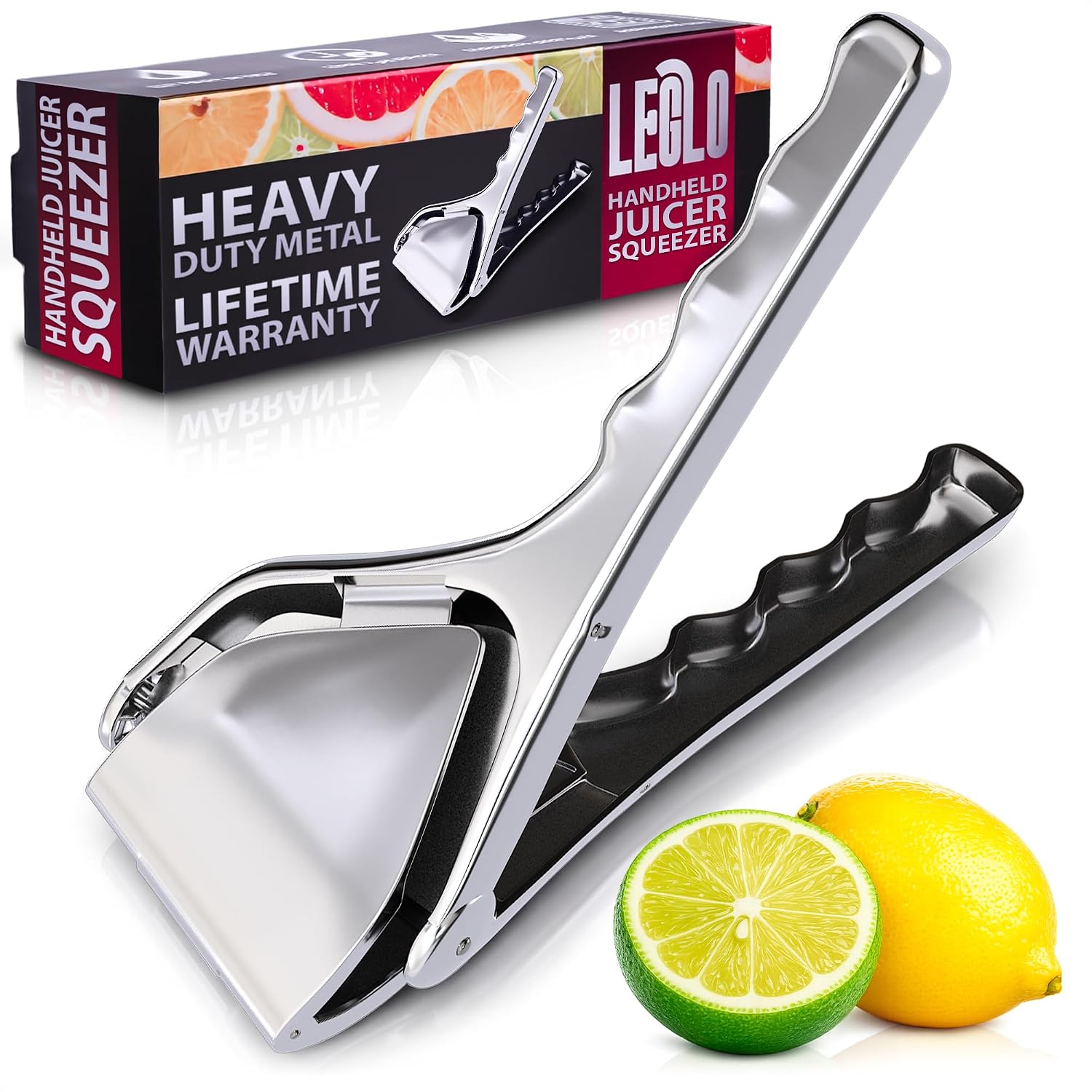
LEGLO Stainless Steel Lemon Squeezer
Buy if you want an all-metal citrus press that folds flat and spares your grip strength for daily lemons, limes, and cocktails. Skip if you juice large navel oranges or grapefruit, or you need one squeezer that handles every fruit size.
Buy on AmazonWhat We Liked
- An All-Metal Hinge That Will Not Snap Under Pressure
- Over A Pound Of Stainless Steel Pressing Power
- Two-Handle Leverage That Spares Your Grip Strength
- The Built-In Seed Catcher Keeps The Juice Clean
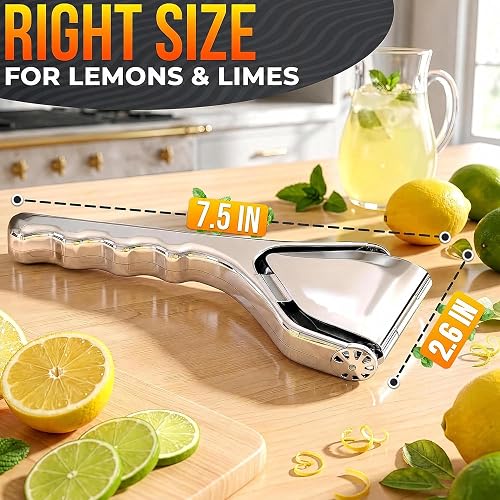
- Folds Flat To 7.5 By 2.6 Inches For Drawer Storage
What Could Be Better
- Big Lemons Need A Second Fold-And-Squeeze Pass
- The Listing Contradicts Itself On Dishwasher Safety
- A Little Juice Escapes From The Sides Under Press
- Too Small For Large Navel Oranges And Grapefruit
How we test: Every product is used in real conditions and evaluated using our standardized scoring criteria. Read our full review methodology.
If you have ever squeezed a lemon by hand, you know how it ends. Seeds in the glass, half the juice still locked in the peel, and citrus on your fingers for the rest of the afternoon.
The LEGLO stainless steel lemon squeezer is a $19.79 answer to that problem, and it takes an unusual route to get there. Instead of the straight up-and-down press most handheld models use, it pivots sideways on two handles, then folds flat to 7.5 by 2.6 inches so it lies down in a drawer. Amazon shoppers have given it 4.5 stars across 165 ratings.
I put it through a full hands-on lemon test to see whether the all-metal build is a genuine advantage or just heft. The short answer: the hinge is the reason to buy this, the seed catcher works better than the listing photos suggest, and there is one contradiction buried in the product page that nobody selling it wants to talk about.
I scored it 4.3 out of 5.
What I Liked
An All-Metal Hinge That Will Not Snap Under Pressure
Every bit of force you apply to a citrus squeezer lands on one place: the hinge. That is exactly where plastic and thin-gauge models fail, and it is the single most common complaint in the whole category.
This one is stainless steel throughout, pins included. I looked closely at the pinned joint on the inside and it does not flex or bend even on large, firm lemons. Cooking forum regulars have been making this argument for years, with one long-time poster choosing an all-metal squeezer over a geared plastic rival because with plastic gears “the operative question is ‘for how long?’” That same question of what a hinge can take runs through every pressing tool, and the Chef’n FreshForce potato ricer answers it with a geared joint that cuts the force your hands have to supply.
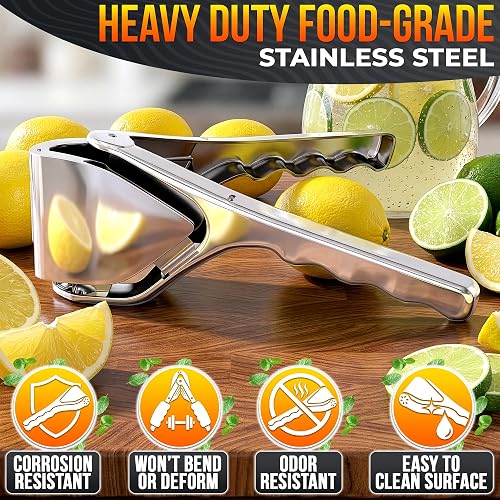
Over A Pound Of Stainless Steel Pressing Power
The squeezer weighs a little over a pound, and that mass does real work. Heavier metal means more force reaches the fruit for the same effort from your hand.
It is also rust resistant, which matters for a tool that lives next to the sink and gets splashed with acidic juice. One Amazon buyer put it plainly: “Very heavy but is excellent for juicing lemons and limes!”
Two-Handle Leverage That Spares Your Grip Strength
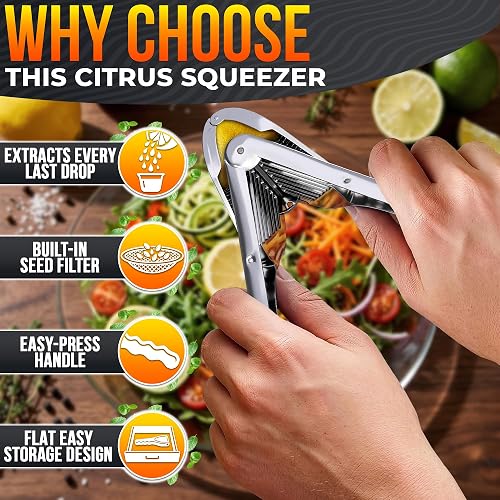
The sideways pivot is what separates this from a standard hinged press. You squeeze two handles toward each other rather than mashing straight down, which recruits your arm instead of your grip.
Scalloped finger slots run along both handles, so your hand settles into the tool instead of clamping around it. Raised ridges inside the cup bite the peel and stop the fruit sliding mid-press, which is a real usability gain if your hands are not strong.
A buyer with rheumatoid arthritis wrote that “it was easy for me to use even with my Rheumatoid Arthritis!!!” — and after using it, that tracks with how little force the press demands.
Serious Eats reached the same conclusion about the category as a whole after testing 13 juicers: hinged handheld models with ridged cups and added leverage “performed the best,” and extra leverage mechanisms “make a juicer easier to operate with less force.”
The Built-In Seed Catcher Keeps The Juice Clean
A small perforated seed catcher sits at the bottom of the cup and acts as a sieve. When I squeezed, the juice ran through and the seeds stayed behind.
My test glass came out with zero seeds in it and a trace of pulp — a few juice vesicles, nothing you would strain out. For a cocktail or a salad dressing, that is the difference between juice you pour and juice you have to fish through with a spoon. Halving the fruit first goes faster with a sharp blade, and the Amorston 22 Piece Knife Set covers that prep for anyone outfitting a first kitchen in one purchase.
Folds Flat To 7.5 By 2.6 Inches For Drawer Storage
Solid metal squeezers usually pay for their durability in drawer space, since the domed cup catches on everything above it. This one collapses flat and measures 7.5 by 2.6 inches folded.
It slides into a shallow utensil tray without jamming the drawer. Reviewers of the all-steel Zulay model flag the opposite problem — it “takes up more room in a kitchen drawer than a simple wooden reamer” — so getting steel and flat storage together is worth something. Knives lose the same battle for drawer room, and the Cutluxe Magnetic Knife Holder settles it by moving your most used blades onto a wall or a fridge door instead.
What Needs Improvement
Big Lemons Need A Second Fold-And-Squeeze Pass
The press flattens most of the fruit, but not all of it. When I pulled my lemon out, the top end was still intact — the cup could not reach it on a single close.
The fix takes two seconds: fold the spent rind over on itself and squeeze again. It works, and it gets you the rest of the juice, but it is a step. A four-star Amazon reviewer docked a star for the same thing, noting it “usually requires two squeezes to get all the juice from a half lemon or lime, folding over the rind between squeezes.”
The Listing Contradicts Itself On Dishwasher Safety
This one is worth flagging carefully. The Amazon title and bullet points say the squeezer is dishwasher safe. Amazon’s structured product-care field on the same page says “No Dishwasher Safe,” and the listing’s own item highlight reads “Hand Wash and Towel Dry.”
The manufacturer’s gallery panels dodge the question entirely and claim only an “easy to clean surface.” Three fields on one product page disagree about whether the thing is dishwasher-safe, so until the seller resolves it, rinse it under the tap and towel it dry. That takes about as long as loading the dishwasher anyway, and Consumer Reports notes that material makeup is exactly why some squeezers need handwashing while others do not.
A Little Juice Escapes From The Sides Under Press
Because the two halves close on a lateral pivot, the cup is not fully sealed at the edges. A small amount of juice does escape sideways during the squeeze.
It was minor in my testing and did not make a mess, but it is real, and it is a known weak point for this design. Serious Eats tested a folding model that “sent juice spraying everywhere,” and Consumer Reports repeatedly found juice that “would often spurt out from the sides.” Squeeze over a wide glass or a measuring cup rather than a narrow shaker and you will not notice it.
Too Small For Large Navel Oranges And Grapefruit
The cup is sized for lemons and limes, and the listing’s own recommended-use field lists only those two fruits. A small orange will go in if you quarter it. A large navel orange or a grapefruit will not.
This is a limit of the whole handheld class rather than a flaw unique to LEGLO. Forcing oversized fruit into any press of this size leaves juice behind and strains the hinge, so if orange juice by the pitcher is your goal, you want a countertop press or an electric machine instead.
How It Compares to Other Manual Citrus Juicers
The benchmark here is the Chef’n FreshForce, and it earns that spot — Serious Eats, Wirecutter, and America’s Test Kitchen all make it their top pick among handheld citrus squeezers. Its dual-gear hinge multiplies your grip better than any single-pin design, LEGLO’s included.
The trade-off is material: the FreshForce body is nylon, and its gear teeth trap pulp and fiber that a rinse alone will not clear. At roughly $17 to $25, it is priced right next to this one.
The closest all-steel rival is the Zulay Kitchen stainless squeezer at about $24.99 in 18/8 steel. It is the better comparison on durability and the worse one on storage, since its fixed handles hog drawer space. LEGLO undercuts it at $19.79 and folds flat, which is the whole pitch.
Two products share this exact fold-flat sideways-pivot concept: the iStarcas fold-flat squeezer and the Dreamfarm Lemon Fluicer. Both collapse to about 1.18 inches, and both are built from nylon or plastic with steel only at the pressing surfaces.
A reviewer squeezing citrus that was hard and unripe in the iStarcas saw “significant bending in the handles” and concluded it “lacks the indestructible feel of solid metal.” That is the gap LEGLO fills — same folding trick, metal throughout.
Further down the tested field, the value case sharpens. America’s Test Kitchen found the KitchenAid citrus squeezer too lightweight to flatten a citrus half properly, and rejected the OXO Good Grips citrus squeezer because “the short arms didn’t provide as much leverage as longer-handled models.” Long handles and real mass are what LEGLO brings, and they are why its ease of use holds up across a dozen fruits rather than two.
Two categories sit outside this comparison. A countertop citrus press handles every fruit size but claims permanent counter space, and an electric citrus juicer — a Black+Decker model, say — wins on juice yield and speed at volume while adding a machine you have to clean. Neither is worth it for one lemon.
One last thing if you are weighing the best citrus reamer instead of a press: presses win on both counts. America’s Test Kitchen clocked the fastest press through 10 lemons in under three minutes, while the slowest reamer took an agonizing nine minutes for 10 limes. Pressing also forces oils out of the peel, which testers link to a more fragrant taste in the juice.
Final Verdict
At $19.79, the LEGLO earns its place in the drawer. The all-metal hinge answers the one failure that kills every cheap squeezer, the seed catcher delivered juice with no seeds and barely a trace of pulp in my test, and it takes so little force that grip strength stops being the limiting factor.
It is not flawless. Large lemons want a second fold-and-squeeze pass, a little juice escapes the sides, and the product page cannot decide whether the thing is dishwasher safe. None of those are dealbreakers, but the care-instruction contradiction is the seller’s to fix.
If you juice lemons and limes and want a tool that outlives the plastic one it replaces, this is a straightforward buy at 4.3 out of 5. The seller backs it with a lifetime guarantee, which is easy to offer when the hinge is the part you built the tool around.
Specifications
| blade_material | Stainless Steel |
| brand_name | LEGLO |
| color | Silver Small |
| finish_type | Polished |
| item_dimensions_d_x_w_x_h | 7.5"D x 2.6"W x 0.95"H |
| item_highlight | Stainless Steel Citrus Press for Limes, Cocktails and Marinades; Folds Flat to 7.5" x 2.6", Hand Wash and Towel Dry |
| manufacturer | LEGLO |
| material | Stainless Steel |
| model_name | Lemon Squeezer |
| model_number | A112 |
| number_of_items | 1 |
| part_number | A112 |
| power_source | Manual |
| product_care_instructions | No Dishwasher Safe |
| recommended_uses_for_product | Lemon, Lime |
| unit_count | 1 Count |
Frequently Asked Questions
Is stainless steel good for a lemon squeezer?
It is the best of the common options. Every squeezer concentrates your entire pressing force onto one hinge, and that is where plastic and thin cast models crack. Stainless steel also resists the citric acid that pits bare aluminum and flakes enamel coatings over time, so it can live next to the sink without corroding. The catch is that thickness matters as much as the material — budget presses advertised as stainless can still be thin enough to bend on the first lime, so look for real weight. This LEGLO comes in at just over a pound with steel pins in the hinge.
What is the best material for a lemon squeezer?
Solid stainless steel for longevity, with two honest alternatives. Enamel-coated aluminum, like the classic Mexican Elbow bar squeezer, is cheap and fast but the enamel chips with use and exposes aluminum that discolors under acid. Reinforced nylon, used by the Chef'n FreshForce, survives dishwashers well and allows a geared hinge, but it is the material most likely to crack under a hard press. If you want the best lemon squeezer you will not have to replace in a decade, buy metal and check the gauge.
Are lemon and lime squeezers the same?
They work identically, but they are sized differently, and that matters more than most buyers expect. A lime-sized cup cannot fully close on a large lemon, which leaves juice in the rind and strains the hinge. A lemon-sized cup handles limes without trouble, since a smaller fruit simply sits in a larger bowl with room to spare. If you are only buying one, buy the lemon size. This LEGLO's 7.5 by 2.6 inch body covers both lemons and limes.
Will it fit large lemons and oranges?
Lemons and limes, yes. Large citrus, no. The cup is built for the two fruits in the listing's recommended-use field, and a small orange only works if you quarter it first. Large navel oranges and grapefruit will not fit, and forcing them in is how you leave juice behind and put unnecessary stress on the hinge. For orange juice in any real quantity, a countertop press or an electric juicer is the right tool.
How much juice does it actually get out?
Most of it on the first press, and the rest on a quick second one. In my test the lemon came out visibly crushed with the juice running clean into the glass, using far less force than I expected. The top end of the fruit stayed intact, though, so a full extraction means folding the spent rind over and squeezing once more. An Amazon reviewer independently described the same two-pass routine, so treat it as how the tool works rather than a defect.
How can I juice citrus without a juicer?
Roll the fruit firmly on the counter first to break down the internal membranes, then cut it in half and squeeze by hand over a sieve to catch the seeds. It works, and it costs nothing. It is also slower, messier, and leaves noticeably more juice in the peel — America's Test Kitchen measured the fastest press through 10 lemons in under three minutes, which is not a pace hand-squeezing matches. A press mainly buys you speed, cleaner juice, and hands that are not sore afterward.
Ready to Buy?
LEGLO Stainless Steel Lemon Squeezer delivers on its promises. If it fits your needs, it's a solid choice you won't regret.
Check Price on Amazon Founder & Product Reviewer at TheReviewRewind
Daniel has tested 400+ products across 20+ categories through hands-on, real-world testing. Every review includes video documentation and standardized scoring criteria. His reviews appear as Amazon shoppable videos and here on TheReviewRewind.
We earn a commission if you make a purchase, at no extra cost to you. This does not influence our ratings or recommendations. Full disclosure
Looking for more options? See all our Home & Kitchen reviews.
Related Reviews