PGID Smart Body Composition Scale Review: 8-Electrode Body Pod Tested


PGID Smart Body Composition Scale Review: 8-Electrode Body Pod Tested
PGID Smart Body Composition Scale
Buy if you want limb-by-limb body composition tracking, offline daily readings, and profiles for up to 24 users. Skip if you only need your weight or can't reach the handle while standing.
Buy on AmazonWhat We Liked
- Eight Electrodes Measure Your Whole Body, Not Just Your Legs
- Limb-by-Limb Breakdown Shows Exactly Where You Change
- Offline Mode Gives You Five Key Numbers Without Your Phone
- The Bright Color Handle Display Is Easy to Read at a Glance
- 24 User Profiles With Automatic Person Recognition
- Solid 6mm Tempered Glass Build With a Tucking Handle
- The FitDays App Explains Every Metric and Charts Your Trends
What Could Be Better
- Full Body Measurements Take 20 to 30 Seconds of Standing Still
- BIA Readings Track Trends Better Than Absolute Body Fat Numbers
- The Full Experience Really Depends on the Companion App
- Not Suitable for Pacemaker Users or During Pregnancy
How we test: Every product is used in real conditions and evaluated using our standardized scoring criteria. Read our full review methodology.
A regular bathroom scale gives you one number and nothing else. You step on, you see your body weight, and you have no idea whether that number is muscle, fat, or water. If you are actually working on a fitness goal, that single figure just isn’t telling you enough.
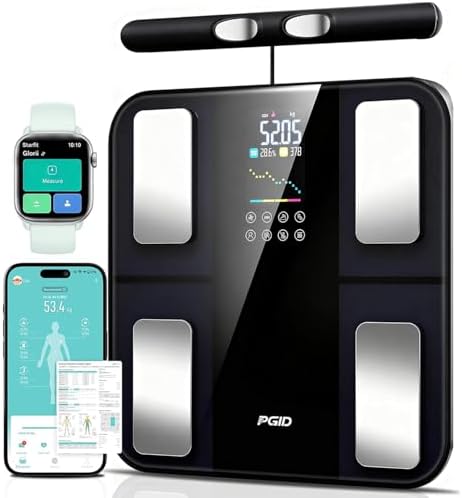
The PGID Body Pod Scale sets out to fix that. Its full Amazon listing is a mouthful: the PGID Smart Scale for Body Weight, 8-Electrode Digital Bathroom Scale for Fat BMI Muscle Mass BIA Full Body Composition Analyzer 28 Measurements. In plain English, it is a body composition analyzer that reads far more than your total body weight.
Instead of guessing at your upper body like a foot-only smart scale, it runs a reading through your arms, trunk, and legs. It tracks 28 metrics, including BMI (body mass index) and fat mass, for around $99.99. Among scales for body weight, that puts it a real step above plain digital scales.
I ran multiple weigh-ins both on and off the FitDays app to stress-test its syncing and accuracy. This is a first-person write-up of my hands-on video review for The Review Rewind, so everything here comes from actually living with the scale.
The short version? For anyone who wants real body composition data at home, this body fat scale delivers far more than a plain weight scale, with only a couple of caveats worth knowing before you buy.
What I Liked
Across my weigh-ins, the PGID Body Pod scale earned its keep in several specific ways. Here is what stood out.
Eight Electrodes Measure Your Whole Body, Not Just Your Legs
This is an 8-electrode body composition scale, with four electrodes on the platform and four more on the retractable handle. That matters because a basic smart scale only has sensors under your feet, so the electrical signal passes through your lower body and then estimates your upper body from averages.
Because you also hold the handle, the current travels through your arms, trunk, and legs. PGID pairs that with dual-frequency BIA at 20kHz and 100kHz, which is meant to sharpen the impedance readings across all five body segments. For a home body composition scale, that is a genuinely more complete measurement than the foot-only crowd.
Limb-by-Limb Breakdown Shows Exactly Where You Change
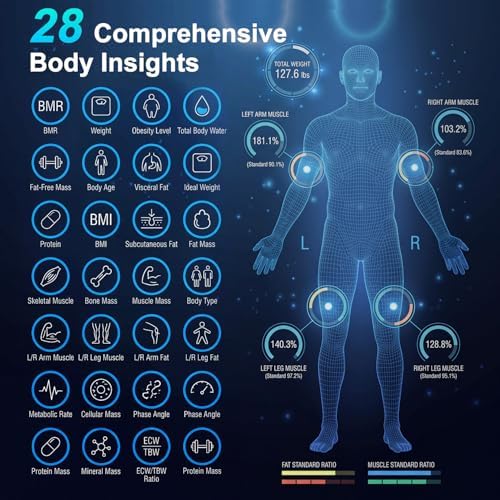
The payoff of that setup is a per-limb readout. You see your left arm, right arm, left leg, right leg, and trunk separately rather than one blended body fat number.
If you are training and want to know where you are gaining muscle or losing fat, this shows you exactly where the changes are happening. That is the kind of body fat measurement a plain weight scale simply cannot give you.
Offline Mode Gives You Five Key Numbers Without Your Phone
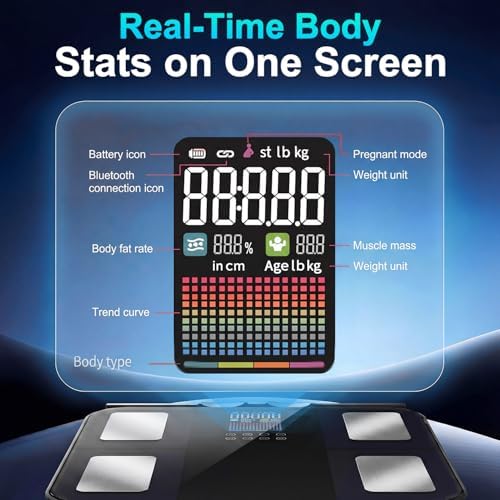
My favorite everyday feature is that you do not have to open the app or connect Bluetooth to get a reading. You step on barefoot, grab the handles, and the display shows five key metrics: weight, BMI, body fat percentage, muscle mass, and body water.
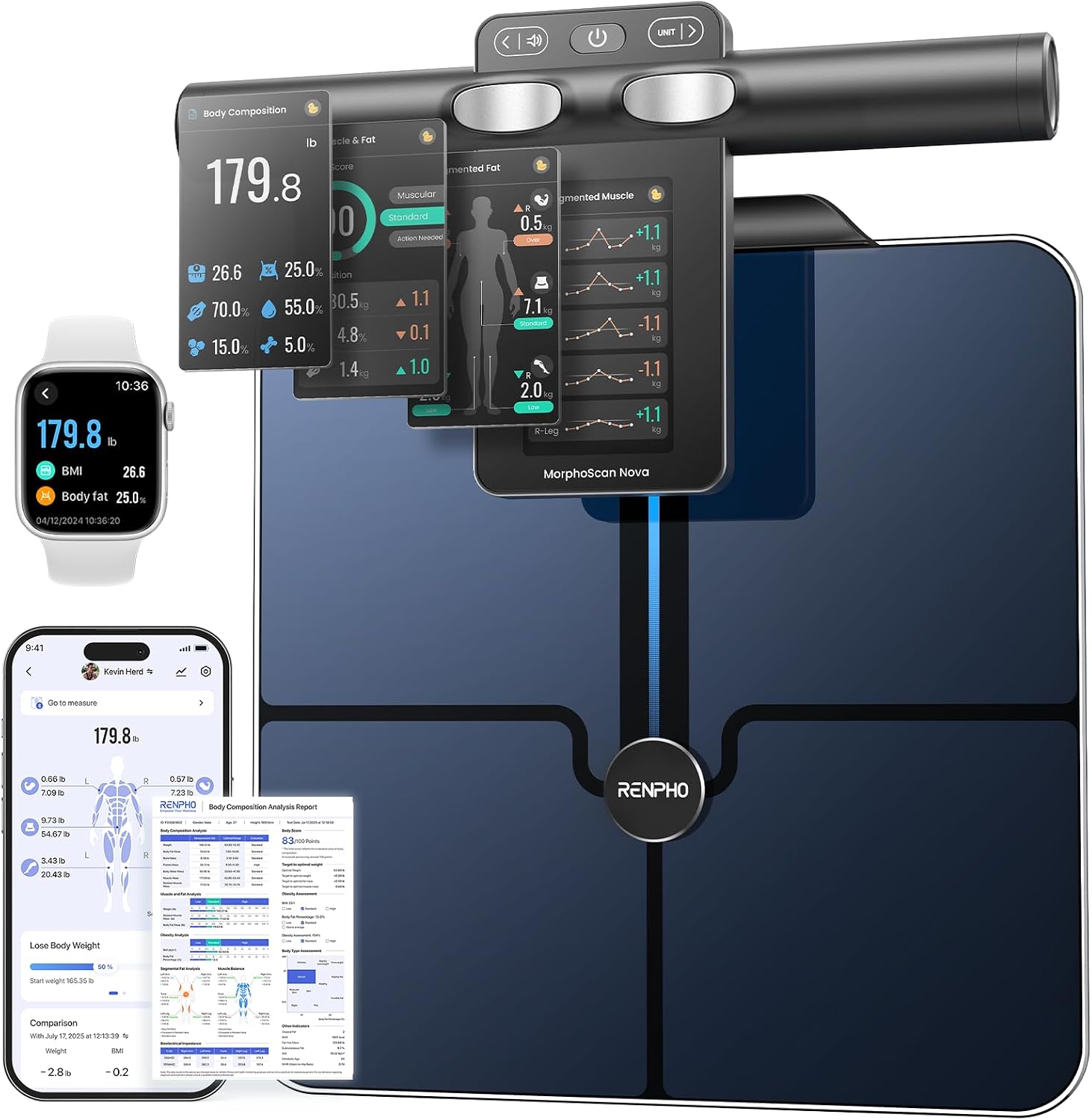
It cycles through two screens, briefly showing your age and height before the results. Later, when you do open the app, it syncs every past measurement automatically. For a quick morning check-in, stepping on and going is exactly what I want. If you like reading stats on the scale itself and want an even bigger screen, the RENPHO MorphoScan Nova Smart Scale takes a similar handle display approach and adds unlimited user profiles. Shoppers weighing that offline convenience against broader app support may also consider the GE Body Pod Smart Scale, which pushes body composition data into Apple Health and Fitbit but leans more on its companion app.
The Bright Color Handle Display Is Easy to Read at a Glance
The full-color handle display is built right into the platform, and it is bright enough that you do not squint or reach for your phone. You just look down and read your weight and body data at a glance.
That sounds minor, but plenty of a smart scale hides everything behind an app. Having the core data on the scale itself makes the PGID far more usable day to day. If you like that at-a-glance readout, the Arboleaf Smart Scale with Handle Display takes the same approach with a bright LED that shows seven core metrics the moment you step off.
24 User Profiles With Automatic Person Recognition
The scale supports up to 24 individual users, and each person gets their own goals and tracking history. More impressively, it recognizes who stepped on and routes the data to the right profile automatically.
With most smart scales, a second person stepping on scrambles your data. Being able to intelligently assign each reading to the correct user is a real advantage for a whole household.
Solid 6mm Tempered Glass Build With a Tucking Handle
The build quality is solid and does not feel cheap or wobbly. It uses 6mm tempered glass with an ITO coating, which is why you do not see traditional metal electrode pads; the whole surface acts as the sensor.
Four AA batteries are included, and PGID rates the battery life at up to 130 days. The handle tucks neatly back into the body of the scale, keeping a slim profile that looks fine in a bathroom.
The FitDays App Explains Every Metric and Charts Your Trends
The FitDays app is where the data comes alive, and it is refreshingly simple to use. Each metric includes a plain-language explanation with low, standard, and high ranges, plus links out to references if you want to dig deeper.
One thing that surprised me: it logs more metrics in the app than PGID even advertises, with roughly 14 extra measurements beyond the on-scale five. The charts, per-user switching, and exportable reports turn all that body composition data into trends you can actually follow.
What Needs Improvement
No scale is perfect, and there are a few things to weigh before you buy.
Full Body Measurements Take 20 to 30 Seconds of Standing Still
A full body composition reading takes about 20 to 30 seconds while you stand there holding the handle. It is not long, but you do have to stay put with your arms at a 45-degree angle the whole time.
If you are rushing out the door, that is something to keep in mind. To be fair, this is the same trade-off you get with most handle-style smart scales.
BIA Readings Track Trends Better Than Absolute Body Fat Numbers
This is a bioelectrical impedance scale, and BIA has real limits worth understanding. Experts note that consumer body fat scales typically run within roughly 3 to 8 percent of a DEXA scan, and readings shift with hydration, time of day, and recent meals.
Owners of similar 8-electrode scales report the same thing: the numbers are best used as trends, not gospel. One reviewer of a comparable body pod said their readings swung from 8 to 10.7 percent body fat inside a single 12-hour window. Treat the PGID the same way and track the direction over weeks rather than fixating on any one figure.
The Full Experience Really Depends on the Companion App
The on-scale display shows only five key metrics, so the deeper picture lives in the FitDays app. If you never sync, you are leaving most of the 28 measurements on the table.
The app itself is simple and syncing was quick for me. Just know that the full body composition data, charts, and reports all assume you will pair your phone at least occasionally.
Not Suitable for Pacemaker Users or During Pregnancy
Like all BIA scales, this one sends a small current through your body, so PGID notes it is not for pacemaker users and not recommended during pregnancy. There is a pregnancy mode in the app, but that is for tracking weight rather than a green light to run impedance readings.
This is a category-wide safety limitation rather than a PGID-specific flaw. Still, it is important enough that I would not want anyone to miss it.
How It Compares
The 8-electrode smart scale category has a few notable players, so here is where the PGID Body Pod lands against them.
vs RENPHO MorphoScan Nova
The RENPHO MorphoScan Nova is the closest match in spirit: it also puts electrodes and a display on a handlebar and tracks a long list of metrics at a glance. On price they are in the same neighborhood, with the MorphoScan typically selling around $140 to $180 versus the PGID’s roughly $100.
Both give you handle-based, whole-body readings rather than foot-only estimates. If brand familiarity and app polish matter most, RENPHO is a safe pick; if you want the same handle-style approach for less money, the PGID is the value play.
vs Withings Body Scan
The Withings Body Scan is the premium option, and it does more than body composition. It adds a multi-lead ECG and segmental analysis through its handle, but it typically costs around $400, roughly four times the PGID.
If you specifically want heart and nerve-health insights baked into your scale, Withings justifies its price. For pure body composition tracking, the PGID covers the core job (weight, BMI, body fat, muscle, visceral fat, and bone mass) for a fraction of the cost.
vs Basic 4-Electrode Scales (and the Garmin Index S2)
Then there are the cheap foot-only smart scales, from $20 sub-brands up to the Garmin Index S2. They read weight accurately, but with only four electrodes under your feet, the fat estimate for your upper body is largely an average.
Independent testing suggests 8-electrode scales narrow the error margin against DEXA scans compared with 4-electrode models. If you only care about weight and total body weight trends, a basic scale is fine and cheaper. If you want the per-limb detail, the PGID’s extra electrodes are the whole point. When the muscle numbers motivate you to fuel your training properly, a clean option like BioSteel Whey Protein delivers 24 grams of NSF certified protein per scoop. And for active people whose workouts leave their toes cramped from snug training shoes, the Hyggear Bunion Corrector offers gentle silicone toe spacing that fits inside regular footwear.
Final Verdict
The PGID Body Pod is a smart scale that does the one thing a plain weight scale cannot: it tells you what your weight is actually made of. The 8-electrode design, per-limb breakdown, offline readings, and 24-user recognition add up to a genuinely useful home body composition scale.
I am giving it a 4.2 out of 5.
It loses a little for the 20-to-30-second measurement and the usual BIA accuracy limits, but those apply to the whole category, and the value here is strong at around $100. As a body fat scale for everyday tracking, it punches above its price.
Bottom line: if you want more than a number and will use the FitDays app to follow your trends, the PGID Body Pod is an easy recommendation.
Specifications
| Brand | PGID |
| Model | FG2421LB |
| Special Features | Basal Metabolic Rate, Bodyweight, Calorie Consumption, High Weight Capacity |
| Display Type | LED color screen (handle display) |
| Weight Capacity Maximum | 400 Pounds (180 kg) |
| Form Factor | Handheld retractable handle with 8 electrodes |
| Readout Accuracy | 0.1g |
| Measurement Type | Dual-frequency BIA (20KHz/100KHz) |
| Metrics Tracked | 28 body composition metrics |
| Users Supported | 24 users with auto-recognition |
| Material Type | Tempered glass |
| Color | Black |
| Battery Life | Up to 130 days |
Frequently Asked Questions
How accurate is the PGID Body Pod smart scale?
It weighs accurately, but like all BIA body fat scales its composition readings are best treated as trends rather than exact figures. Consumer scales generally run within about 3 to 8 percent of a DEXA scan and shift with hydration and time of day. The 8-electrode, dual-frequency design narrows that gap compared with foot-only scales, but it is not a clinical DEXA replacement.
What does the PGID body composition scale measure?
It advertises 28 body composition measurements. On the scale display you see five key ones: weight, BMI, body fat percentage, muscle mass, and body water. The FitDays app adds many more, including skeletal muscle, bone mass, protein, and visceral fat, and I found it logs even more than PGID lists.
Can multiple users track their data on the PGID scale?
Yes. The PGID Body Pod supports up to 24 users, each with their own profile, goals, and history. It recognizes who steps on and routes the reading to the correct profile automatically, which makes it well suited to families.
Does the PGID smart scale work without a phone?
Yes. You can step on and read five key metrics right on the bright color display with no phone or Bluetooth connection. When you next open the FitDays app, it syncs your past measurements automatically, and the app can pass data along to Apple Health.
How much weight can the PGID Body Pod scale hold?
The scale supports up to 400 lb (180 kg). It runs on four AA batteries, which are included, with a rated battery life of up to 130 days.
Is the PGID body fat scale worth it?
For around $100, yes, if you want real body composition data instead of just a weight number. You get 8-electrode limb-by-limb readings, offline daily weigh-ins, and 24-user support. If you only care about your body weight, a basic digital scale is cheaper and enough.
Ready to Buy?
PGID Smart Body Composition Scale delivers on its promises. If it fits your needs, it's a solid choice you won't regret.
Check Price on Amazon Founder & Product Reviewer at TheReviewRewind
Daniel has tested 400+ products across 20+ categories through hands-on, real-world testing. Every review includes video documentation and standardized scoring criteria. His reviews appear as Amazon shoppable videos and here on TheReviewRewind.
We earn a commission if you make a purchase, at no extra cost to you. This does not influence our ratings or recommendations. Full disclosure
Looking for more options? See all our Health & Household reviews.
Related Reviews