Puroth Red Light Therapy Lamp Review: Big Panel, Honest Limits

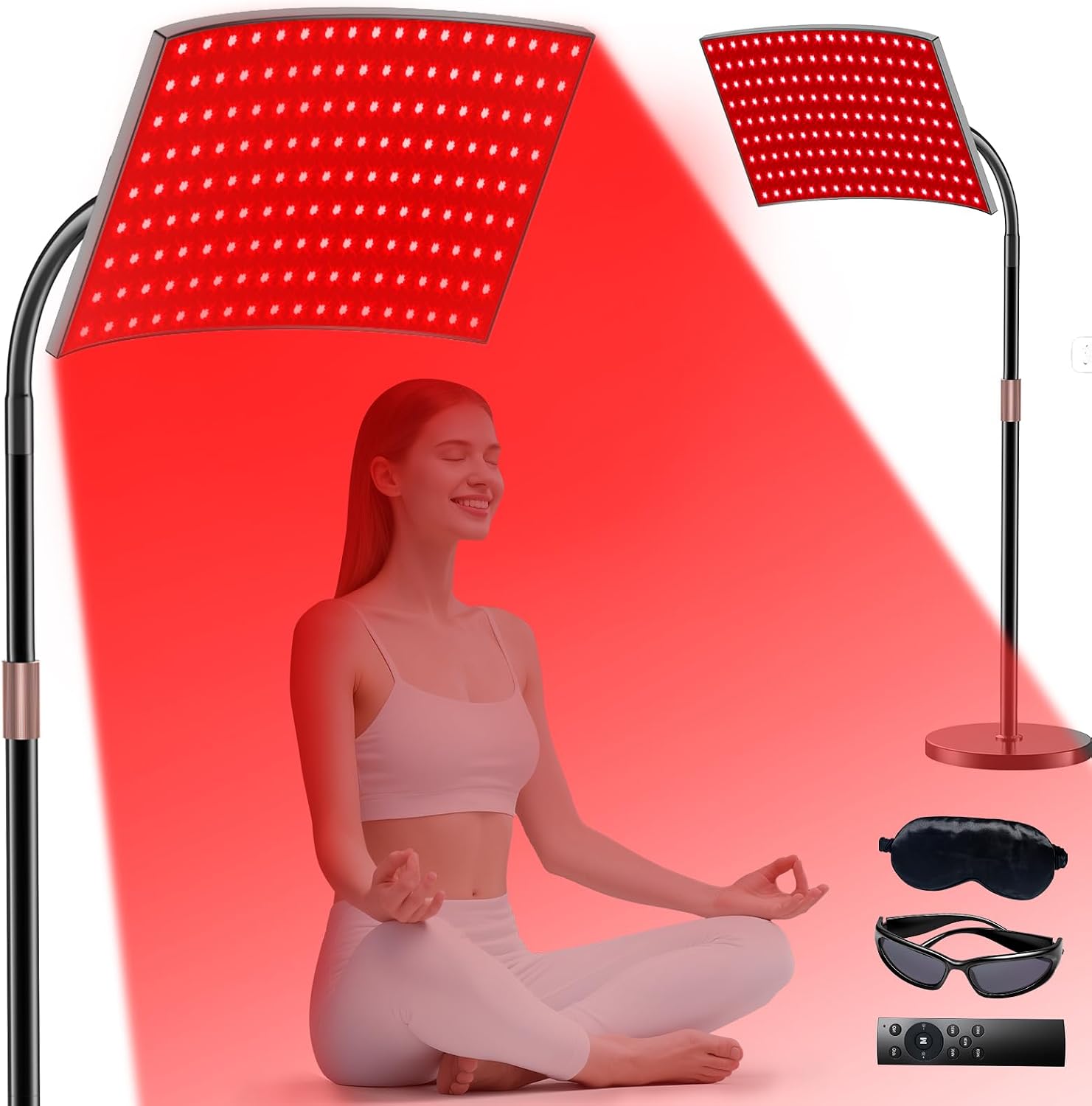

Puroth Red Light Therapy Lamp Review: Big Panel, Honest Limits
Puroth Red Light Therapy Lamp
Buy if you want an affordable, flexible 660nm and 850nm panel with a large 11 x 14.5-in head, a 45-60 in stand, a bendable gooseneck, a timer, and goggles for face and recovery use. Skip if you need published, measured irradiance, true full-body coverage, or a premium build.
Buy on AmazonWhat We Liked
- Genuine 660nm Red And 850nm Near-Infrared Output
- Large 11 x 14.5-Inch Panel Covers A Real Area
- Flexible Gooseneck And 45-60 Inch Adjustable Stand
- Heavy Weighted Base Keeps The Panel Planted
- Five Levels, Preset Timer, And Two Remotes Included
What Could Be Better
- No Published Or Measured Irradiance To Verify Dose
- Treats One Area At A Time, Not True Full-Body
- Twenty-Minute Minimum Timer And AAA Batteries Not Included
- Plastic Housing And No Independent Lab Data
How we test: Every product is used in real conditions and evaluated using our standardized scoring criteria. Read our full review methodology.
Red light therapy used to mean booking a spa or recovery-clinic session and paying every single time you wanted to sit under the light. A stand-mounted home panel is the obvious shortcut, and the Puroth Red Light Therapy Lamp is one of the cheaper ways to try it. It pairs 660nm red and 850nm near-infrared light in a large 11 x 14.5-inch panel on an adjustable floor stand for around $59, so you can do red light therapy at home instead of paying for sessions.
I went through it the way most buyers actually use one: a flexible panel you aim at your face for skin care and at sore muscles after a workout. The Puroth delivers genuine dual-wavelength output, a bigger-than-usual panel, and a reassuringly heavy stand. It also carries the caveats every budget LED panel does — no published irradiance, a 20-minute minimum timer, and results that only show up with consistent use over weeks.
It holds a 4.5-star average across 244 Amazon ratings, which lines up with my own take. Here is what the Puroth Red Light Therapy Lamp gets right, where it falls short, and who should actually buy it.
Genuine 660nm Red And 850nm Near-Infrared Output
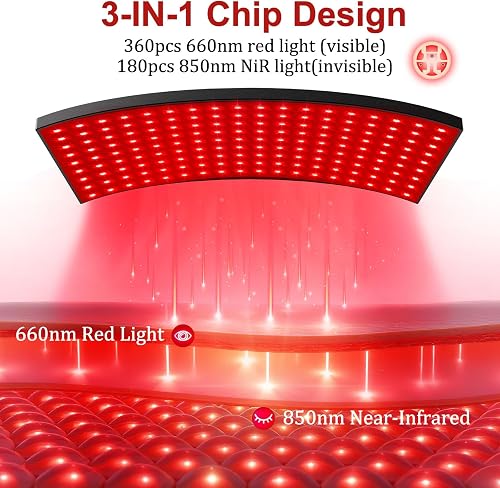
The core of any red light therapy panel is the light itself, and the Puroth runs both wavelengths that matter. Each of its 180 light-emitting diodes carries two 660nm red chips plus one 850nm near-infrared chip, for 540 chips in total — 360 visible red for the skin surface and 180 near-infrared where the light penetrates deeper into muscle and joint tissue. Puroth calls it a “3-in-1 chip,” which simply means three emitters per lens rather than a third wavelength.
Both wavelengths fire together, so a single session covers skin care and recovery at once. That 660nm-plus-850nm combination is the same core mix used in panels that cost several times more, which is the real appeal of a budget unit like this. The near-infrared side is the one the video reviewer leaned on after training five to six days a week, and he credited consistent use for taking the edge off sore spots.
The claimed benefits of red light therapy map to those two wavelengths. Red at 660nm is tied to photorejuvenation of the skin surface — collagen support, fine-line and wrinkle softening, and a more even tone — while 850nm near infrared is used for muscle recovery, inflammation, pain management, and tissue healing by nudging cellular energy production in the mitochondria. In short, infrared light therapy targets what red light alone cannot reach. The evidence here is real but modest, so think of the Puroth as a tool for gradual skin and recovery gains rather than a cure.
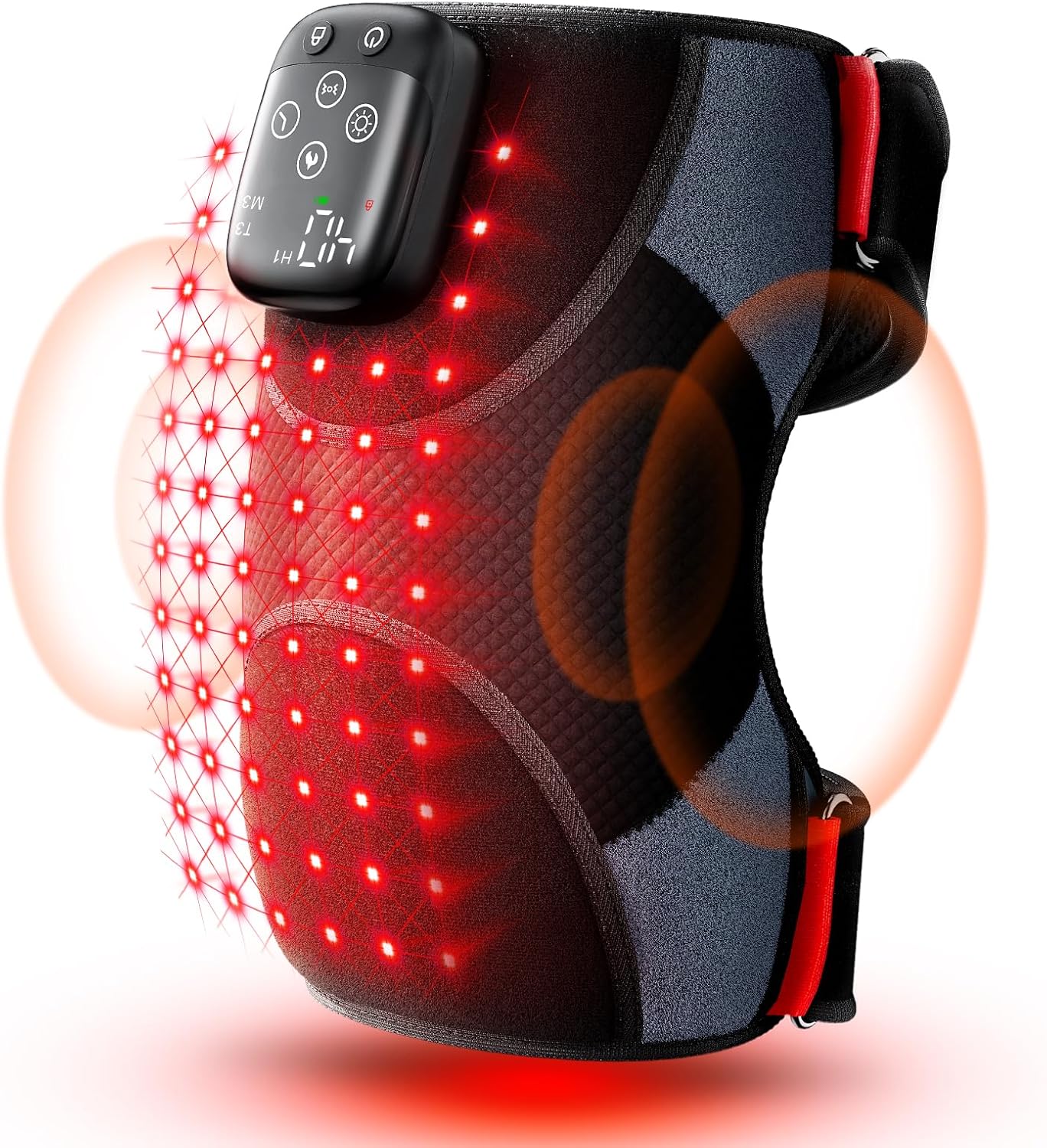
If you want that same pairing somewhere hot and humid, the BestQool Waterproof Red Light Therapy Panel is built to run inside a sauna or steam shower. For aiming near-infrared at a single joint instead of a whole panel, the LTW Knee Massager wraps red light therapy with heat and vibration around the knee itself.
Large 11 x 14.5-Inch Panel Covers A Real Area
At 11 x 14.5 inches, the panel is larger than most budget stand lamps, and that extra surface area is genuinely useful. You can light up your whole back, both shoulders, your chest, or your entire face without nudging the head every 30 seconds. For a sub-$60 red light therapy device, that is a meaningful amount of coverage per therapy session.
It still is not a head-to-toe system, and the reviewer was upfront that it treats one area at a time. But compared with the small face-only wands and tiny light therapy devices in this price range, the Puroth puts both red and near-infrared light over far more skin in a single sitting.
Flexible Gooseneck And 45-60 Inch Adjustable Stand
Flexibility is where this lamp earns its keep. The floor stand extends from 45 to 60 inches, and the head sits on a rubber-coated gooseneck that bends 360 degrees and holds its angle once you set it. You can point it straight at your face on the couch, tilt it down at your quads, or level it at your lower back in a chair.
The panel also pops off the gooseneck for handheld or tabletop use, and the whole thing breaks down for storage. It plugs straight into a wall outlet, so there is no bulky battery pack to manage. Compared with the stiff, single-angle panels that fight you on positioning, the Puroth is easy to aim and easy to keep using. For athletes who would rather strap that near-infrared light straight onto a knee or elbow than aim a stand, the Kineon Move+ Pro red light therapy wrap takes a hands-free, single-joint approach instead.
Heavy Weighted Base Keeps The Panel Planted
The base is one of the quiet strengths here. It is a thick, heavy weighted base, and the video reviewer called it sturdy enough that the lamp stays put instead of drifting or tipping as you reposition the head. On a tall stand with a cantilevered panel, that stability is not a given, and plenty of budget stands wobble.
That heft is the trade-off for portability — this is not a grab-and-go unit — but it is the right call for a floor lamp you will be nudging around during a session. It stays where you aim it.
Five Levels, Preset Timer, And Two Remotes Included
The Puroth gives you five brightness levels, so you can dial intensity down for sensitive skin or up when you sit farther back. A preset timer runs 20, 30, 40, 50, or 60 minutes and shuts the panel off on its own, which matters because these sessions are relaxing and easy to doze through. There is also a mode button that switches between steady and blinking light, though the blink is fast and easy to ignore if you are sensitive to it.
You control everything from either an attached controller on the panel or a separate wireless remote control, which is a nice touch at this price. The kit is complete out of the box, too: panel, stand, weighted base, both remotes, power adapter, safety glasses, a relaxation eye cover, and the manual. You are not buying extras to get started, aside from the two AAA batteries the wireless remote needs.
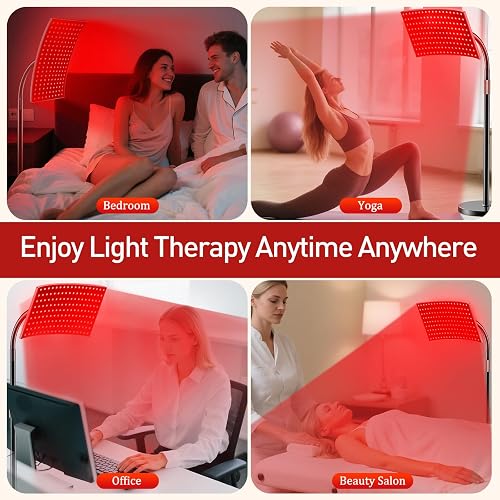
That combination makes this LED lamp easy to build into a real routine. You can run it as self-care at a desk, as a wind-down before sleep, or as a recovery session after exercise, and the auto shut-off means you are not tied to a clock through any of it.
No Published Or Measured Irradiance To Verify Dose
Here is the single biggest caveat with the Puroth: it publishes no irradiance or power-output figure at all. In red light therapy, the dose at your skin is what decides whether anything biological happens, and that dose is set by irradiance (mW/cm²) and fluence (J/cm²), not by bead count. As Dermatology Times puts it, clinical photobiomodulation systems run at 100-plus mW/cm² while most at-home devices sit in the 20-40 mW/cm² range, and “many consumer devices do not disclose irradiance at all, making it impossible to verify whether a therapeutic dose is actually being reached.”
Without a number — let alone an independently measured one — you cannot know where the Puroth lands. Budget panels routinely meter far below their marketing, and one owner of a comparable stand lamp measured less than 3 mW/cm² on their own meter before returning it. The practical workaround is to use it close to the skin, since the reviewer notes that sitting too far back means you are “not going to get the effects of it.”
Treats One Area At A Time, Not True Full-Body
Puroth’s marketing leans on “Full-Body Red Light Care,” with images of shoulders, backs, necks, and ankles. In practice, the panel treats one area at a time, and the reviewer said so plainly: it is a real panel, but if you are picturing something that lights you up head to toe in one shot, this is not it. He even said he wished it were a little bigger.
That is the honest ceiling of an 11 x 14.5-inch panel. It covers more than most budget lamps, but a genuine whole-body session still means repositioning it from your back to your legs to your front. If one-shot full-body coverage is the goal, you want a much larger (and far pricier) panel array. If the goal behind full-body sessions is overall physique change, the LOFTILLA Smart Body Scale tracks body fat and muscle trends so you can see whether your recovery routine is actually paying off.

Twenty-Minute Minimum Timer And AAA Batteries Not Included
The timer is convenient, but its shortest preset is 20 minutes. Most clinical protocols use roughly 10-15 minutes per area, and red light therapy follows a biphasic dose curve where more is not automatically better. If you want a quick five- or ten-minute session on one spot, you will be watching the clock and switching off manually rather than letting the timer handle it.
The wireless remote is also a minor annoyance out of the box: it needs two AAA batteries that are not included. The attached controller on the panel works without them, so this is a small gripe, but it is the kind of thing worth knowing before your first session.
Plastic Housing And No Independent Lab Data
The housing is plastic, and the reviewer was candid that this is a budget panel, not something you would mistake for a high-end unit. That is reasonable at the price, but it sets expectations: the build is mid-tier, and a few roundups mention isolated reports of the on/off switch failing within a year. There is also no third-party lab data behind any of Puroth’s claims.
Medical sources are consistent that at-home devices are weaker than professional ones — the Cleveland Clinic notes that in-office LED therapy “uses more powerful strengths than at-home devices.” The Puroth is not cleared by the Food and Drug Administration for any condition, so treat it as a wellness device rather than a medical treatment, and expect subtle, gradual results that build with near-daily use rather than anything dramatic overnight.
A couple of common-sense cautions apply to any red light panel. Never stare into the panel, and wear the included glasses, since direct eye exposure is the main safety risk. During pregnancy, or if you have a condition affecting your skin, take photosensitizing medication, or are unsure how your skin type will react, check with a clinician before starting.
Puroth vs Hooga HG300
The Hooga HG300 is the value-tier benchmark at around $199. It runs the same two wavelengths, 660 and 850nm, across 60 LEDs and publishes a claimed 73 mW/cm² at six inches, backed by a three-year warranty. The catch is that it ships with a small tabletop kickstand rather than a floor stand, and there is no remote.
The Puroth undercuts it by roughly $140 and adds the things Hooga leaves out: a full 45-60 inch floor stand, a 360-degree gooseneck, five brightness levels, a timer, two remotes, and goggles. Hooga’s edge is a stated irradiance figure and a longer track record; the Puroth’s edge is a bigger panel, far more flexibility, and a much lower price. If a published output number matters most, Hooga. If you want the most adjustable stand setup for the least money, the Puroth. For a verified, higher-output step up, the BestQool Red Light Therapy Panel adds more wavelengths and independently measured irradiance.
Puroth vs Mito Red MitoMIN 2.0
Mito Red’s MitoMIN 2.0 runs about $249 with a 50/50 split of 660 and 850nm across 60 LEDs, US-based support, and a two-year warranty. It is a more transparent brand, though its page lists “FDA Class II Registered,” which is not the same as FDA-cleared — a distinction worth noticing whenever marketing starts to sound medical.
Against it, the Puroth is a fraction of the price, includes the floor stand Mito sells separately, and offers a larger panel. You give up Mito’s reputation and stated specs in exchange for cost, coverage, and a complete kit. For a shopper testing whether red light therapy does anything for them before spending real money, the Puroth is the lower-risk experiment. If your target is a specific sore area rather than a panel, a wearable like the Comfytemp Red Light Therapy Belt or the Comfytemp Red Light Shoulder Wrap wraps 660 and 850nm directly around the spot.
Puroth vs PlatinumLED BIO 300
PlatinumLED’s BIO series is the premium reference, with the BIO 300 historically around $369. It delivers higher measured output and the most published data, but it uses a simple on/off switch with no brightness levels or timer, and its floor stand is a separate purchase.
The Puroth cannot match PlatinumLED on raw output or lab transparency. What it offers instead is adjustable intensity, a built-in timer, two remotes, a larger-than-Hooga panel, and a complete stand kit for roughly one-sixth of the price. If measured dose and clinical backing are the priority, PlatinumLED earns the premium. If flexibility and affordability come first, the Puroth makes sense — and if you want to compare it against another budget stand panel, the LEDINO Red Light Therapy Panel is the closest head-to-head at a similar price.
My final rating for the Puroth Red Light Therapy Lamp is 4.3 out of 5. For around $59 you get a true dual-wavelength 660nm and 850nm panel, a larger-than-usual 11 x 14.5-inch head, a 45-60 inch stand with a flexible gooseneck, five brightness levels, a 20-to-60-minute timer, two remotes, and goggles — a combination of coverage, flexibility, and included extras that costs three to six times more from Hooga, Mito, or PlatinumLED.
The honest limits keep it from scoring higher. Puroth publishes no irradiance figure at all, so the actual dose at your skin is unknown; the shortest timer preset is 20 minutes; and the plastic build sits squarely in budget territory with no third-party lab data. The heavy, stable base and the big panel are genuine wins, but the lack of any measured output is the one caveat to price in before you buy.
If you want to bring red light therapy home without the appointments — and without committing $200 to $500 before you know whether it helps you — the Puroth is a sensible, flexible way to start. Buy it as a returnable experiment, use it close to the skin and consistently, and judge it on how your skin and sore spots actually respond over a few weeks.
This review is informational and is not intended to diagnose, treat, or prevent any disease, or to replace consulting a clinician when you are treating a health problem.
Specifications
| Wavelengths | 660nm red + 850nm near-infrared (dual) |
| LED beads | 180 LEDs, 540 chips (360x 660nm, 180x 850nm) |
| Panel size | 11 x 14.5 in (flat) |
| Intensity levels | 5 brightness levels |
| Light modes | Steady and blink |
| Timer | 20/30/40/50/60 min auto shut-off |
| Stand | 45-60 in height, 360-degree gooseneck head |
| Controls | Attached remote + wireless remote (2 AAA, not included) |
| In the box | Panel, stand, weighted base, remote, power adapter, safety glasses, eye cover, manual |
| Irradiance | Not published by the manufacturer |
| Assembled dimensions | 14.96 x 9.84 x 62.99 in |
| Weight | 7 lb |
| Manufacturer | Puroth |
Frequently Asked Questions
Does the Puroth red light therapy lamp actually work?
It delivers genuine 660nm red and 850nm near-infrared light, the two wavelengths most studied for skin and deeper tissue, so the underlying mechanism is real. The honest catch is dose. Puroth does not publish an irradiance figure, and at-home panels are weaker than in-office units, so expect subtle, gradual results rather than dramatic ones. Peer-reviewed guidance suggests roughly 10-12 minute sessions a few times a week over 4 to 12 weeks, and consistency matters far more than any single session.
What wavelengths does the Puroth lamp use?
Two of them, 660nm visible red for the skin surface and 850nm near-infrared that penetrates deeper into muscle and joint tissue. The 3-in-1 chip marketing refers to three emitters per LED bead, two red plus one near-infrared, not a third wavelength. Despite what some listicles imply, this model does not add 940nm; it is a dual-wavelength 660/850 panel with 180 LEDs and 540 chips.
How long and how close should I use the Puroth lamp?
A reasonable starting point for one area is about 10 to 15 minutes, though the Puroth timer presets start at 20 minutes, so you may need to switch it off manually for shorter sessions. Stay relatively close to the panel, since the reviewer notes that sitting too far back means you will not feel the effects. More time is not automatically better, because red light therapy follows a biphasic dose curve where overdoing it can reduce the benefit.
Is the Puroth red light therapy lamp FDA approved?
No at-home panel in this class is FDA approved. At most these devices are FDA-cleared or registered, which signals low risk rather than proof that they treat a specific condition. Treat the Puroth as a wellness device, not a medical treatment, and talk to a clinician for any actual health problem.
What is the downside of red light therapy panels like this one?
The main downsides are unverifiable output, subtle and slow-building results, and the discipline required to use the device consistently. Budget panels in particular often measure far below their marketing, and the Puroth does not publish any irradiance number, so the real dose at your treatment distance is unknown. It is best viewed as a low-cost, returnable experiment rather than a guaranteed fix.
How do I know if a red light therapy lamp is legit?
Look for clearly listed wavelengths in the studied ranges, which are roughly 630-660nm for red and 810-850nm for near-infrared, and ideally a stated irradiance measured at a specific distance. The Puroth gets the wavelengths right at 660 and 850nm but gives no irradiance figure, which is common for cheap panels. When output is undisclosed, the safest move is to buy from a seller with easy returns and judge results over several weeks.
Can you use the Puroth lamp for both skin care and muscle recovery?
Yes, and that dual use is the main appeal. The 660nm red light targets the skin surface for tone and fine lines, while the 850nm near-infrared reaches muscles and joints for recovery, and both run together by default. The large 11 x 14.5-inch panel and the adjustable gooseneck stand let you aim it at your face, back, shoulders, knees, or legs, so one device covers both jobs.
Ready to Buy?
Puroth Red Light Therapy Lamp delivers on its promises. If it fits your needs, it's a solid choice you won't regret.
Check Price on Amazon Founder & Product Reviewer at TheReviewRewind
Daniel has tested 400+ products across 20+ categories through hands-on, real-world testing. Every review includes video documentation and standardized scoring criteria. His reviews appear as Amazon shoppable videos and here on TheReviewRewind.
We earn a commission if you make a purchase, at no extra cost to you. This does not influence our ratings or recommendations. Full disclosure
Looking for more options? See all our Health & Household reviews.
Related Reviews