SOARAISE Solar Power Bank 48000mAh Review: Off-Grid Backup


SOARAISE Solar Power Bank 48000mAh Review: Off-Grid Backup
SOARAISE Solar Power Bank 48000mAh
Buy if you want a high-capacity 48,000mAh backup with built-in cables, wireless charging, a flashlight, and four solar panels for camping, boating, and outages. Skip if you want a slim pocket charger, high-wattage fast charging, or expect solar to be your main way to refill it.
Buy on AmazonWhat We Liked
- Massive 48,000mAh Capacity for Multi-Day Trips
- Four Fold-Out Solar Panels, Not One Tiny Panel
- Four Built-In Cables You Can't Forget at Home
- Wireless Charging Pad and Seven Devices at Once
- A Rugged IPX5 Body with a Built-In Flashlight
- A 3A USB-C Output for Quick Phone Top-Ups
What Could Be Better
- Solar Charging Is a Backup, Not a Refill Plan
- The 48,000mAh Number Oversells Real Capacity
- It Needs a Proper 5V Wall Charger to Fill Up
- It's Heavy and Bulky at Roughly One Pound
- Some Owners Report Early Unit Reliability Issues
How we test: Every product is used in real conditions and evaluated using our standardized scoring criteria. Read our full review methodology.
You’re a day into a camping trip, the phones are dying, and the nearest outlet is an hour’s drive away. That is the exact situation the SOARAISE Solar Power Bank 48000mAh is built for, and it leans on one backup trick that most chargers skip.
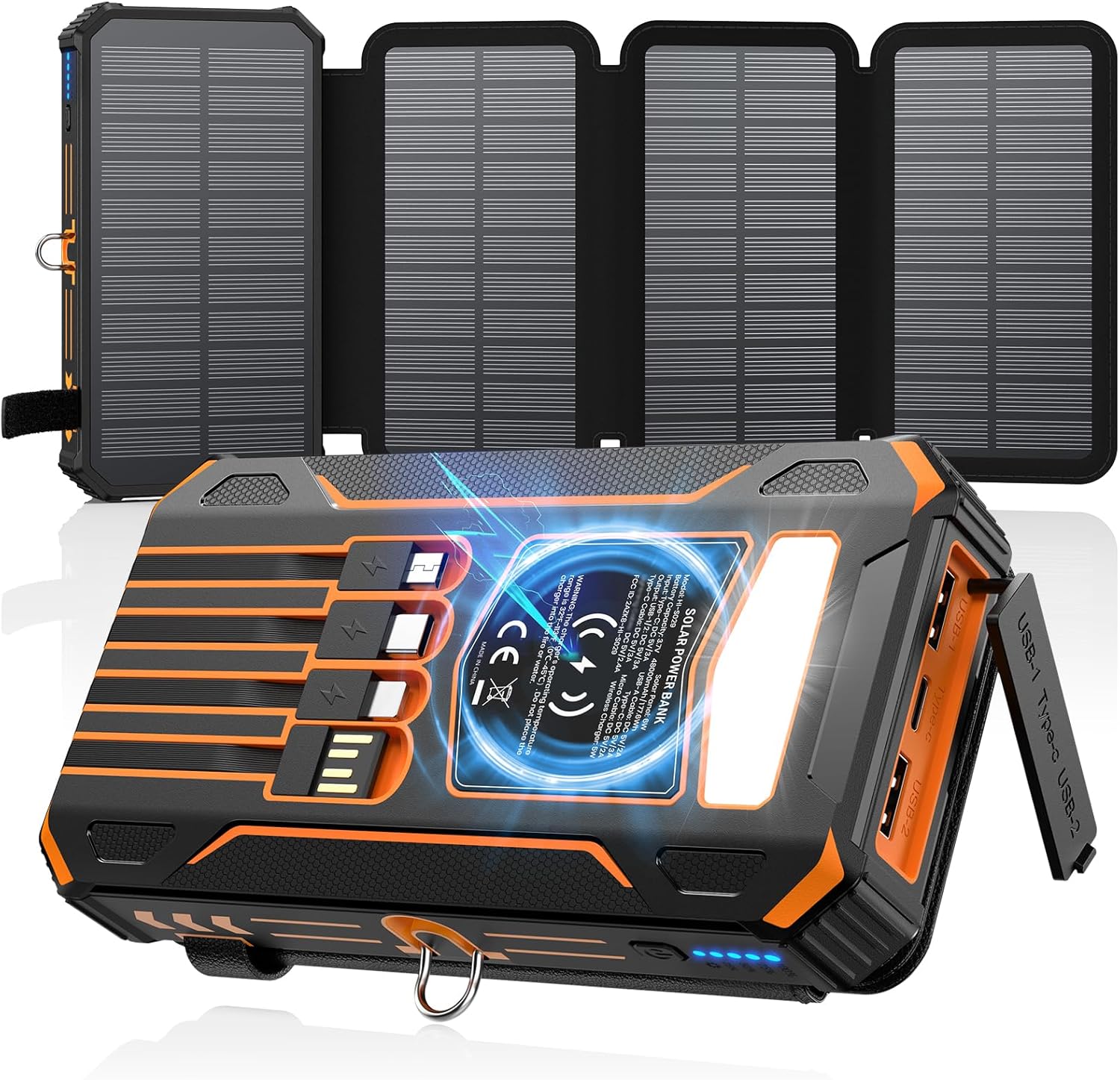
At its core this is a high-capacity portable charger, a 48,000mAh lithium polymer battery pack wrapped in outdoor extras. Officially the SOARAISE Solar Charger Power Bank, it gives you four built-in cables, extra USB ports, a Qi wireless charging pad, a flashlight, and four fold-out solar panels, all in one rugged orange shell that charges from the wall, a Universal Serial Bus (USB) source, or the sun.
I put the capacity, cables, solar panels, wireless pad, and flashlight through a hands-on review to see whether the features hold up and which number on the box to ignore. SOARAISE sells this as an off-grid and emergency battery pack, not a slim everyday charger, and that framing decides who should buy it.
The short version: it is a genuinely useful chunk of backup power for camping, boating, and outages, with a few honest trade-offs you should understand first. Here is what stood out after real-world use.
What I Liked
After handling this solar charger and testing what it does, several things stood out that make it a smart pick for time away from outlets.
Massive 48,000mAh Capacity for Multi-Day Trips
The headline feature is the 48,000mAh battery, and it holds a serious amount of power. A typical pocket power bank stores around 10,000mAh, so this is roughly five times that in one brick.
In practice that works out to about four full phone charges, which is enough to keep a couple of phones and an iPad going through a whole weekend. One camper used it to keep two phones charged across a weekend trip, and that matches what I would expect from a cell this size. For a long weekend on the boat or at the lake, you top up devices and forget about the bank. If you want a lighter pack sized for travel rather than multi-day off-grid use, the Orfeika 20000mAh Power Bank covers about three phone charges in an airline-legal body. For an even larger pack that adds a hand crank as a last resort when the sun and the wall both fail, the FEELLE Solar Power Bank 50000mAh keeps campers and families powered through the same days off grid.
Four Fold-Out Solar Panels, Not One Tiny Panel
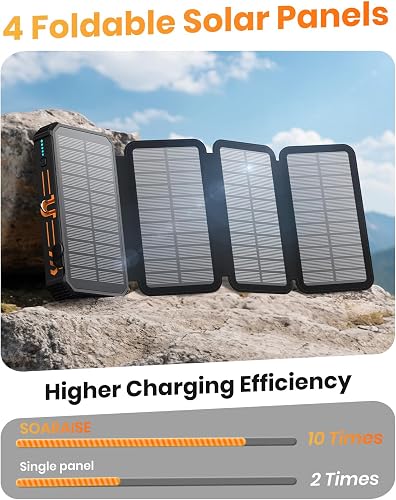
Instead of a single postage-stamp panel glued to the side, the SOARAISE fans out 4 solar panels that shut with a Velcro flap. Those four foldable photovoltaic panels give it more surface area to capture solar energy than the single-panel power banks most people picture.
A small green light next to the sun icon comes on when the panels are actually pulling a charge, so you know it is working. In strong direct sun you will add a real top-up over the course of a day, which is a useful way to stretch your power when you are off-grid for days at a time.
Four Built-In Cables You Can’t Forget at Home
Four charging cables live right in the body: USB-C, a Lightning-style phone cable, Micro-USB, and USB-A. Between those and the ports, you are never stuck because you left a cord at home.
The cables pop out and back in simply, though they are on the short side, so you will keep devices close while charging. It is the kind of practical touch that makes this easy to grab for a trip.
Wireless Charging Pad and Seven Devices at Once
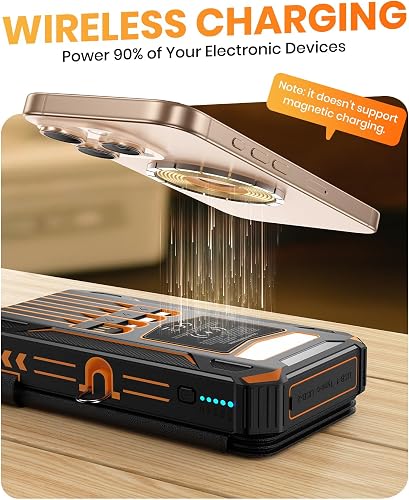
A Qi wireless pad sits on the front, so you set a compatible iPhone or Samsung Galaxy S24 flat on top and it starts charging without a cable. Note that it is a standard Qi pad, not a magnetic MagSafe mount, so the phone has to lie flat and centered.
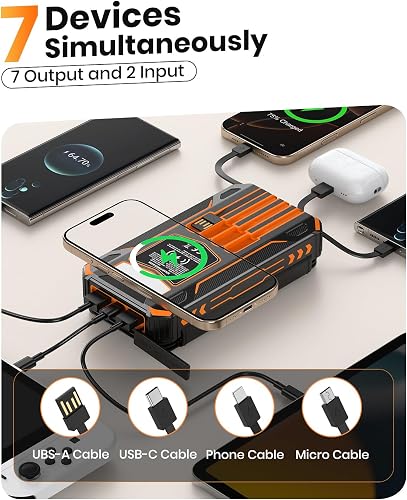
Combine the wireless pad with the four built-in cables and the USB-A and USB-C ports, and the SOARAISE can run up to seven devices at once. That makes it a family-and-group charger rather than a single-phone topper, though spreading the load across many devices slows each one down. For a smaller travel pack that still fans power across several gadgets, the Orfeika 10000mAh Portable Charger spreads its charge over six outputs in a pocketable body.
A Rugged IPX5 Body with a Built-In Flashlight
The build feels solid, with rubber bumpers on the corners and an IPX5 rating that shrugs off rain and splashes, though you should not dunk it in a lake. It is the kind of pack you can toss in a backpack, drop a few times, and keep using.
A built-in LED flashlight turns out to be more useful than you would expect when you are setting up a tent in the dark. A double-tap of the power button switches it on, and you can cycle through steady, strobe, and SOS modes, which makes it a genuinely handy flashlight for camping and late-night tasks.
A 3A USB-C Output for Quick Phone Top-Ups
Capacity only matters if power actually gets into your phone, so it helps that the USB-C port pushes 5V/3A, around 15 watts. SOARAISE markets this with PD QC 3.0 fast charging and rates it at taking an iPhone from 15% to 60% in about 30 minutes, which held up as a quick top-up before heading out.
That output is plenty for phones and tablets, but it is a modest 15W rather than the 45W to 100W you would need to fast-charge a laptop. If you want to push a big USB-C laptop quickly, a wall-class brick like the UGREEN Nexode 100W Power Bank is a better tool than any solar bank. For everyday phone top-ups in a pocket instead of an off-grid brick, the Coowisty Portable Charger with Wall Plug folds its own wall prongs into a phone-sized body.
What Needs Improvement
No power bank is all upside, and this one asks for a few compromises in exchange for its capacity and features.
Solar Charging Is a Backup, Not a Refill Plan
The four panels help, but solar is still a top-off, not a real way to fill this battery from empty. Even SOARAISE positions the sun as a backup, and in practice it is slow: one owner measured four full days of sun-up-to-sun-down charging to take the pack from 0 to 100%.
That matches every expert test of built-in solar. OutdoorGearLab found a comparable multi-panel bank collected only about 692mAh in an hour of direct midday sun, calling it “more a battery bank that happens to have integrated solar panels for emergency recharging than a solar charger you can count on for many days in a row.” On a cloudy day, expect even less, so charge it full at home and let the sun keep it topped up.
The 48,000mAh Number Oversells Real Capacity
Like most budget high-capacity banks, the 48,000mAh figure, an ampere-hour rating, is a best-case cell number, not the usable energy you get out of the ports. One detailed reviewer measured roughly 60 watt-hours of real output, which is less than four full charges for a modern phone.
That is still a large battery, so this is about setting expectations rather than a dealbreaker. Judge it by the four-ish phone fills you actually get, not the listicle claims of 10 to 12 charges.
It Needs a Proper 5V Wall Charger to Fill Up
To recharge the bank completely, you have to plug it into a true 5V source. A weak or cheap adapter that sags to around 4.2V can stall the pack at roughly two indicator bars, about half its usable capacity, which is easy to miss.
Both the hands-on video and a technical Amazon reviewer ran into the same wall. Use a known-good 5V wall charger and verify it reaches a full charge before you rely on it in the field.
It’s Heavy and Bulky at Roughly One Pound
The trade-off for all that capacity and four panels is heft. At right around a pound, the SOARAISE is a brick you clip to a pack or toss in a glove box, not something you forget in a pocket.
If you want a slim charger for everyday errands, this is the wrong tool. For that, a palm-sized pack like the INIU Mini 10000mAh Power Bank makes far more sense than this off-grid unit.
Some Owners Report Early Unit Reliability Issues
The SOARAISE holds a solid 4.2-star average across more than 6,000 Amazon ratings, but a minority of buyers report quality-control misses. One camper’s unit died after charging two phones just once on a four-day trip, and Reddit owners of integrated solar banks warn that cheap units can overheat in the sun or fail early.
The 12-month warranty softens the risk, but it is worth buying from a seller with an easy return policy and testing the bank before a trip. Treat the first charge as a shakedown rather than assuming it will work when you need it most.
How It Compares
On the spec sheet the SOARAISE competes on raw capacity and its all-in-one feature set. As a battery pack you actually carry for camping and outages, the alternatives fall into a few clear buckets.
The closest direct rival is another rugged solar bank like the DJKK Solar Power Bank 66800mAh, which trades the SOARAISE’s wireless pad for a hand crank and an even larger cell. Both share the same core story: a huge battery with built-in cables and lights, plus solar that is best treated as a backup. If you want wireless charging and four fold-out panels, the SOARAISE has the edge; if you want a crank for true no-sun, no-outlet emergencies, the DJKK pulls ahead.
Serious campers often skip all-in-one solar banks entirely. The common setup on r/CampingGear is a quality power bank paired with a separate 30-to-40W folding panel from a brand like FlexSolar or BigBlue. That combo charges far faster from sunlight, since OutdoorGearLab measured a FlexSolar 40W panel pulling about 4,302mAh per hour of direct sun, roughly six times the input of integrated panels. The catch is that it costs more, packs bigger, and drops the built-in cables and flashlight.
That is the real trade-off. The SOARAISE bundles a 48,000mAh battery, four cables, a wireless pad, four panels, and a flashlight into one package for about $60. You give up fast solar and laptop-class charging, but few rivals match that all-in-one kit at the price. If fast charging matters more than solar, a cable-equipped brick like the CUKTECH 45W Power Bank refills devices quicker in a smaller body, just without the panels or the outage-ready extras.
Final Verdict
The SOARAISE Solar Power Bank 48000mAh earns a 3.9 out of 5 from me. It nails the fundamentals of an off-grid backup, with a genuinely large battery, four built-in cables, a Qi wireless pad, a flashlight, and four fold-out solar panels that gather more sun than the single-panel banks most people picture.
It is not perfect. The solar is slow and best treated as a top-off, the 48,000mAh label oversells the roughly four real phone charges you get, and the one-pound weight keeps it out of your pocket. You also need a proper 5V wall charger to fill it, and a minority of owners have run into early reliability issues.
None of that undercuts the core value. For about $60, this is one of the easier backups to recommend to a camper, a family out on the boat, a road tripper, or an emergency-prep household that wants power and light when the grid goes down. Go in with the right expectations, charge it off the wall first, and treat the solar as your safety net, and the SOARAISE does exactly what you need.
Specifications
| amperage | 3 A |
| battery_capacity | 48000 milliamp_hours |
| battery_cell_type | Lithium Polymer |
| brand | SOARAISE |
| color | Orange |
| compatible_devices | Camera, MP3 Player, Projector, Smartphone, Tablet |
| connector_type | USB-A, USB-C, Micro-USB |
| included_components | Built in Cables, User Manual X1, Wireless Solar Power Bank X1 |
| item_dimensions | 6.38 x 3.43 x 1.57 inches |
| manufacturer | Yuwei Technology (Dongguan) Co., Ltd. |
| model_name | Solar Power Bank |
| model_number | HI-S029 |
| number_of_ports | 3 |
| other_special_features_of_the_product | 4 Solar Panels, Built In 4 Cables, Auto Shut-Off, Fast Charging, LED Camping Flashlights, Waterproof, Shockproof, Dustproof, Wireless Charging |
| output_current | 3 A |
| power_source | Corded Electric & Solar Powered |
| reusability | Rechargeable |
| voltage | 5 volts |
| warranty_description | 12months |
| item_weight | About 1 lb |
Frequently Asked Questions
Does the SOARAISE solar power bank really charge from solar?
Yes, but slowly. The four fold-out panels trickle in power to top off the bank in direct sun, and a green light comes on when they are charging. They are designed as an emergency backup, not your main method, so one owner measured about four days of full sun to refill the pack from empty. Charge it from a wall outlet whenever you can and treat the sun as a bonus.
How many times can the SOARAISE 48000mAh charge a phone?
Around four full charges for a modern smartphone. While the label reads 48,000mAh, a detailed reviewer measured roughly 60 watt-hours of usable output after conversion losses, so expect about four phone fills rather than the 10 to 12 some listings suggest.
Why is my SOARAISE solar power bank not charging fully?
The most common cause is a weak wall adapter. The bank needs a true 5V source to fill completely, and a cheap charger that sags to around 4.2V can stall it near two bars, about half capacity. Switch to a known-good 5V wall charger and it should reach a full charge.
How many devices can the SOARAISE charge at once?
Up to seven. It combines four built-in cables (USB-C, Lightning-style, Micro-USB, and USB-A), two USB-A ports, a USB-C port, and a wireless pad, so you can charge a mix of phones, tablets, and accessories together. Charging many devices at once splits the available power and slows each one.
Is the SOARAISE solar power bank waterproof?
It is rated IPX5, which means it resists rain and splashes but is not submersible. The rubber-bumpered shell also handles drops and dust, so it is built for a backpack or glove box, but do not dunk it in a lake.
Is the SOARAISE 48000mAh solar power bank worth buying?
For about $60 it is strong value as an off-grid and emergency backup, pairing a large battery with built-in cables, wireless charging, a flashlight, and four solar panels. The main trade-offs are slow solar, optimistic capacity, real weight, and occasional reliability misses, so buy it for camping and outages rather than pocket carry.
Ready to Buy?
SOARAISE Solar Power Bank 48000mAh delivers on its promises. If it fits your needs, it's a solid choice you won't regret.
Check Price on Amazon Founder & Product Reviewer at TheReviewRewind
Daniel has tested 400+ products across 20+ categories through hands-on, real-world testing. Every review includes video documentation and standardized scoring criteria. His reviews appear as Amazon shoppable videos and here on TheReviewRewind.
We earn a commission if you make a purchase, at no extra cost to you. This does not influence our ratings or recommendations. Full disclosure
Looking for more options? See all our Cell Phones & Accessories reviews.
Related Reviews