
Young Living Thieves Household Cleaner Review: One Bottle, Every Surface


Young Living Thieves Household Cleaner Review: One Bottle, Every Surface
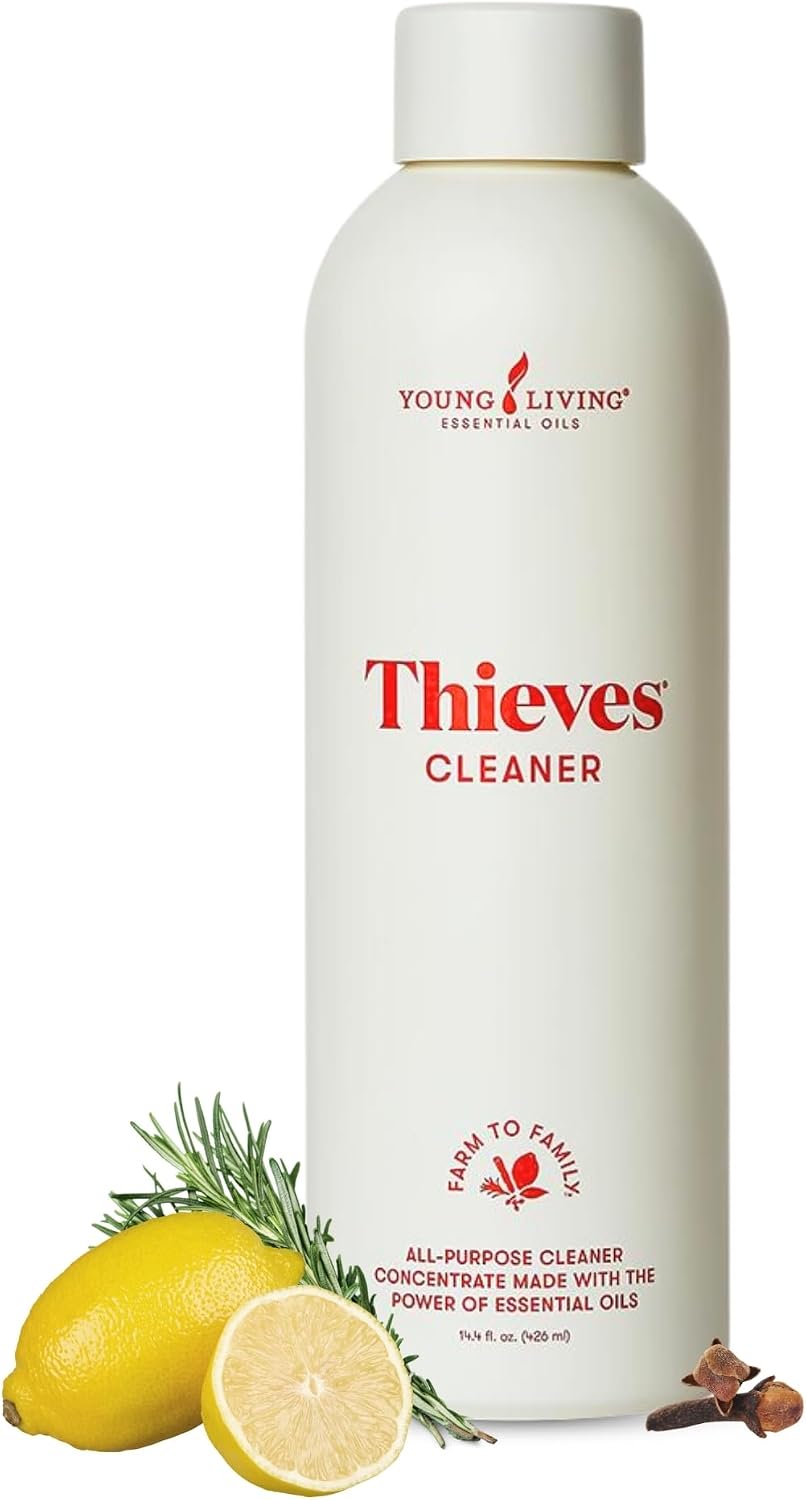
Young Living Thieves Household Cleaner
Buy if you want one plant-derived concentrate that handles counters, glass, and floors and you like a warm clove-cinnamon scent. Skip if you want a citrus-fresh smell, a grab-and-spray bottle, or an EPA-registered disinfectant.
Buy on AmazonWhat We Liked
- One Concentrated Bottle Replaces a Whole Cabinet
- Printed Dilution Ratios Take the Guesswork Out
- Cuts Kitchen Grease and Leaves Glass Streak Free
- Young Living's Plant-Based Formula Skips Harsh Chemicals
- The Cost Per Spray Bottle Is Under Two Dollars
What Could Be Better
- The Thieves Essential Oil Blend Leans Heavy on Clove
- It Is a Cleaner, Not an EPA-Registered Disinfectant
- You Need a Spray Bottle and a Mixing Step
- Some Surfaces Still Need a Patch Test First
How we test: Every product is used in real conditions and evaluated using our standardized scoring criteria. Read our full review methodology.
If you have switched to natural cleaners before, you know the two ways they fail. They either leave a hazy film on glass, or they smear the mess around and you burn through twice as much product getting nowhere.
Young Living’s Thieves Household Cleaner is a 14.4 fl oz plant-derived concentrate built to avoid both problems. You do not spray it straight from the bottle. You mix one capful with water, and the ratio you pick decides whether you are making a glass cleaner, an everyday surface spray, or a degreaser.
I mixed it at the printed ratios and put it on countertops, mirrors, appliances, and floors to see whether one bottle could carry a whole house.
The short version: it cuts grease and leaves glass streak free, and the concentrate math makes the sticker price look different than it first appears. The scent and the disinfectant question are where you need to think carefully before buying.
What I Liked About the Thieves Household Cleaner
Five things stood out once I stopped treating this like a ready-to-use spray and started mixing it properly.
One Concentrated Bottle Replaces a Whole Cabinet
This is a true all-purpose cleaner. Counters, floors, cabinets, glass, carpets, and appliances all come off the same bottle, and I ran it through a mop bucket for tile and took it outside for patio furniture without switching products.
The concentrated formula also covers spot cleaning, so pet stains on carpet get the same bottle as the kitchen counter. Instead of five specialized sprays crowded under the sink, you keep one 14.4 oz bottle and a spray bottle, and that storage win is easy to underrate until you clear the cabinet out.
Printed Dilution Ratios Take the Guesswork Out
The back of the bottle prints the cleaner-to-water ratio for every job. Everyday surfaces run 1:30, heavy degreasing steps up to 1:15, light degreasing sits at 1:50, and glass thins right out to 1:100.
Having that chart on the label matters more than it sounds. Most concentrates leave you estimating, and the wrong mix is the single most common reason someone decides a natural cleaner does not work.
Cuts Kitchen Grease and Leaves Glass Streak Free
Grease and smears on countertops lifted without repeat passes at the everyday dilution. Mirrors and glass dried clear with no sticky residue, which is not what I expected from a plant-based formula.
One Amazon reviewer who mixed the same 1:30 ratio reported it independently: “I was amazed at how clear and streak free it leaves glass. It does not leave a residue.” That lined up with my own results closely enough to treat it as repeatable rather than luck.
Young Living’s Plant-Based Formula Skips Harsh Chemicals
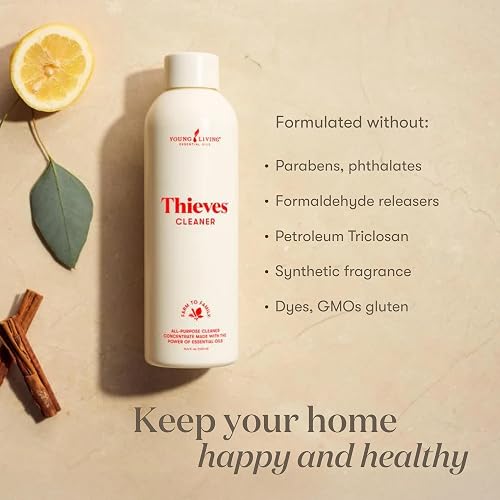
The cleaning agents here are plant-based ingredients: coconut-based cleansers and plant-derived wetting agents in place of the harsh chemicals in conventional sprays. Young Living’s own panel states the formula is made without parabens, phthalates, formaldehyde releasers, petroleum triclosan, synthetic fragrance, dyes, and GMOs.
There is no mystery substance on the ingredient list, which is the whole point for the households buying it. If your reason for natural cleaning is the counters your kids eat off and the floors they crawl on, that is the core of what you are paying for. If that plant-derived, non-GMO standard is what you shop on, it extends past the spray bottle to things like the BioBag compostable food scrap bags that line a kitchen scrap bin.
The Cost Per Spray Bottle Is Under Two Dollars
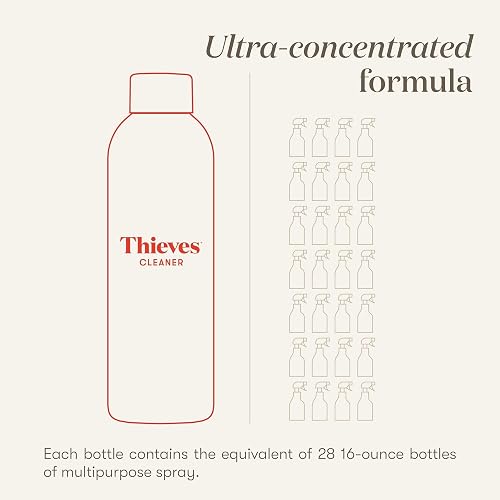
A little goes a long way here. One capful makes a full 16 oz spray bottle of finished cleaner, and Young Living’s product panel puts the total at 28 sixteen-ounce bottles of multipurpose spray from a single 14.4 oz concentrate.
At the $38.99 listing price, that works out to roughly $1.39 per spray bottle you mix. The upfront number looks steep beside a $4 supermarket spray, but the finished cost per bottle undercuts most ready-to-use natural cleaners on the shelf.
How to Dilute Thieves Household Cleaner
Getting the ratio right is the whole game with this product. Mixing it too weak is the single most common reason someone concludes a natural cleaner does not work.
The ratios below are the ones printed on the back of the bottle, measured with the cap that comes with it. One capful is roughly half a fluid ounce.
- Everyday surfaces (1:30) — one capful in a 16 oz spray bottle. Counters, tables, appliances, and routine wipe-downs.
- Heavy degreasing (1:15) — double strength for greasy stovetops, backsplashes, and oven doors. Let it sit a minute before wiping.
- Light degreasing (1:50) — a thinner mix for dusting and light routine surfaces.
- Glass and mirrors (1:100) — the thinnest mix of all. Use distilled water and finish with a dry polishing cloth.
- Floors — a squirt straight into a full mop bucket handles tile, vinyl, and sealed wood.
Start stronger than you think you need on anything greasy. The concentrate stretches far enough that using a little extra on a tough job costs you almost nothing.
What Needs Improvement
Four things are worth knowing before you commit, and two of them are dealbreakers for the wrong buyer.
The Thieves Essential Oil Blend Leans Heavy on Clove
The formula is infused with the Thieves essential oil blend: clove, lemon, cinnamon bark, eucalyptus, and rosemary. In use, the clove and cinnamon dominate completely, and the spicy aroma reads as warm autumn baking rather than as a cleaning product.
The lemon never surfaces. A four-star Amazon reviewer put it plainly: “I was hoping the lemon would be the pronounced scent. It is not.”
If your mental picture of clean is a citrus or pine odor, this will not deliver it. The aroma is a defining feature rather than a background note, and it is the most common reason people bounce off the product.
It Is a Cleaner, Not an EPA-Registered Disinfectant
Thieves Household Cleaner is not registered with the EPA as a disinfectant, so it cannot legally claim to kill bacteria or viruses. It removes dirt, grease, and grime, and the physical act of wiping carries germs off the surface with them.
That distinction matters after raw chicken or during a stomach bug. Clean with this first, then follow up with an EPA-registered product on those specific jobs.
You Need a Spray Bottle and a Mixing Step
The concentrate does nothing until you mix it. You want at least one 16 oz spray bottle, and a second if you plan to keep a separate glass dilution ready.
Spray bottles are cheap, but it is still an upfront errand and a recurring half-minute of measuring. Against a grab-and-spray competitor that is a genuine convenience gap. For baked-on messes that no spray will lift on its own, you will still reach for something with bristles like the Dawn Radial Head Kitchen Brush.
Some Surfaces Still Need a Patch Test First
“Safe on nearly every surface” has limits. Usage guides consistently flag unsealed stone, raw or oiled wood, delicate plastics, and carpet as spot-test-first materials, since the oils can soak into porous surfaces and stain them.
Glass carries a technique requirement too. Minerals in tap water leave spots behind, so distilled water and a dry polishing cloth are what separate a clear finish from a faintly streaked one.
Grout is the other honest limit. Reviewers who pushed it there found a baking soda paste or a dedicated grout product cheaper and more effective, and the same goes for old ink and permanent marker, which this will not lift.
How It Compares to Other Natural Cleaners
The natural cleaner shelf splits into ready-to-use sprays and concentrates you dilute. Thieves sits firmly in the second camp, and that shapes every comparison.
Thieves Cleaner vs Mrs. Meyer’s Clean Day
Mrs. Meyer’s is the ready-to-use answer. You buy a 16 oz bottle for around $4.50 and spray it, with no capful, no measuring, and no second bottle to fill.
The tradeoff shows up in cost per bottle. Thieves lands near $1.39 per mixed 16 oz bottle at the Amazon price, so you pay roughly three times as much per spray for the convenience of skipping the mixing step.
Mrs. Meyer’s lemon verbena is also the brighter, more familiar scent if the clove profile is what puts you off.
Neither product is an EPA-registered disinfectant, so that is not a deciding factor between the two.
Thieves Cleaner vs Branch Basics
Branch Basics is the closest structural competitor: another plant-based concentrate you dilute at different ratios for different jobs, working out to roughly $0.92 per finished 16 oz bottle.
The real split is fragrance. Branch Basics ships unscented so you add your own essential oil, which makes it the better pick for a scent-sensitive household or anyone who wants to change the smell room by room. If you want the Thieves blend specifically, Branch Basics has no equivalent to offer.
Thieves Household Cleaner vs Method All-Purpose
Method is the budget ready-to-use option: plant-based, priced well per ounce, and rated streak free on glass and mirrors by testers who put it through kitchen cleanup.
Where it falls behind is heavier soil. One editor test found Method “took the most swipes to clean up a sticky substance,” and CNET’s roundup notes it “was unable to cut through tough build-up like others.” Thieves at the 1:15 degreasing ratio has a gear that a fixed-strength spray cannot reach.
The DIY route deserves a mention too, since plenty of people mix Thieves essential oil with water and a spoonful of dish soap instead. That will make a room smell right, but a homemade oil-and-soap spray does not carry the surfactants needed to cut grease the way a formulated concentrate does.
If you would rather skip cleaning products altogether on floors and sealed surfaces, a steam unit like the TVD Steam Cleaner is the other direction to go, using water and heat instead of any detergent at all.
Final Verdict
Young Living Thieves Household Cleaner does the thing most natural cleaners fail at: it cleans without leaving film. Grease came off counters in one pass, glass dried clear, and a single bottle covered the kitchen, the bathroom, the floors, and the patio furniture.
I am giving it a 4.5 out of 5.
The concentrate math is what makes the price defensible. At $38.99 for 28 mixed spray bottles, the finished cost per bottle sits below most ready-to-use natural cleaners even though the shelf price suggests otherwise. Amazon shoppers back that up with a 4.8 average across more than 6,100 ratings.
What keeps it off a 5 is the scent and the label. The clove-cinnamon aroma is polarizing and will never read as fresh to a citrus person, and the product is not an EPA-registered disinfectant, so it cannot be your only line of defense after raw meat or illness.
Bottom line: If you want one plant-derived concentrate to clean your home from a cabinet’s worth of sprays down to a single bottle, and the warm spice smell appeals to you, this earns its spot under the sink. If you need a citrus-fresh odor or a certified disinfectant, put your money elsewhere.
Specifications
| item_model_number | 3743 |
| manufacturer | Young Living Essential Oils |
| product_dimensions | 7.9 x 2.7 x 2.3 inches; 15.04 ounces |
Frequently Asked Questions
Does Thieves Cleaner actually work?
Yes, on everyday household soil. At the 1:30 everyday dilution it lifted grease and smears from countertops in a single pass, and glass and mirrors dried clear with no sticky residue. It is not a miracle worker on food that has dried on overnight, which still needs a soak and a scrubbing pad. Treat it as a strong all-purpose cleaner rather than a stain remover.
What can I use Thieves Household Cleaner for?
Young Living lists countertops, floors, cabinets, glass, carpets, and appliances, and it handled all of those for me plus outdoor patio furniture and a mop bucket of tile. Spot-test first on unsealed stone, raw or oiled wood, delicate plastics, and carpet, because the essential oils can soak into porous material and stain it. Never spray any liquid directly onto electronics.
How do you dilute Thieves Household Cleaner?
The ratios are printed on the back of the bottle. Use one part cleaner to 30 parts water for everyday surfaces, 1:15 for heavy degreasing, 1:50 for light degreasing, and 1:100 for glass. One capful fills a standard 16 oz spray bottle at the everyday strength. Use distilled water for glass and mirrors, since minerals in tap water are what leave spots behind.
How long does one bottle last?
Young Living's product panel states that one 14.4 fl oz bottle makes the equivalent of 28 sixteen-ounce bottles of multipurpose spray. At the $38.99 Amazon price that is roughly $1.39 per finished spray bottle. For a household mixing a bottle every week or two, the concentrate realistically lasts several months to a year.
Is Thieves Household Cleaner a disinfectant?
No. It is not registered with the EPA as a disinfectant, so it cannot legally claim to kill bacteria or viruses. It removes dirt and grime, and wiping physically carries germs off the surface. For cleanup after raw meat or during illness, clean with Thieves first and then follow with an EPA-registered disinfectant.
Branch Basics vs Thieves Cleaner: which is better?
Both are plant-based concentrates you dilute for different jobs, and Branch Basics is slightly cheaper per finished bottle at roughly $0.92 against $1.39. The deciding factor is fragrance. Branch Basics is unscented so you add your own essential oil, which suits scent-sensitive households, while Thieves commits you to its clove and cinnamon blend. Neither one is an EPA-registered disinfectant.
What does Thieves Household Cleaner smell like?
Warm autumn spice. The blend contains clove, lemon, cinnamon bark, eucalyptus, and rosemary, but the clove and cinnamon dominate and the lemon barely registers. Several buyers expecting a citrus-fresh cleaner have been disappointed by that, so if you associate clean with a lemon or pine odor, this is the wrong bottle for you.
Ready to Buy?
Young Living Thieves Household Cleaner delivers on its promises. If it fits your needs, it's a solid choice you won't regret.
Check Price on Amazon Founder & Product Reviewer at TheReviewRewind
Daniel has tested 400+ products across 20+ categories through hands-on, real-world testing. Every review includes video documentation and standardized scoring criteria. His reviews appear as Amazon shoppable videos and here on TheReviewRewind.
We earn a commission if you make a purchase, at no extra cost to you. This does not influence our ratings or recommendations. Full disclosure
Looking for more options? See all our Health & Household reviews.
Related Reviews