70mai A900 4K Dash Cam Review: True Dual 4K Front and Rear, With Real Caveats


70mai A900 4K Dash Cam Review: True Dual 4K Front and Rear, With Real Caveats
70mai A900 4K Dash Cam
Buy if you want genuine dual 4K footage front and rear, sharp daytime plate detail, and fast Wi-Fi 6 transfers without paying flagship money. Skip if you need the A900 Ultra's Sony night sensor, motion-based parking surveillance out of the box, or a 60fps option.
Buy on AmazonWhat We Liked
- True 4K Recording on Both Front and Rear
- Genuinely Usable Night Footage, Front and Rear
- Fast Wi-Fi 6 Transfers and a Polished App
- A Supercapacitor Made for Brutal Summer Heat
- Wide 140-Degree Coverage and a Discreet Body
What Could Be Better
- Serious Parking Protection Needs a Hardwire Kit
- Parking Mode Skips Motion Detection and Low-Bitrate Recording
- The GC8613 Sensor Trails the Ultra at Night
- 4G Cloud Needs a Module, a SIM, and a Data Plan
How we test: Every product is used in real conditions and evaluated using our standardized scoring criteria. Read our full review methodology.
Here’s the thing about most front-and-rear dash cams: the front camera gets all the attention, and the rear is an afterthought. Then someone tailgates or rear-ends you, you go to pull the footage, and the plate on the car behind is a blurry smear. That one shot you actually needed is the one the camera couldn’t resolve. The 70mai A900 is built around fixing exactly that problem.
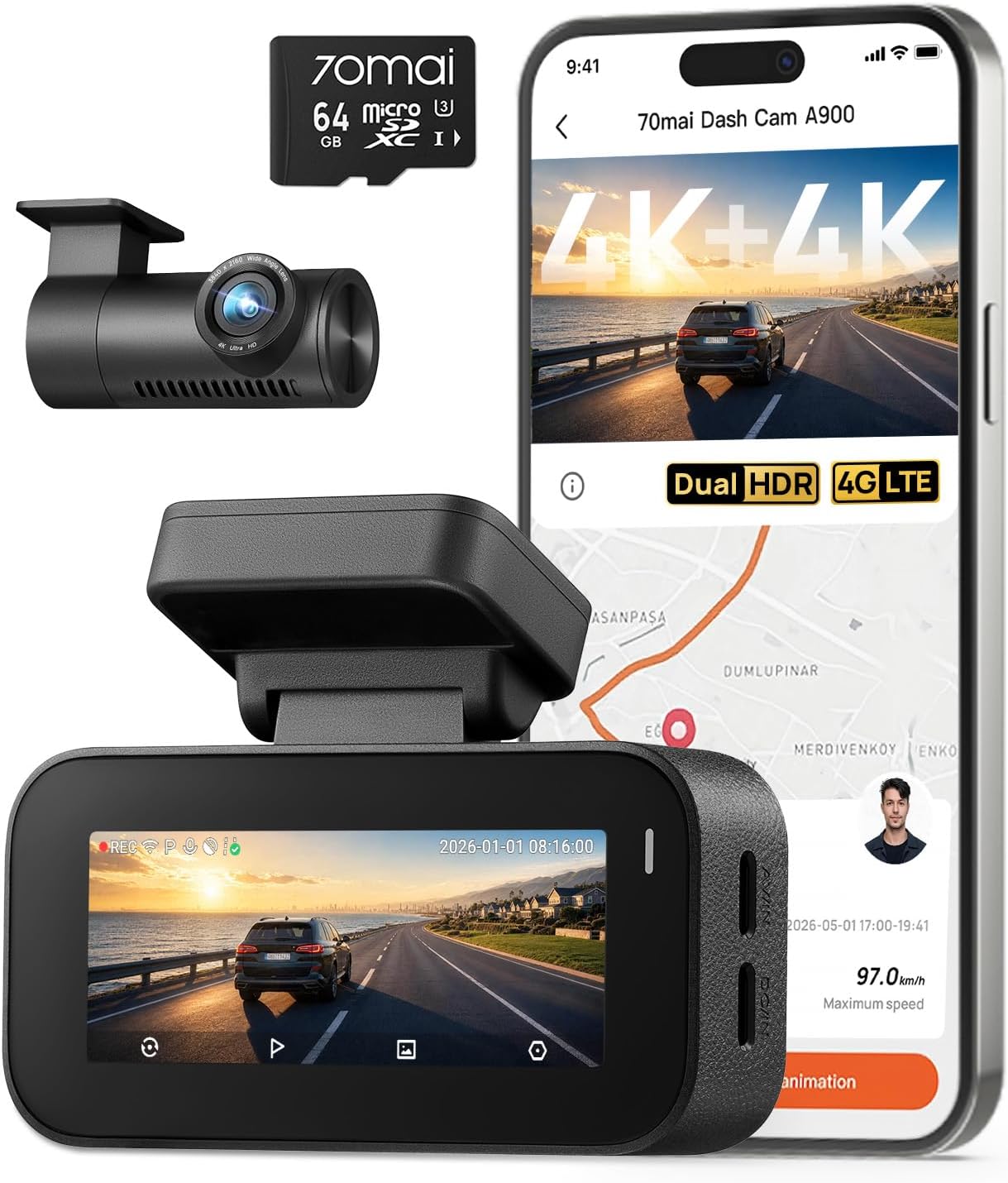
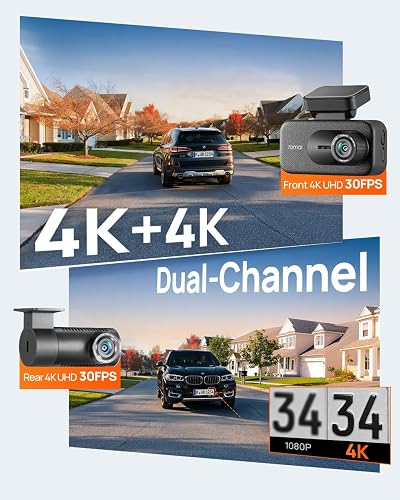
This is a dual-channel dash cam that records true 4K (3840x2160) at 30fps on both the front and the rear camera, not the upscaled 2K that a lot of cameras still call 4K. Each lens has a 140-degree field of view, an f/1.55 aperture, and HDR, and the whole thing runs off USB-C power from your car’s 12-volt socket. You also get Wi-Fi 6, built-in GPS, voice control, a supercapacitor instead of a lithium battery, and the hardware for 70mai’s 4G cloud features.
I went through the camera and its app end to end, then cross-checked my impressions against what owners on Reddit, Amazon reviewers, and dash cam forums are reporting. The short version: as a driving camera it’s genuinely good value, with a few caveats worth understanding before you buy, most of them around the parking mode and the sensor it uses.
What I Liked
Five things stood out after going through the A900, and they line up with what early owners and dash cam testers are praising.
True 4K Recording on Both Front and Rear
This is the whole reason to look at the camera. Both lenses capture a real 3840x2160 image, so you can pause a clip from either camera and actually read a license plate. That matters most on the rear, because almost every dual setup cuts corners there: even pricier cameras often drop the rear to 1080p, where plates only resolve if the car is right on your bumper. On the A900 the rear footage is as clean as the front. A tester on the DashCamTalk forum who ran it for weeks put it plainly: “The A900 produces sharp footage, strong colors, and very good plate detail during the day. Front and rear both perform very well.” HDR on both channels keeps a plate readable instead of a blown-out white rectangle when you drive into a tunnel or straight at the sun, and you can schedule HDR to switch on only in the evening if you want.
Genuinely Usable Night Footage, Front and Rear
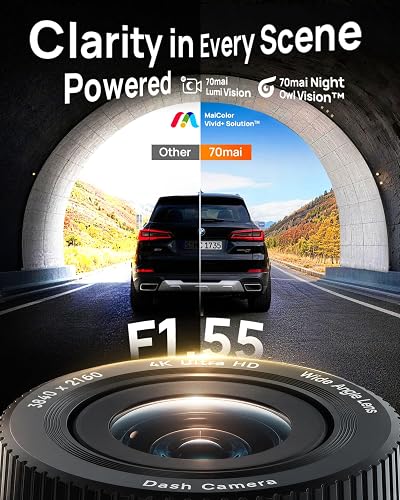
Both lenses use that f/1.55 aperture, which is a wide opening that lets more light hit the sensor, paired with 70mai’s Night Owl Vision and MaiColor Vivid+ processing. On a dark street under street lights you can still pick out plates and pedestrians on both cameras, not just the front. One Amazon reviewer who compared it to older 70mai hardware called its night image “almost perfect,” adding that away from direct headlight glare it is “better than a lot of IMX675 dash cams.” Keep expectations realistic, though: no dash cam reads every plate at highway speed in total darkness, and the camera is at its best in the city and below about 70 km/h.
Fast Wi-Fi 6 Transfers and a Polished App
A 4K clip is a big file, and on older cameras with slow Wi-Fi, pulling even one clip to your phone is a wait. The A900 runs Wi-Fi 6 on both the 2.4 and 5 GHz bands, so a transfer finishes quickly enough that you can stand at the roadside and have the footage on your phone to show someone. The 70mai app gives you a live view, lets you flip between the front and rear camera, and shows a shared timeline where both channels line up on the same timestamp. Every setting is adjustable from your phone, which is easier than poking at the little on-screen display (OSD) menu on the unit itself. Built-in GPS quietly stamps each clip with your speed and route, so if there’s ever a dispute about how fast you were going, that data is baked into the video.
A Supercapacitor Made for Brutal Summer Heat
Instead of the lithium battery that older dash cams used, the A900 runs on a supercapacitor, and the reason that matters is heat. Batteries swell and die baking on a windshield all summer, which is a complaint you still see about older 70mai models on Reddit. The supercapacitor is rated from -4 up to 158 degrees Fahrenheit, so it is built to live in the glass year-round. The unit also charges and powers over USB-C at both ends, including the rear-camera link, which makes future camera swaps far less of a headache than the proprietary connectors some rivals still use.
Wide 140-Degree Coverage and a Discreet Body
Each camera sees 140 degrees, so on a three- or four-lane road you are capturing the lanes on either side of you plus the shoulder or sidewalk, front and back. If someone drifts into you from the side, it is in the frame instead of just off the edge. The front unit is compact with a retro-camera look, and it mounts on a static cling sticker rather than sticking adhesive straight to the glass, so it peels off clean if you move it or sell the car. If you want that same fast-transfer convenience with a third cabin channel for rideshare or delivery work, the Vantrue N4S 3-Channel Dash Cam adds an interior camera, and budget-minded buyers can compare it against the BOTSLAB G300 Plus 4K Dash Cam.
What Needs Improvement
The A900 gets the fundamentals right, but there are real trade-offs worth knowing before you commit, and most of them cluster around parking and the choice of sensor.
Serious Parking Protection Needs a Hardwire Kit
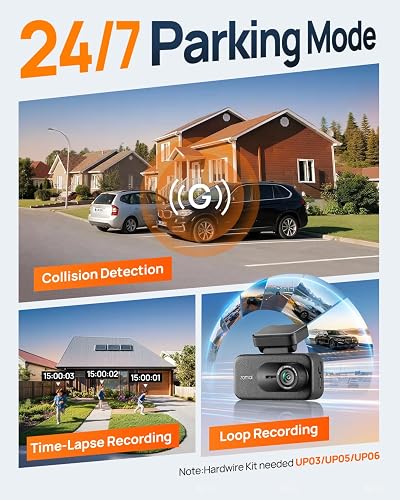
The 24/7 parking surveillance is a headline feature, but the included car charger only powers the camera while the engine is running. To keep watching the car once it is off, you need constant power, which means buying 70mai’s hardwire kit (UP03, UP05, or UP06) separately. The kit does add low-voltage protection that cuts itself off before it can drain your car battery, which is genuinely useful, but the point stands: real parking protection is a second purchase. This is true of nearly every dash cam, yet the listing’s “24/7” messaging can leave buyers expecting more out of the box than they get.
Parking Mode Skips Motion Detection and Low-Bitrate Recording
Even once it is hardwired, the parking feature set is thin. You get impact (collision) detection and time-lapse recording, and that is it. There is no motion detection and no low-bitrate continuous mode, both of which the pricier A900 Ultra includes through its AI-based parking system. The DashCamTalk tester called this “clearly the biggest weakness of the A900,” and noted a practical catch: when an impact triggers a clip, the camera records about 30 seconds after the hit, so you can miss the moment itself unless time-lapse is already running. If catching the person who dinged your door is your main goal, that limitation matters.
The GC8613 Sensor Trails the Ultra at Night
The standard A900 uses GalaxyCore GC8613 sensors rather than the Sony STARVIS 2 IMX678 found in the A900 Ultra. In good light the GC8613 is genuinely sharp, but as a Reddit owner flagged, “this model isn’t the ‘ultra’ version… it comes with the more economical GC8613 sensors.” In testing, night plate capture held up well in lit city streets and at lower speeds, but above roughly 70 km/h, or on unlit rural roads, the Sony sensor pulls clearly ahead. The rear camera also struggles to read plates once you are away from street lighting, and one early buyer reported glare and rear-defroster lines interfering with the rear image on their car. It is also worth noting the A900 records at 30fps only, with no 60fps option.
4G Cloud Needs a Module, a SIM, and a Data Plan
The remote features, live view from anywhere, collision alerts on your phone, cloud backup of emergency clips, and two-way talk, all run through 70mai’s optional 4G module (UP05), which ships with a SIM but still requires a data plan on top. On top of that, 70mai’s full Cloud+ 2.0 feature set is still rolling out through firmware updates, so check what is actually live when your unit arrives. One more friction point several owners raise: the 70mai app, and even firmware updates, are locked behind a mandatory account you have to register with an email. None of this is a dealbreaker, but it means the camera’s most advanced tricks are gated behind extra hardware, a subscription, and some patience.
How It Compares
At a street price that reviewers have pegged around $200 (and often less with a coupon), the A900 sits at the entry-level end of dual 4K dash cams, and the most important comparison is with its own sibling. The 70mai A900 Ultra uses Sony STARVIS 2 IMX678 sensors on both cameras, adds Night Owl Vision 2.0 and an AI-driven low-power parking mode, and uses a slim LVDS rear connection. If night plate capture at speed and motion-based parking are your priorities, the Ultra is the technically stronger system, and you pay for it. The standard A900 is the right call when you want true dual 4K and solid 4G without the flagship cost.
Against the wider market, Wirecutter’s current overall pick is the Viofo A229 Pro, which pairs a 4K front and 2K rear using dual Sony sensors, includes a CPL filter, and offers three parking modes, including the low-bitrate continuous recording the A900 lacks. It costs more (around $270) and its rear tops out at 2K rather than true 4K, so the A900 actually wins on rear resolution while the Viofo wins on night sensor and parking flexibility.
The A900’s closest in-house rival is the older 70mai A810, which uses a Sony STARVIS 2 front sensor with class-leading front night quality but only a 1080p rear on a more proprietary connector. The A900 trades a little front-camera sharpness for a genuine 4K rear and tidy USB-C connections. And if you need to record the cabin, a three-channel rig like the TERUNSOUL 4K 3 Channel Dash Cam or the iiwey N5 4-Channel Dash Cam covers front, rear, and interior at once, something no two-camera 70mai does. For most drivers who only care about the road ahead and behind, though, the A900’s dual native 4K is the stronger evidence setup.
Final Verdict
As a driving camera, the 70mai A900 is an easy one to recommend. You get true 4K on both ends with HDR, wide 140-degree coverage front and back, fast Wi-Fi 6 transfers, built-in GPS, and a supercapacitor that won’t cook in the summer, all in a unit that all but disappears behind your mirror. Daytime footage is sharp enough to read plates on either camera, and night performance is a real step up from a budget dash cam, as long as you are realistic about speed and lighting.
The caveats are honest ones rather than dealbreakers. The parking mode is limited and needs a separate hardwire kit, the 4G cloud features add a module and a data plan, the GC8613 sensor trails the Ultra’s Sony at night, and it records at 30fps only. But if what you actually care about is reading the plate, front or back, day or night, without paying flagship money, the A900 delivers that squarely. Whether it is your first 4K dash cam or an upgrade from a 1080p rear setup, it earns a confident 4.1 out of 5 and is well worth a look.
Specifications
| auto_part_position | Front, Rear |
| Brand | 70mai |
| built_in_media | Car Charger x 1 Memory Card x1 & Lens Wipe x 2, Dash Cam ×1, Data Transfer Cable x 1 & Power Cord ×1 & Rear Camera Cable x 1 User Manual x1, Electrostatic Sticker × 4 & Adhesive Sticker × 2 Adhesive Cable Clip x 5 & Wiring Trim Tool x1, Rear Camera x 1 |
| Color | Black |
| compatible_devices | Laptop, Personal Computer, Smartphone, Tablet |
| compatible_with_vehicle_type | Car, Minivan, Truck |
| Connectivity Technology | WiFi 6 5GHz |
| control_method | App, Push Button, Remote, Voice |
| display_type | LED |
| Field Of View | 140 degrees |
| flash_memory_supported_size_maximum | 512 GB |
| flash_memory_type | microSD |
| frame_rate | 30FPS |
| included_memory_card_size | 64 GB |
| item_dimensions_d_x_w_x_h | 3.58"D x 0.98"W x 1.81"H |
| item_weight | 115.1 g |
| manufacturer | 70mai |
| maximum_aperture | 1.55 f_stop |
| memory_slots_available | 1 |
| memory_storage_capacity | 64 GB |
| Model Name | A900 |
| model_number | A900 |
| Mounting Type | Dashboard Mount |
| number_of_items | 1 |
| number_of_packs | 1 |
| optical_sensor_technology | CMOS |
| other_special_features_of_the_product | App Control, Built-In Microphone, Compact Design, Night Vision, Voice Control |
| photo_sensor_size | 1/2.8 inches |
| real_angle_of_view | 140 degrees |
| screen_size | 3.18 inches |
| unit_count | 1 Count |
| Video Capture Resolution | 2160p |
| warranty_description | 18 months |
| Vehicle Service Type | Car, Minivan, Truck |
| Special Feature | App Control, Built-In Microphone, Compact Design, Night Vision, Voice Control |
| Included Components | Car Charger x 1 Memory Card x1 & Lens Wipe x 2, Dash Cam ×1, Data Transfer Cable x 1 & Power Cord ×1 & Rear Camera Cable x 1 User Manual x1, Electrostatic Sticker × 4 & Adhesive Sticker × 2 Adhesive Cable Clip x 5 & Wiring Trim Tool x1, Rear Camera x 1 |
Frequently Asked Questions
Is the 70mai A900 a true 4K dash cam?
Yes. Both the front and rear cameras record a native 3840x2160 image at 30fps, not an upscaled 2K signal that some cameras market as 4K. In testing, daytime footage was sharp enough to read plates on either camera. The main asterisk is the sensor itself, which is a GalaxyCore GC8613 rather than the Sony STARVIS 2 used by the pricier A900 Ultra.
Does the 70mai A900 need a hardwire kit for parking mode?
Yes, for round-the-clock parking surveillance. The included car charger only powers the camera while the engine is running, so you need 70mai's separately sold hardwire kit (UP03, UP05, or UP06) to keep it recording while the car is off. The kit adds low-voltage protection so it won't drain your car battery.
Does the 70mai A900 include a memory card?
Yes, it ships with a 64GB microSD card and supports cards up to 512GB. Because two 4K streams write a lot of data, a larger high-endurance U3-rated card is a worthwhile upgrade if you want more loop-recording time before footage overwrites.
How good is the 70mai A900 at night?
Good for its class, with limits. The f/1.55 aperture and 70mai's Night Owl Vision processing keep plates and pedestrians visible under street lighting on both cameras. Night plate capture weakens above roughly 70 km/h and on unlit roads, where the Sony sensor in the Ultra does noticeably better.
What is the difference between the 70mai A900 and the A900 Ultra?
The Ultra uses Sony STARVIS 2 IMX678 sensors, adds Night Owl Vision 2.0, a slim LVDS rear cable, and an AI low-power parking mode with motion detection. The standard A900 uses GalaxyCore GC8613 sensors and a simpler parking mode, but still records true dual 4K and costs less.
Does a 70mai dash cam drain your car battery?
While driving, no, it runs off your car's power. In parking mode it draws from a hardwire kit, which includes a low-voltage cutoff that shuts the camera down before your battery gets too low. The A900 itself uses a supercapacitor rather than a lithium battery, which also handles heat better.
Is 70mai a reputable dash cam brand?
Yes. 70mai is an established maker in the Xiaomi ecosystem with a wide model range and a following among dash cam enthusiasts. The A900 is a newer dual 4K model, so it carried few aggregate Amazon ratings at the time of this review, but forum and early-owner feedback has been largely positive.
Ready to Buy?
70mai A900 4K Dash Cam delivers on its promises. If it fits your needs, it's a solid choice you won't regret.
Check Price on Amazon Founder & Product Reviewer at TheReviewRewind
Daniel has tested 400+ products across 20+ categories through hands-on, real-world testing. Every review includes video documentation and standardized scoring criteria. His reviews appear as Amazon shoppable videos and here on TheReviewRewind.
We earn a commission if you make a purchase, at no extra cost to you. This does not influence our ratings or recommendations. Full disclosure
Looking for more options? See all our Electronics reviews.
Related Reviews