LEDINO Red Light Therapy Panel Review: Flexible Stand, Honest Limits


LEDINO Red Light Therapy Panel Review: Flexible Stand, Honest Limits
LEDINO Red Light Therapy Panel
Buy if you want an affordable, genuinely flexible 660nm + 850nm panel with a 40-60 in stand, pop-off desktop mount, timer, and goggles for face and recovery use. Skip if you need published, measured irradiance, full-body coverage, or a premium build.
Buy on AmazonWhat We Liked
- True 660nm And 850nm Dual Wavelength In One Panel
- Unusually Flexible Stand And Pop-Off Panel Design
- Curved Panel Spreads Light Over Face And Body
- Five Levels, Auto-Off Timer, Remote, And Goggles
- Budget Price With Flicker-Free, No-Blue-Peak Output
What Could Be Better
- Advertised Irradiance Is An Unverified Seller Claim
- Base Topples When The Head Is Cantilevered Out
- Level Five Runs Warm At The Panel Surface
- Plastic Housing And No Published Lab Output Data
How we test: Every product is used in real conditions and evaluated using our standardized scoring criteria. Read our full review methodology.
If you have been curious about red light therapy but do not want to book a spa or recovery-clinic appointment every week, a stand-mounted home panel is the obvious shortcut. The LEDINO Red Light Therapy Panel is one of the cheapest ways to try that, pairing 660nm red and 850nm near-infrared light in a single curved panel on an adjustable floor stand for around $53.
I went through it the way most buyers actually use one: a flexible panel you point at your face for skincare and at sore muscles after a workout. The LEDINO delivers real dual-wavelength output and a genuinely clever stand, but it also carries the caveats every budget LED panel does — an irradiance number you cannot verify, a base that needs a counterweight in some positions, and results that only show up with consistent use.
Here is what the LEDINO Red Light Therapy Panel gets right, where it falls short, and who should actually buy it.
True 660nm And 850nm Dual Wavelength In One Panel
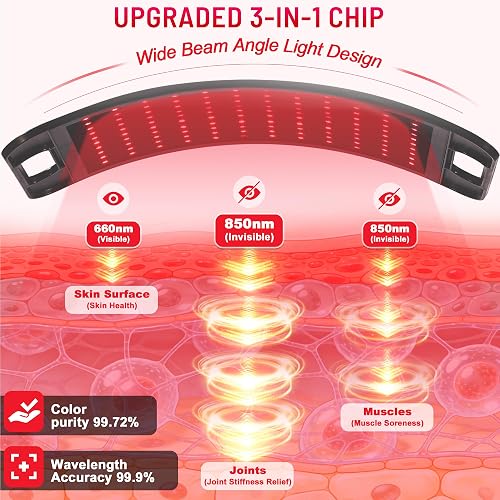
The core of any red light therapy panel is the light itself, and the LEDINO runs both wavelengths that matter. The panel packs 360 LED chips — 120 at 660nm red for the skin surface and 240 at 850nm near-infrared that pushes deeper into muscle and joint tissue. LEDINO calls it a “3-in-1 chip,” which simply means each lens cup holds one red plus two near-infrared emitters rather than a single bulb.
You are not forced to pick one or the other. Both run together by default (the remote even labels the startup mode 660nm + 850nm + 850nm), so a single session covers skincare and recovery at once. That is the setup the video reviewer reached for after training five to six days a week, and the near-infrared side is the one he said took the edge off sore spots with consistent use. If you want that same 660nm and 850nm pairing somewhere hot and humid, the BestQool Waterproof Red Light Therapy Panel is built to run safely inside a sauna or steam shower. For aiming that near-infrared at a single joint rather than a whole panel, the Kineon Move+ Pro Red Light Therapy Wrap straps the same wavelengths directly onto a knee, elbow, or shoulder.
Unusually Flexible Stand And Pop-Off Panel Design
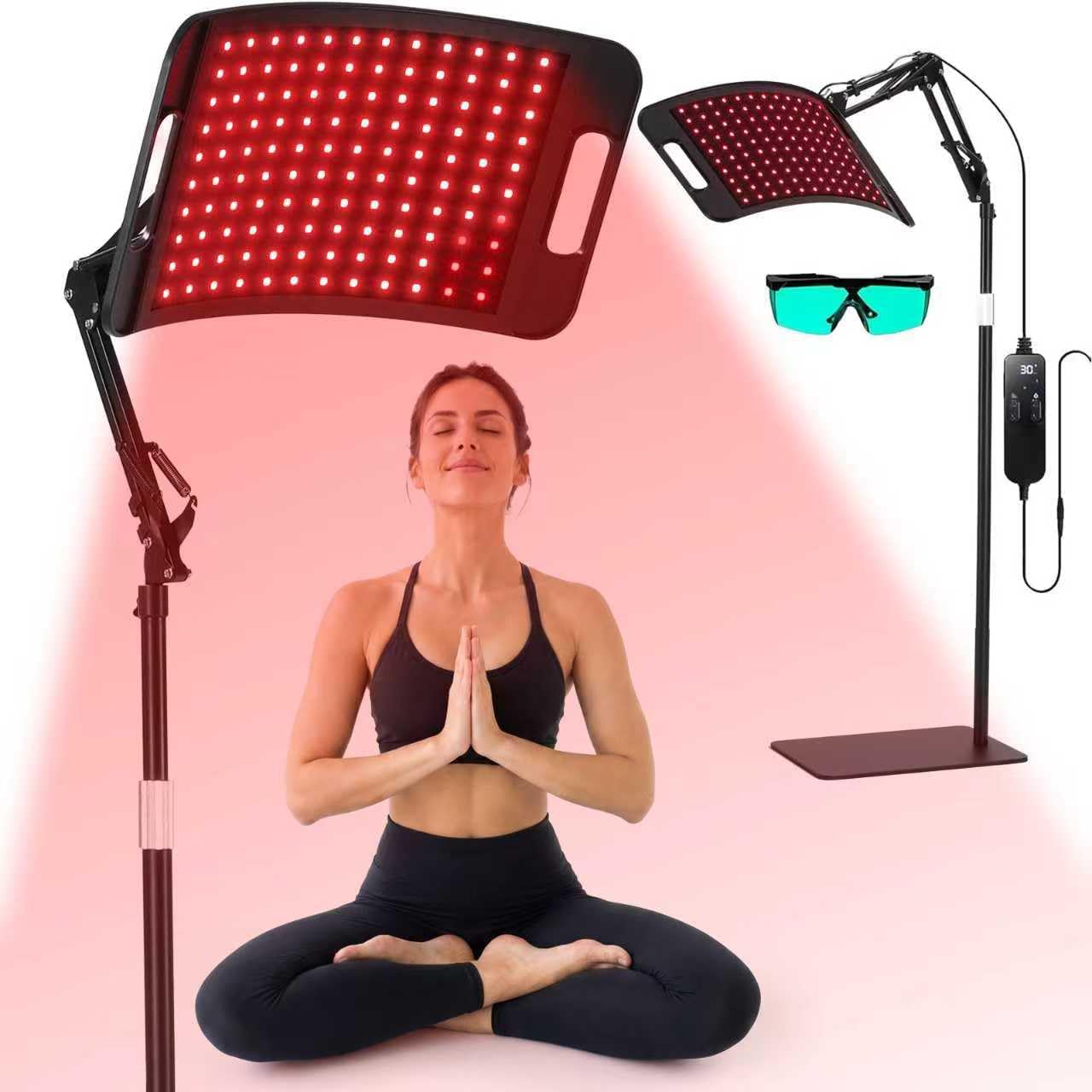
Flexibility is where this panel earns its keep. The floor stand adjusts from 40 to 60 inches, the head rotates a full 360 degrees on a ball mount, and it holds its angle without sagging once you lock it. You can aim it straight down at your knees, level at your back in a chair, or tilt it up at your face on the couch.
The panel also pops off the stand and drops into a smaller desktop stand for quick face sessions, and the whole thing folds down to roughly 16 x 10 x 3.8 inches for storage. It plugs straight into a wall outlet with no bulky transformer and accepts multiple voltages, so there is no brick to trip over. Compared with the heavy, single-angle metal panels that are a chore to reposition, the LEDINO is easy to move and easy to actually keep using.
Curved Panel Spreads Light Over Face And Body
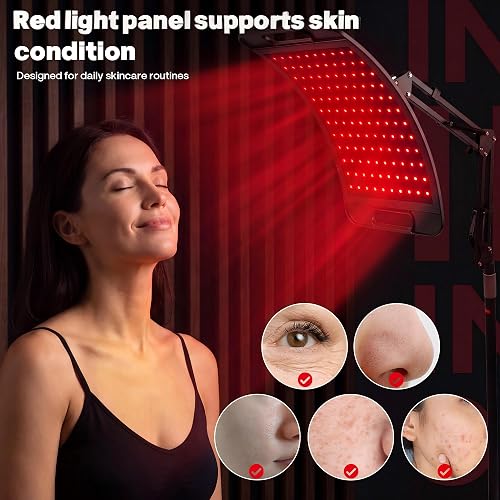
At 15.5 x 8.75 inches, the panel is large enough to treat your back, shoulders, or whole face without constantly repositioning it. The curve is the part most flat panels skip — it wraps the light slightly so it lands more evenly across your face and over rounded areas like shoulders and calves, instead of concentrating on one flat spot.
Five Levels, Auto-Off Timer, Remote, And Goggles
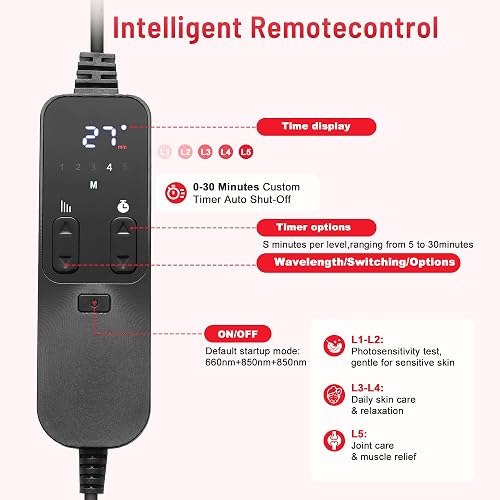
The screened remote offers five intensity levels: L1 to L2 are gentle for a photosensitivity test or sensitive skin, L3 to L4 are the daily-use range, and L5 is the strong setting. A 1-to-30-minute auto shut-off timer handles the detail that matters most — these sessions are relaxing, so if you doze off the panel turns itself off rather than staying on. LEDINO also includes protective goggles, which it recommends wearing whenever the panel faces you, plus the desktop stand in the box.
Budget Price With Flicker-Free, No-Blue-Peak Output
For roughly $53, the measurable light quality is better than the price suggests. LEDINO’s own comparison panel lists a 620-670nm range with no blue peak (under 0.1 percent) and flicker-free operation above 1000Hz. There is no UV, so it will not tan you, and the lack of visible flicker makes longer sessions more comfortable than cheap blinking LEDs. As an entry point into red light therapy, the cost of admission is low.
Advertised Irradiance Is An Unverified Seller Claim
LEDINO lists 203-206 mW/cm² at level five, but the number comes with no measurement distance and no independent test, which makes it close to meaningless for comparison. This is the single biggest caveat with any budget Amazon panel. One Reddit owner measured a panel advertised at over 100 mW/cm² and got roughly 2 mW/cm² on their own meter before returning it. A peer-reviewed photobiomodulation review is blunt about why this matters: “The parameters of most importance in PBM are the power density (irradiance) and the energy density (fluence)” — in other words, the real dose at your actual treatment distance decides whether anything happens, not the bead count or the headline wattage. Treat LEDINO’s figure as a ceiling, not a delivered dose.
Base Topples When The Head Is Cantilevered Out
The stand is stable when the panel points the same direction as the base, but the reviewer was candid about the limit: swing the head out so it makes a right angle with the base and “it’ll just topple over” unless you set a weight on the base. LEDINO clearly knows this, because the listing advertises a “Bracket Stability Upgrade” with reinforced screws and a heavier base — an admission that earlier stability was a weak point. Plan to counterweight it for any off-axis position, especially around kids or pets.
Level Five Runs Warm At The Panel Surface
The panel is not a heat lamp, but level five runs warm at roughly 104-110°F at the surface, pulling 43-45W. For short, close-range sessions some users find that hot, and it is worth keeping a little distance or dropping to L3-L4 if you are sensitive. The lower levels stay comfortable.
Plastic Housing And No Published Lab Output Data
The panel is plastic on the outside, and while the metal base feels solid, the build sits squarely in mid-tier territory. The video reviewer put it plainly: this is not the highest-quality panel on the market. There is also no third-party lab data behind LEDINO’s claims, and medical sources are consistent that at-home devices are weaker than in-office units. As the Cleveland Clinic notes, “In-office LED light therapy uses more powerful strengths than at-home devices,” so expect subtle rather than dramatic results, and know this is a wellness device, not a medical treatment.
LEDINO vs Hooga HG300
The Hooga HG300 is the value-tier benchmark at around $199. It runs the same two wavelengths (660 and 850nm) across 60 single-chip LEDs, publishes a claimed 73 mW/cm² at six inches, and backs it with a three-year warranty. The catch: it ships with a small tabletop kickstand, not a floor stand, and no remote.
The LEDINO undercuts it by roughly $145 and adds the things Hooga leaves out — a full 40-60 inch floor stand, a 360-degree head, a screened remote with five levels, and included goggles. Hooga’s edge is brand track record and a stated irradiance figure; LEDINO’s edge is flexibility and price. If you want measured-ish output from an established brand, Hooga. If you want the most adjustable setup for the least money, LEDINO. For a verified, higher-output step up, the BestQool Red Light Therapy Panel adds six wavelengths and independently measured irradiance. And if your focus is a single aching knee rather than full-body coverage, the LTW Knee Massager wraps red light therapy with heat and vibration around the joint itself.
LEDINO vs Mito Red MitoMIN 2.0
Mito Red’s MitoMIN 2.0 runs about $249 with a 50/50 split of 660 and 850nm across 60 LEDs, 85W draw, US-based support, and a two-year warranty. It is a more credible brand with better transparency, but its page lists “FDA Class II Registered,” which is not the same as FDA-cleared — a distinction worth noticing when marketing sounds medical.
Against it, the LEDINO is a fraction of the price and includes the floor stand Mito sells separately. You give up Mito’s reputation and support in exchange for cost and a bundled stand. For a shopper testing whether red light therapy does anything for them before spending real money, the LEDINO is the lower-risk experiment. If you want a similarly affordable stand panel with a larger head and a bundled timer, the Puroth Red Light Therapy Lamp is the closest budget alternative to weigh against it.
LEDINO vs PlatinumLED BIO 300
PlatinumLED’s BIO series is the premium reference, with the BIO 300 historically around $369 (the current BIO 450 lists at $499). It delivers higher measured output and the most published data, but uses a simple on/off switch with no levels or timer, and its mobile floor stand is a separate purchase.
The LEDINO cannot match PlatinumLED on raw output or lab transparency. What it offers instead is adjustable intensity, a built-in timer, a remote, and a complete stand kit for roughly one-seventh of the price. If measured dose and clinical backing are your priority, PlatinumLED earns the premium. If flexibility and affordability come first, the LEDINO makes sense. For targeted recovery rather than a full panel, a wearable like the Comfytemp Red Light Therapy Belt or the Comfytemp Red Light Shoulder Wrap wraps 660 and 850nm directly around the sore area.
My final rating for the LEDINO Red Light Therapy Panel is 4.2 out of 5. For about $53 you get a true dual-wavelength 660nm and 850nm panel, a 40-60 inch stand with a 360-degree head, a pop-off desktop mount, five intensity levels, a 1-to-30-minute timer, and goggles — a combination of flexibility and included extras that costs two to seven times more from Hooga, Mito, or PlatinumLED.
The honest limits keep it from scoring higher. The 203-206 mW/cm² irradiance figure is an unverified seller claim with no stated distance, the stand needs a counterweight when you cantilever the head to one side, and level five runs warm. None of those is a dealbreaker at this price, but they should be priced into the decision. This is a wellness device, not a medical treatment, and like every panel the results build gradually with near-daily use over weeks rather than overnight.
If you want to bring red light therapy home without the appointments — and without committing $200 to $500 before you know whether it helps you — the LEDINO is a sensible, flexible way to start. Buy it as a returnable experiment, use it consistently, and judge it on how your skin and sore spots actually respond.
This review is informational and is not intended to diagnose, treat, or prevent any disease, or to replace consulting a clinician when you are treating a health problem.
Specifications
| Wavelengths | 660nm red + 850nm near-infrared (dual) |
| LED beads | 360 chips (120x 660nm, 240x 850nm) |
| Panel size | 15.5 x 8.75 in, curved |
| Intensity levels | 5 (L1-L5) |
| Irradiance (claimed) | 203-206 mW/cm2 at L5, distance unstated |
| Power draw | 43-45W at L5 |
| Timer | 1-30 min auto shut-off |
| Stand | 40-60 in height, 360-degree rotating head |
| Panel temp at L5 | 104-110F |
| In the box | Panel, floor stand, desktop stand, remote, goggles |
| Weight | 6.88 lb (packaged) |
| Manufacturer | SHENZHEN YIHONG LIGHTING CO., LTD |
Frequently Asked Questions
Does the LEDINO red light therapy panel actually work?
It delivers genuine 660nm red and 850nm near-infrared light, the two wavelengths used for skin and deeper tissue, so the mechanism is real. But at-home panels are weaker than in-office units, and LEDINO publishes no independently measured irradiance, so expect subtle rather than dramatic results. Medical sources like the American Academy of Dermatology note it is difficult to know how effective at-home devices are because studies test different devices and schedules. Consistency over weeks matters more than any single session.
What wavelengths does the LEDINO panel use?
Two — 660nm visible red for the skin surface and 850nm near-infrared that penetrates deeper into muscle and joint tissue. The "3-in-1 chip" marketing refers to one red plus two near-infrared emitters per lens, not a third wavelength. Despite what some listicles claim, this specific model does not add 940nm; it is a dual-wavelength panel.
Is 10 minutes of red light therapy enough with this panel?
For a single area, roughly 10 to 15 minutes per session is a reasonable starting point, and the built-in timer runs from 1 to 30 minutes. More is not automatically better — red light therapy follows a biphasic dose curve, so very long sessions can reduce the benefit. Daily use over several weeks drives results far more than marathon sessions.
Is the LEDINO red light therapy panel FDA approved?
No at-home panel in this class is FDA approved. At most these devices are FDA-cleared or registered, which signals low risk rather than proof that they treat a specific condition. Treat the LEDINO as a wellness device, not a medical treatment, and consult a clinician for any health problem.
How do I keep the LEDINO stand from tipping over?
The base is stable when the panel faces the same direction as the base. When you swing the head out to one side so it makes a right angle with the base, set a weight on the base or it can topple. LEDINO added a "Bracket Stability Upgrade" with reinforced screws and a heavier base, but counterweighting in off-axis positions is still the safe habit.
What is the downside of red light therapy panels like this one?
The main downsides are unverifiable output claims, subtle and slow-building results, and the discipline required to use the device consistently. Budget panels in particular often measure far below their advertised irradiance, so the real dose at your treatment distance may be modest. It is best viewed as a low-cost, returnable experiment rather than a guaranteed fix.
Can you use the LEDINO panel for both skincare and muscle recovery?
Yes. The 660nm red light targets the skin surface for tone and collagen, while the 850nm near-infrared reaches muscles and joints for recovery, and both run together by default. The curved 15.5 x 8.75 inch panel and adjustable stand let you aim it at your face, back, shoulders, knees, or legs, so one device covers both use cases.
Ready to Buy?
LEDINO Red Light Therapy Panel delivers on its promises. If it fits your needs, it's a solid choice you won't regret.
Check Price on Amazon Founder & Product Reviewer at TheReviewRewind
Daniel has tested 400+ products across 20+ categories through hands-on, real-world testing. Every review includes video documentation and standardized scoring criteria. His reviews appear as Amazon shoppable videos and here on TheReviewRewind.
We earn a commission if you make a purchase, at no extra cost to you. This does not influence our ratings or recommendations. Full disclosure
Looking for more options? See all our Health & Household reviews.
Related Reviews