NOAA Solar Hand Crank Weather Radio Review: Is This 12000mAh Emergency Radio Worth It?


NOAA Solar Hand Crank Weather Radio Review: Is This 12000mAh Emergency Radio Worth It?
NOAA Solar Hand Crank Weather Radio
Buy it as an affordable do-everything emergency radio with strong AM/FM/NOAA reception, four ways to stay powered, and a real 12000mAh power bank. Skip it if you need hands-off weather alerts while it's switched off, since it only warns you while powered on and tuned to the weather band.
Buy on AmazonWhat We Liked
- Four Power Sources Keep It Running Off-Grid
- Strong, Clear AM, FM, and NOAA Band Reception
- Doubles as a 12000mAh Power Bank for Your Phone
- Bright 600-Lumen Flashlight, Reading Lamp, and SOS
- Solid, High-Visibility Build That Is Easy to Grab
What Could Be Better
- No True Passive Auto-Alert When Powered Off
- Not Public Alert Certified and No SAME Codes
- Solar Charging Is Only a Slow Trickle Charge
- Hand Crank Power Is Strictly a Last Resort
How we test: Every product is used in real conditions and evaluated using our standardized scoring criteria. Read our full review methodology.
When the power is out and the cell towers are jammed, the last thing you want is to be in the dark with no idea what the storm is actually doing. That is the whole reason a hand crank weather radio exists, and the NOAA Solar Hand Crank Weather Radio aims to be the one you grab first.
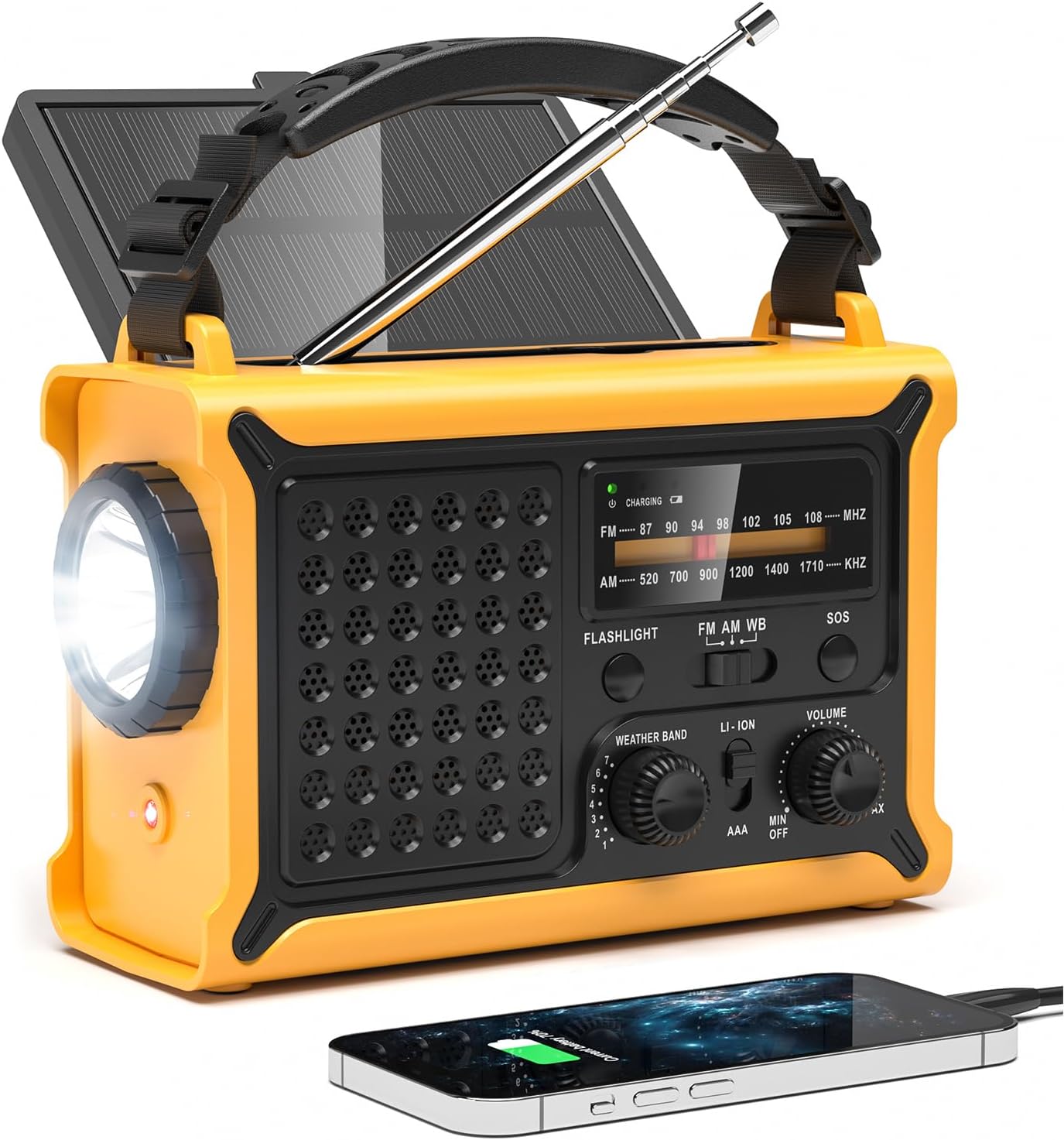
This portable emergency radio pulls in AM, FM, and all seven NOAA weather-band channels from the National Oceanic and Atmospheric Administration, then adds a flashlight, a reading lamp, an SOS siren, and a real 12000mAh rechargeable battery you can use to charge a phone. You can keep it running four ways: the built-in battery, a fold-out solar panel, a hand crank, and three AAA batteries as a separate backup.
I ran it through its paces on the bench, testing reception, the lights, the SOS siren, and the crank. At around $49.99 it undercuts the name brands, so the real question is whether it cuts any corners that matter. The short answer: it is a capable all-in-one radio with one alert limitation you need to understand before you buy.
What I Liked
For a budget emergency radio, this unit packs in more than its price suggests. These are the features that stood out during testing.
Four Power Sources Keep It Running Off-Grid
This is the heart of any emergency radio, and it does not lean on a single power source. You can recharge the built-in battery three ways, through the fold-out solar panel, the hand crank, or USB-C, and then drop in three AAA batteries as a completely separate backup.
That redundancy is the entire point when the grid goes down. If it is sunny you charge off the solar panel, if it is the middle of a storm you crank it, and if the battery is dead you run it on AAAs. You are rarely stuck without a way to power it.
Strong, Clear AM, FM, and NOAA Band Reception
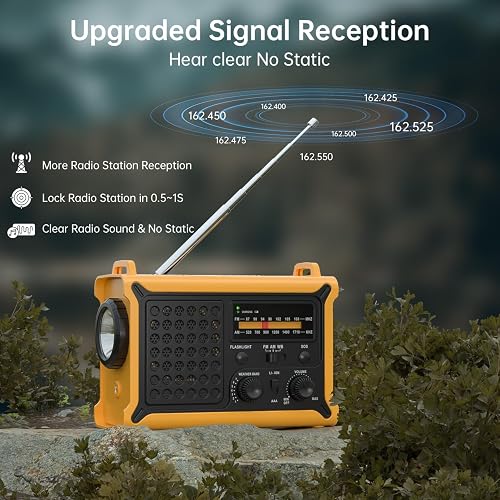
Reception was the pleasant surprise. With the telescoping antenna fully extended, the high-sensitivity chip pulled in AM, FM, and NOAA weather-band stations cleanly, without the static that plagues cheaper radios.
The 57mm, 5-watt speaker with its neodymium magnet gets loud enough to fill a room or a campsite, which matters when an alert is broadcasting. The sound is clear and intelligible for talk and FM broadcasting, though it is an emergency radio speaker, not a hi-fi system.
Doubles as a 12000mAh Power Bank for Your Phone
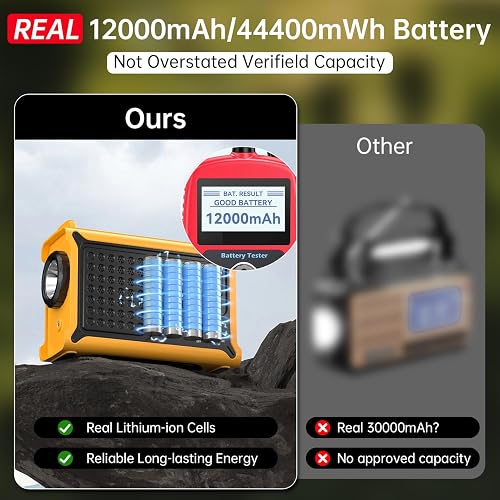
The 12000mAh rechargeable battery is the headline spec, and the gallery panels back up the “real, not overstated” claim with genuine lithium-ion cells. On a single charge the manufacturer rates it for roughly 60 hours of AM/FM radio, about 30 hours of the SOS siren, and around 60 hours of flashlight use.
Because the battery is that large, it also works as a battery charger. The USB-A and USB-C outputs will top off a smartphone or mobile phone enough to send a few texts or make a call, which is exactly what you need in a multi-day outage.
Bright 600-Lumen Flashlight, Reading Lamp, and SOS
The lighting is more than an afterthought. There is a front-facing flashlight, a separate reading lamp tucked behind the solar panel, and a dedicated SOS siren with a flashing red beacon, rated up to 600 lumens.
The flashlight and the lamp each have a bright and a dim setting, so the lamp is genuinely useful for reading in a tent or lighting a room during a blackout. The SOS siren is loud enough to get attention if you are hurt or stranded.
Solid, High-Visibility Build That Is Easy to Grab
The build does not feel cheap or hollow. The housing is sturdy, the carry strap takes a hard yank without complaint, and the whole thing is wrapped in a high-visibility yellow-orange shell that is easy to spot in a drawer or a go-bag.
A large analog tuning dial and simple band switch make it easy to operate quickly, even for older users. It is the kind of radio you keep on a shelf and forget about until the day you need it.
What Needs Improvement
No emergency radio is perfect, and a few of these trade-offs are important enough to change whether this is the right radio for you.
No True Passive Auto-Alert When Powered Off
This is the one limitation to understand before buying. The radio does not have a true passive auto-alert, so it will not wake itself up from off and sound a warning the way a dedicated desktop alert radio does.
To actually receive a weather warning, you have to leave it switched on and tuned to the weather band. You can turn the volume all the way down and it will still blare when an alert comes through, but it has to be sitting on that band, not fully off. Both the review footage and Amazon owners confirm this behavior.
Not Public Alert Certified and No SAME Codes
The listing’s “approved by NOAA” language is marketing, not a certification. The National Weather Service is explicit that it does not endorse any make or model, and it tells buyers to look for the Public Alert (CTA-2009-C) standard and the NOAA Weather Radio All Hazards logo, which this radio does not carry.
It also lacks SAME, the Specific Area Message Encoding that lets a radio alert only for your specific county. Without it, you hear every warning in the transmitter’s range. There is no shortwave radio band here either, so if you want shortwave or county-specific filtering, this is not that receiver.
Solar Charging Is Only a Slow Trickle Charge
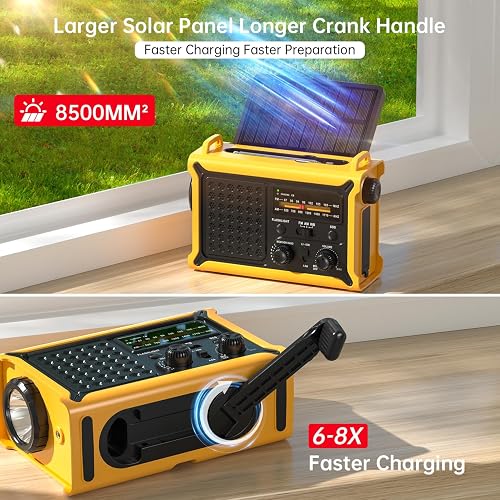
The box advertises an oversized 8500mm2 solar panel with “6-8x faster” charging, but set your expectations for real-world use. In practice, solar on radios like this is a trickle that is best for maintaining a charge rather than filling an empty battery from zero.
Leave it on a sunny windowsill or dashboard and it will add a useful top-up over hours, not minutes. On an overcast day, plan to charge over USB-C instead. There is also no battery-level percentage indicator, so remaining runtime is a bit of a guess.
Hand Crank Power Is Strictly a Last Resort
The hand crank works, and the fold-out handle is larger than the stubby cranks on smaller radios, which does make it easier to turn. It is still the least efficient way to power the unit.
Expect to keep cranking continuously, and a lot of turns, to put a meaningful charge into the battery. Treat it as the backup for when the sun is gone and the battery is flat, not as your everyday recharge method.
How It Compares
Emergency radios range from no-name all-in-ones to certified desktop alert units. Here is where this one lands against the alternatives you will see on Amazon and Walmart.
vs Midland ER310 and WR120B
The Midland ER310 is the model preppers point to most often. It has a tougher reputation, a bright CREE flashlight, and reliable NOAA weather scanning, but it typically costs noticeably more and still lacks SAME county alerts. If build reputation matters most and you can spend up, it is the safer name-brand pick.
For actual hands-off alerting, the Midland WR120B is the real benchmark. It is Public Alert certified, supports SAME county codes, and wakes from standby to sound a warning. The catch is that it is an AC and battery desktop unit, with no crank, no solar, and no power-bank function, so it is a home base station rather than a grab-and-go tool.
vs RunningSnail and Eton Crank Radios
The RunningSnail Solar Crank radio is the closest budget rival, usually with a smaller battery in the 4000 to 6000mAh range. This PPLEE unit’s 12000mAh pack is the clear advantage if you want it to double as a serious battery charger.
Eton’s American Red Cross crank radios step up with extras like SAME alerts, Bluetooth, and an ambient light, but you pay for them. None of these budget cranks, including this one, match a dedicated receiver on pure alert reliability.
vs the Mesqool and Roxicosly CR1030
Here is the detail most listings hide: this radio shares the CR1030 model number with the Mesqool and Roxicosly versions. They are essentially the same hardware, the same 12000mAh battery, and the same 8500mm2 solar panel, sold under different brand names. If you are cross-shopping them, ignore the badge and the inflated test scores on affiliate listicle sites, and simply buy whichever twin has the better price and seller rating on the day.
Final Verdict
The NOAA Solar Hand Crank Weather Radio delivers on what matters most in an emergency radio. Reception is strong and clear across AM, FM, and the NOAA weather band, the four power options mean you are rarely stuck, and the 12000mAh battery genuinely pulls double duty as a flashlight and a phone power bank. For around $49.99, that is a lot of capability.
I am giving it a 4.0 out of 5.
It loses points for things that matter on a device you are trusting in a storm. There is no true power-off auto-alert, no Public Alert certification, and no SAME county filtering, so it is a radio you have to leave switched on to stay protected. The solar panel is a trickle and the crank is a last resort, which is normal for this class but worth knowing.
Bottom line: If you want an affordable, do-everything radio to keep in the house, the car, or a go-bag, this is an easy recommendation, and I would grab two. If you specifically need a set-it-and-forget-it alert radio that wakes itself up, pair it with a Public Alert certified unit like the Midland WR120B instead.
Specifications
| additional_features | Built-In AM Antenna, Built-In Flashlight, Portable Emergency radio, Rechargeable, SOS Alarm |
| audio_output_mode | Stereo |
| Brand | PPLEE |
| built_in_media | Owner's Manual, Power Adapter, Weather radio |
| Color | Yellow |
| compatible_devices | phone tablet |
| Connectivity Technology | Auxiliary, USB |
| display_type | LED |
| frequency | 162.5 MHz |
| hardware_interface | Radio Frequency |
| Product Dimensions | 4.7"L x 2.9"W x 6.8"H |
| item_highlight | AM/FM, 8500mm² Solar Panel, Rechargeable Battery, Flashlight, Reading Light, SOS and USB Charging for Camping and Emergencies |
| manufacturer | PPLEE E-commerce Co.Ltd |
| model_number | CR1030 |
| number_of_batteries | 1 Nonstandard Battery batteries required. (included) |
| number_of_items | 1 |
| Power Source | Hand Crank, Solar Panel, AC 110V, 12000mAh Rechargeable Battery, 3*AAA Battery |
| Radio Bands Supported | FM:87.5-108 MHz / AM:520-1710 KHz /7 NOAA Weather Band: 162.400MHz;162.425MHz;162.450MHz;162.475MHz;162.50MHz;162.525MHz;162.550MHz |
| speaker_maximum_output_power | 5 watts |
| Style | Weather Radio |
| tuner_type | AM/FM/NOAA Weather Radio |
| unit_count | 1 Count |
| warranty_description | 1 Year Manufacture |
| water_resistance_level | Waterproof |
| Special Feature | Built-In AM Antenna, Built-In Flashlight, Portable Emergency radio, Rechargeable, SOS Alarm |
| Tuner Technology | AM/FM/NOAA Weather Radio |
| Included Components | Owner's Manual, Power Adapter, Weather radio |
Frequently Asked Questions
What weather radio does NOAA actually recommend?
NOAA and the National Weather Service do not endorse any specific make or model. They recommend you look for a receiver that is Public Alert certified (CTA-2009-C) and carries the NOAA Weather Radio All Hazards logo, ideally with SAME technology for county-specific alerts. This radio is not Public Alert certified and does not have SAME, so treat it as a capable all-in-one rather than a certified alert receiver.
Does the NOAA Solar Hand Crank Weather Radio have automatic weather alerts?
Not in the hands-off sense. It will not wake itself up from a powered-off state and sound a warning. To get alerts you leave it switched on and tuned to the weather band, where you can turn the volume down and it will still blare when a warning broadcasts.
Can the NOAA Solar Hand Crank Weather Radio charge a phone?
Yes. The real 12000mAh battery feeds USB-A and USB-C outputs, so it works as a power bank for a smartphone. Expect enough charge for calls and texts in an outage rather than multiple full phone charges, especially if you are also running the radio and lights.
How long does the battery last on a single charge?
The manufacturer rates the 12000mAh battery at roughly 60 hours of AM/FM radio, about 30 hours of the SOS siren, and around 60 hours of flashlight use. Real runtime depends on volume, brightness, and whether you are also charging other devices.
Do hand crank weather radios really work?
They do, but cranking is the least efficient way to power one. On this radio a lot of continuous cranking yields only a modest charge, so the crank is a genuine last resort. Day to day you will rely on USB-C and the solar panel, with the crank reserved for when everything else is dead.
What is the best hand crank weather radio?
It depends on your priority. The Midland ER310 is the community favorite for build quality, and the Midland WR120B is the pick for certified, hands-off county alerts. This NOAA Solar Hand Crank Weather Radio is the value choice if you want the biggest battery and the most features for the money.
Ready to Buy?
NOAA Solar Hand Crank Weather Radio delivers on its promises. If it fits your needs, it's a solid choice you won't regret.
Check Price on Amazon Founder & Product Reviewer at TheReviewRewind
Daniel has tested 400+ products across 20+ categories through hands-on, real-world testing. Every review includes video documentation and standardized scoring criteria. His reviews appear as Amazon shoppable videos and here on TheReviewRewind.
We earn a commission if you make a purchase, at no extra cost to you. This does not influence our ratings or recommendations. Full disclosure
Looking for more options? See all our Electronics reviews.
Related Reviews