Cobra HHRT50 Road Trip CB Radio Review: How Far Does It Really Reach?


Cobra HHRT50 Road Trip CB Radio Review: How Far Does It Really Reach?
Cobra HHRT50 Road Trip CB Radio
Buy if you want a no-license handheld CB for convoys, overlanding, or an emergency kit and you will lean on the included magnetic roof antenna for usable range. Skip if you expect constant CB chatter in everyday driving, need a weather-sealed radio, or want the longest possible range without upgrading the antenna.
Buy on AmazonWhat We Liked
- Included Magnetic Roof Antenna Makes the Signal Actually Get Out
- Soundtracker Noise Reduction Delivers Clearer CB Audio
- 40 CB Channels Plus 10 NOAA Weather Channels Built In
- Instant Channel 9 and 19 Plus Dual Watch Monitoring
- Runs Off Your 12V Outlet and Bypasses the Batteries
- Twist-Off Antenna Lets You Upgrade for Far More Range
What Could Be Better
- Stock Rubber Antenna Only Reaches About a Mile Open-Air
- Not a Weather-Sealed Unit With Its Exposed Side Ports
- Takes Nine AA Batteries and Adds Half a Pound of Weight
- No USB-C Charging in a 12V-Only Power Design
- CB Airwaves Are Often Dead Outside of Emergencies
How we test: Every product is used in real conditions and evaluated using our standardized scoring criteria. Read our full review methodology.
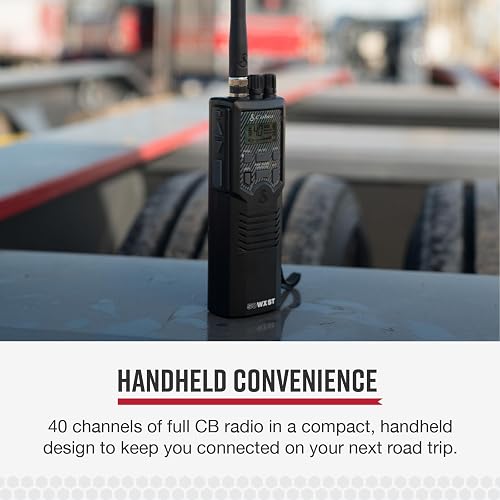
If you have ever been on a road trip or out on a trail and watched your phone drop to no service right when you needed to reach the people you are with, that is the exact problem this radio is built for. The Cobra HHRT50 Road Trip is a handheld unit that runs on the Citizens band radio frequencies, needs no license, and fits in your hand at about six inches tall.
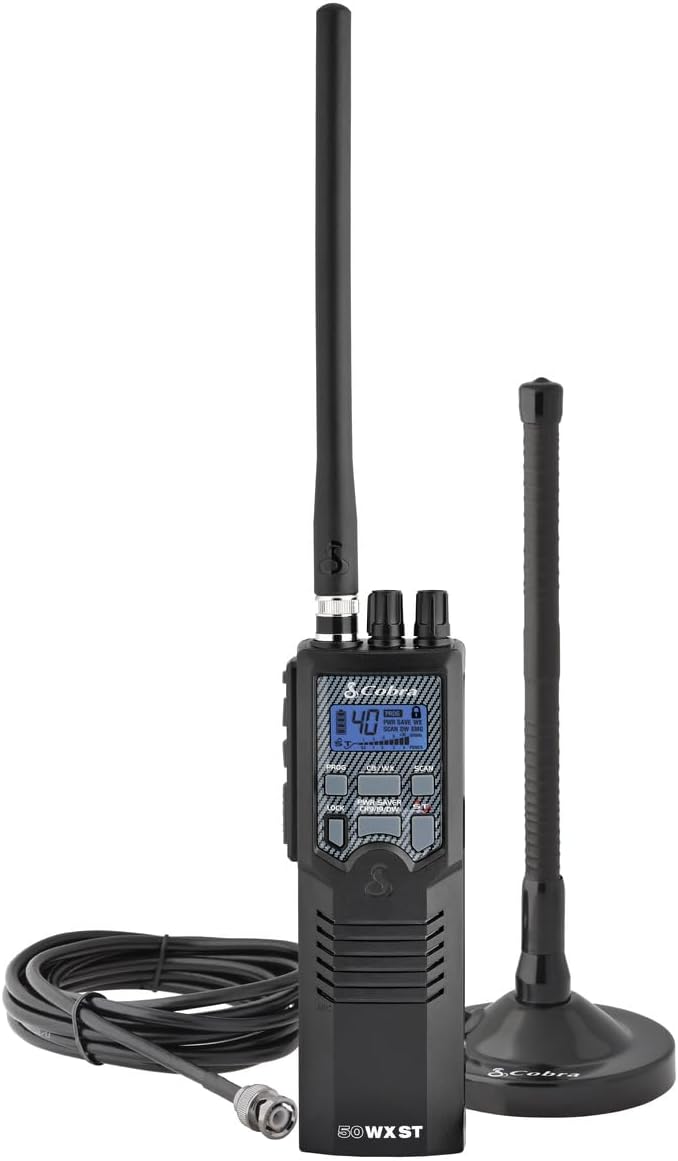
It ships as a kit: the radio itself plus a heavy-duty magnetic antenna that mounts to your vehicle roof. One detail worth knowing up front is that this is internally the same unit Cobra sells as the HH50 WXST; the “Road Trip” name just means it comes with that magnetic roof antenna added in the box. That antenna is not a bonus accessory here, because it is the single thing that decides whether this radio is genuinely useful or nearly useless to you.
I spent time with the HHRT50 testing how it actually works, where its range tops out, and who it really suits. The short version is that the radio puts out the legal maximum power, so your reach comes down almost entirely to the antenna you run and the terrain you are in. Here is what stood out, good and bad.
What I Liked
After running the HHRT50 through real setup-and-talk use, a handful of things make it a sensible grab-and-go CB. Here is what worked.
Included Magnetic Roof Antenna Makes the Signal Actually Get Out
The radio puts out 4 watts, which is the legal ceiling for any CB, so no handheld legally goes higher. That means your range does not really come down to the radio; it comes down to the antenna. With the little rubber antenna out in the open you are looking at roughly a mile, and inside a vehicle it is worse because the metal body blocks the signal.
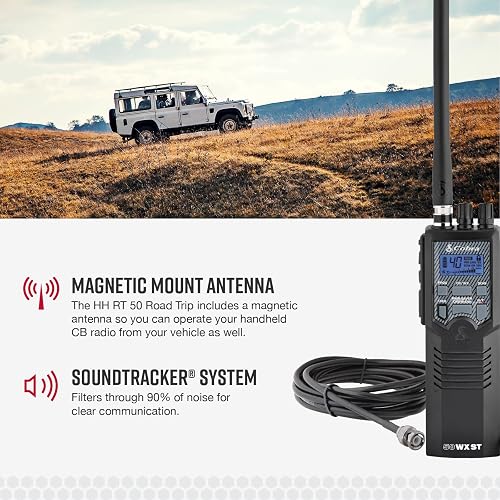
That is the whole reason the Road Trip kit includes the magnetic mount antenna. You stick it on the center of your roof, run the cable in through a window, and your signal finally gets out of the vehicle. The magnet is strong enough to hold on a metal roof at highway speeds, which is the difference between “why can’t anyone hear me” and a radio that works on the road. Since you are already wiring up gear in the vehicle for the road, a windshield dash cam such as the E-YEEGER S50 Dash Cam captures 2.5K evidence footage of whatever happens out on those same drives.
Soundtracker Noise Reduction Delivers Clearer CB Audio
CB audio can get really staticky and harsh, and Cobra’s Soundtracker system is built to filter out most of that noise so the person on the other end comes through cleaner. Cobra lists it as removing up to 90% of background noise, and owners back that up; one long-time user said voices came through fuller and clearer than on his old Midland.
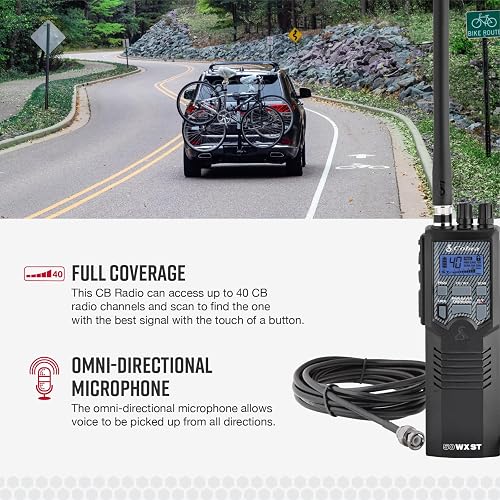
Paired with the omni-directional microphone, which picks up your voice from any angle, it makes for clear conversations once you have it dialed in. There is a squelch knob right next to the volume on top, so you can cut the background hiss while you talk without digging through menus.
40 CB Channels Plus 10 NOAA Weather Channels Built In
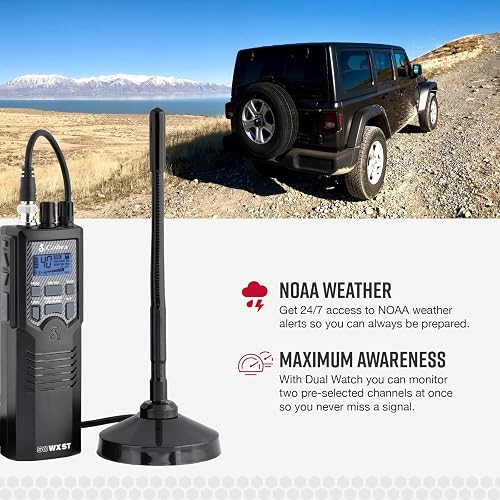
You get all 40 CB channels and a scan function that runs through them to find where the activity is. The part I actually point to, though, is the weather coverage. The radio pulls in the 10 National Oceanic and Atmospheric Administration weather channels, so you get real-time forecasts and hazard alerts wherever you are.
If you see dark clouds rolling in on a trip, you flip over to the weather band and know exactly what is coming. For a dedicated emergency unit that leans on the same NOAA system, the NOAA solar hand-crank weather radio is a useful companion, but having weather built into the CB you are already carrying is genuinely handy. Drivers building out that same road-trip safety kit often pair the radio with a dash cam like the 70mai A900 4K Dash Cam, which records true 4K front and rear footage for evidence after an incident on the road.
Instant Channel 9 and 19 Plus Dual Watch Monitoring
There are dedicated buttons that jump you straight to Channel 9 and Channel 19 without scrolling. Channel 9 is the emergency channel and Channel 19 is where the truckers are, and that emergency channel is not just for show. In a bad storm it lights up with truckers and stranded drivers getting help when the roads are a mess and cell towers are jammed.
The radio also has Dual Watch, which lets you monitor two channels at once. You can keep an ear on your group’s channel and the emergency channel at the same time without constantly flipping back and forth, and a signal-strength meter on the backlit screen shows you when someone is coming in.
Runs Off Your 12V Outlet and Bypasses the Batteries
The HHRT50 runs on nine AA batteries, but it also powers another way. You plug the included cord into your 12V vehicle outlet, and when it is plugged in the radio runs off the car and bypasses the batteries entirely, so a long drive does not drain anything.
That wired adapter also feeds the unit the full 13.5 volts it wants, and owners note it runs at a steadier 4 watts when plugged in than it sometimes does on battery power. One rider pointed out that, unlike some competitor power packs, Cobra’s cable produced zero interference on his setup.
Twist-Off Antenna Lets You Upgrade for Far More Range
Here is what makes it worth keeping long term: the antenna just twists off, so you can throw a bigger vehicle antenna on it for far more reach. People serious about range do exactly that, and the forums are full of owners who swapped in a 50-inch whip and jumped from about a mile to five-plus miles.
That means you are not stuck with what it ships with. The stock setup is a good starting point rather than the ceiling, and because the connector is standard, upgrade antennas are cheap and easy to find when you outgrow the kit.
What Needs Improvement
No CB is perfect, and the HHRT50 has a few honest trade-offs worth knowing before you buy. These are the limits that keep it from being a five-star unit.
Stock Rubber Antenna Only Reaches About a Mile Open-Air
The Amazon listing shows a 10-mile talking range maximum, and that number is the manufacturer’s best-case ceiling, not what you will see. With the stock rubber antenna, reviewers measured 100 to 200 yards in an open field and far less inside a vehicle. Swap to the included magnetic roof antenna and real-world range lands around 1 to 2.5 miles in good conditions.
That is normal for any handheld CB, but the gap between the box claim and reality catches people out. If you need more, you are into antenna upgrades, and even then terrain and line of sight matter more than wattage.
Not a Weather-Sealed Unit With Its Exposed Side Ports
The speaker, mic, charge, and power ports on the side are all exposed, so this is not a weather-sealed radio. Cobra itself lists it as “Not Water Resistant,” and one owner flagged the same thing, warning that it is not something you want out in sustained rain.
Keep that in mind if your use is wet trail work or open-top driving in bad weather. It is fine for a glovebox or a day pack, but it is not built to shrug off a downpour the way a sealed marine handheld would.
Takes Nine AA Batteries and Adds Half a Pound of Weight
The HHRT50 needs nine AA batteries, which is a lot, and that pack adds about half a pound of weight on top of the radio. Loading and swapping nine cells is a chore, and the batteries do not insert the usual all-positive-up way, so it is easy to fumble.
There is a quirk worth knowing too: if the radio powers on fine but quits a few seconds after you key the mic, usually with a repeated beep, it is almost always one bad battery dragging the whole pack down rather than a broken unit. Rechargeable AA cells are the way to go here, and they are effectively mandatory if you use it often.
No USB-C Charging in a 12V-Only Power Design
The only charging path is through the 12V vehicle tip, so there is no USB-C port anywhere on the radio. In a world where nearly everything else in your bag charges off a USB-C cable or an emergency power bank, a 12V-only design feels dated.
It works, and bypassing the batteries in the car is genuinely useful, but you cannot top it up from a laptop, a wall adapter, or a portable battery without extra adapters. For a modern emergency kit, that is a real inconvenience.
CB Airwaves Are Often Dead Outside of Emergencies
This is less about the radio and more about CB itself: in normal everyday driving, the airwaves are frequently dead, with nobody on. One thorough owner ran this and a second CB across a 4,000-mile road trip and heard exactly one trucker and two other people the entire way.
The radio shines when you have your own group to talk to or when an emergency fills Channel 9, not as something chattering all day. Go in expecting a tool for your convoy and for bad situations, not a social scanner, and you will not be disappointed.
How the HHRT50 Compares
Handheld CB is a small field, and three alternatives are the ones most buyers weigh against the Road Trip. Here is how it stacks up.
HHRT50 vs Cobra HH50 WXST
The HH50 WXST is the most important comparison because it is the same radio. The HHRT50 is internally identical; the only difference is that the Road Trip version bundles the magnetic roof antenna in the box. Every feature, from Soundtracker to the NOAA weather channels to Dual Watch, is the same.
So the choice is simple. If you plan to use it in a vehicle at all, pay the small premium for the HHRT50 and get the magnetic antenna you would otherwise have to buy separately. If you only ever use it on foot with the rubber antenna, the plain HH50 WXST saves you a few dollars.
HHRT50 vs Midland 75-822
The Midland 75-822 is the most-recommended handheld CB alternative, and its trick is that it is a true hybrid: it snaps out of a 12V vehicle base and onto a battery pack in seconds. It runs on six AA batteries instead of nine, adds a Hi/Lo power switch to stretch runtime, and carries the same 4.2-star reputation at a similar price.
What the Midland does not include is a magnetic roof antenna in the box, and its stock stubby antenna has the same roughly one-mile limit. If the convertible base and fewer batteries appeal to you, the 75-822 is the pick; if you want the bundled roof antenna and Cobra’s Soundtracker audio, the HHRT50 makes its case.
HHRT50 vs Uniden PRO401HH
The Uniden PRO401HH is the budget option, usually under $75, and it strips things back to a simple 40-channel handheld. It skips the Soundtracker-style noise reduction, the NOAA weather channels, and the included magnetic antenna, so you get a plainer radio for less money.
For a bare-bones backup you toss in the truck, the Uniden is fine. But for a road-trip or emergency kit where weather alerts and a vehicle antenna matter, the extra spend on the HHRT50 buys features the Uniden simply does not have. A niche brand like Wouxun also makes capable CB handhelds, but they are harder to find and support in the US market.
Final Verdict
I am giving the Cobra HHRT50 Road Trip a 4.2 out of 5. It is a genuinely handy, no-license, dual-purpose CB that works in your hand or mounted in your vehicle, and it is a far simpler and more affordable path than wiring a permanent CB and tuner into your dash. The Soundtracker audio is clean, the NOAA weather channels are a real safety feature, and the included magnetic antenna is the reason the whole kit works.
It is not flawless. The stock rubber antenna barely reaches, the unit is not weather sealed, it eats nine AA batteries, and the 12V-only charging feels dated with no USB-C in sight. You also have to accept that CB airwaves are usually quiet until an emergency fills them.
Go in with the right expectations and it is an easy one to recommend. Lean on that magnetic antenna, keep a set of rechargeable AA batteries loaded, and know the airwaves are quiet until you need them. For road trips, the trail, and an emergency kit that does not depend on cell service or satellites, the HHRT50 earns its place.
Specifications
| Brand | Cobra |
| Model Number | HHRT50 |
| Manufacturer | Cobra Electronics |
| Item Type | Handheld CB Radio |
| Number of Channels | 40 CB + 10 NOAA Weather |
| Power Output | 4 Watts (FCC legal maximum) |
| Frequency Range | 26.965 - 27.405 MHz |
| Number of Batteries | 9 AA batteries required |
| Battery Average Life | 12 hours |
| Voltage | 13.5 Volts (via included 12V vehicle adapter) |
| Special Feature | Soundtracker noise reduction, Dual Watch, Instant Channel 9/19, 4-color LCD, Magnetic mount antenna, Omni-directional microphone |
| Talking Range Maximum | 10 miles (manufacturer max; ~1-2.5 miles real-world with magnetic antenna) |
| Water Resistance Level | Not Water Resistant |
| Color | Black |
| Item Weight | 10.24 ounces (radio only, without batteries) |
| Product Dimensions | 6.3" x 2" x 1.75" |
| Warranty | 1 Year Manufacturer |
| GTIN | 00028377202032 |
Frequently Asked Questions
What is the real-world range of the Cobra HHRT50?
The Amazon listing shows a 10-mile maximum, but that is a best-case ceiling. With the stock rubber antenna you get about 100 to 200 yards in the open and far less inside a vehicle. With the included magnetic roof antenna, reviewers measured roughly 1 to 2.5 miles in good conditions, and terrain and line of sight matter more than the radio's 4-watt output.
Is the Cobra HHRT50 the same as the HH50 WXST?
Yes. The HHRT50 Road Trip is internally the same radio as the Cobra HH50 WXST. The only difference is that the Road Trip version ships with a magnetic roof-mount antenna added in the box, so you can operate it from inside a vehicle without buying an antenna separately.
Does the Cobra HHRT50 need a license to use?
No. It operates on the 40 Citizens band radio channels, which are open to the public in the US and require no FCC license. You only need to follow basic CB radio etiquette. It also receives the 10 NOAA weather channels for forecasts and hazard alerts.
How many batteries does the Cobra HHRT50 take?
It requires nine AA batteries, which add about half a pound of weight. You can also run it off your vehicle's 12V outlet with the included adapter, which bypasses the batteries entirely. Rechargeable AA cells are strongly recommended, and a single weak battery can make the radio quit a few seconds after you key the mic.
Is the Cobra HHRT50 waterproof?
No. Cobra lists it as not water resistant, and the speaker, mic, charge, and power ports on the side are exposed. It is fine for a glovebox or day pack, but it is not built for sustained rain or open-top driving in wet weather.
Can you improve the range with a different antenna?
Yes, and many owners do. The antenna twists off, so you can fit a taller vehicle antenna. Owners report jumping from about a mile with the rubber antenna to five-plus miles with a 50-inch whip, and even further with a half-wave antenna. The stock setup is a starting point, not the ceiling.
Is the Cobra HHRT50 good for off-roading and overlanding?
It is a natural fit for off-roading, overlanding, convoys, and RV travel, where you need a grab-and-go radio to talk to the other vehicles in your group. It also works as an emergency communicator that does not depend on cell service or satellites. Just set expectations around the short stock-antenna range and often-quiet CB airwaves.
Ready to Buy?
Cobra HHRT50 Road Trip CB Radio delivers on its promises. If it fits your needs, it's a solid choice you won't regret.
Check Price on Amazon Founder & Product Reviewer at TheReviewRewind
Daniel has tested 400+ products across 20+ categories through hands-on, real-world testing. Every review includes video documentation and standardized scoring criteria. His reviews appear as Amazon shoppable videos and here on TheReviewRewind.
We earn a commission if you make a purchase, at no extra cost to you. This does not influence our ratings or recommendations. Full disclosure
Looking for more options? See all our Electronics reviews.
Related Reviews